Backtrader Guide: Python Backtesting Framework
What backtrader is, how its Cerebro engine and Strategy classes work, order types it supports, and how it compares to no-code trade automation.

Marketing

Backtrader is an open-source Python framework for developing, testing, and analyzing rule-based trading strategies. Its event-driven Cerebro engine coordinates historical data, indicators, strategy logic, simulated orders, and performance analysis in one extensible environment.
The framework is best suited to traders who are comfortable maintaining Python code and want control over assumptions such as position sizing, commissions, execution rules, and data preparation. This guide covers installation, lines and data feeds, Strategy classes, order mechanics, optimization, analyzers, and the path from historical research to live execution.
What Is Backtrader?
Origins and Design Goals
Backtrader is a Python framework created for algorithmic strategy research. Daniel Rodriguez is credited in the original project's copyright notices. The documentation describes two main objectives: ease of use and staying out of the user's way while still offering extensive configuration.1
The cloudQuant repository is a community-maintained continuation of the project and is distributed under the GPL-3.0 license.2 This open architecture lets developers inspect the engine, extend framework components, and adapt workflows to their own research requirements.
Core Workflow: Cerebro Engine
A standard workflow starts by creating a Strategy subclass, defining adjustable parameters, instantiating indicators, and writing entry and exit logic. Backtrader also supports signal-based strategies in which indicators produce long and short signals.
The Strategy is added to a Cerebro engine, a data feed is loaded with cerebro.adddata(), and cerebro.run() executes the backtest. Afterward, cerebro.plot() can display the result.3
- Create or select a historical data feed.
- Define a Strategy and its parameters.
- Add the data and Strategy to Cerebro.
- Configure cash, commissions, sizing, and analyzers.
- Run the simulation and inspect the results.
The cloudQuant Backtrader Fork
The cloudQuant fork distributes a pure-Python package named back-trader-python on PyPI, while the import remains backtrader. It also distributes back-trader-cpp, a pybind11-accelerated C++ wheel intended to reduce backtest execution time.4
Across 117 documented strategy benchmark cases, the repository reports a median total-time speedup of 128.82x and a median run-time speedup of 235.78x for the C++ version. Both packages support Python 3.8 or later on macOS, Windows, and Linux.5 These are project-reported benchmarks, so traders should test representative strategies on their own hardware and datasets.
Installing and Setting Up Backtrader
Installation Options
Install the community fork's pure-Python distribution with:
pip install back-trader-python
The distribution name contains hyphens, but Python code still uses import backtrader as bt. To install the accelerated wheel instead, run:
pip install back-trader-cpp
Developers who need the repository source can clone it, install its requirements, and install the local package.6
git clone https://github.com/cloudQuant/backtrader.git
cd backtrader
pip install -r requirements.txt
pip install -U .
Verifying Your Environment
The fork lists Python 3.8 or later as a requirement and recommends Python 3.11 for an approximately 15 percent performance improvement. It supports Windows, macOS, and Linux, with at least 4GB of RAM recommended.7
Verify that the package imports correctly before building a strategy:
import backtrader as bt
print(bt.__version__)
Also pin package versions in a project environment. Reproducible environments matter because library, data-processing, and plotting changes can affect whether older research code runs consistently.
Core Concepts: Lines and Data
Understanding Lines and Index 0
Lines are the core data structure. A line is a sequence of values, and Data Feeds, Indicators, and Strategies are constructed around these sequences. A typical market feed contains Open, High, Low, Close, Volume, and OpenInterest lines. Including DateTime produces seven lines.8
Index 0 accesses the current value, while -1 accesses the previous output value. Earlier values use -2, -3, and so on. For example, self.data.close[0] is the current close and self.data.close[-1] is the preceding close.
Loading Data Feeds
YahooFinanceCSVData can load a local CSV file using arguments such as dataname, fromdate, todate, and reverse. The original quickstart demonstrates adding the resulting feed to Cerebro with cerebro.adddata(data).9
GenericCSVData is useful when column positions must be mapped explicitly for datetime, open, high, low, close, volume, and open interest. PandasData accepts a DataFrame directly through dataname=df.10
The Cerebro Engine Role
cerebro = bt.Cerebro() creates the engine. If the user does not supply a broker, Cerebro creates a default broker with 10,000 monetary units of starting cash. That value can be changed through cerebro.broker.setcash().11
The three central calls are cerebro.adddata(), cerebro.addstrategy(), and cerebro.run(). Together they register the market data, attach the user's logic, and execute the event loop.
Writing a Backtrader Strategy
Strategy Class Structure
A Strategy subclass normally defines __init__() for setup and next() for bar-by-bar logic. A common pattern stores self.datas[0].close as a shorter reference, reducing later access to one level of indirection. The first feed also acts as the system clock, and next() is called as its bars become available.12
next() does not receive a bar number. Calling len(self) or len() on another line-based object reports how many bars have elapsed.
Entry and Exit Logic
self.buy() and self.sell() create and return order instances. When no size is supplied, the configured sizer determines it. The default fixed sizer uses a stake of 1. A default market order in a backtest executes at the opening price of the next bar.13
The Strategy's position attribute reports current exposure. Traders should also implement notify_order() rather than assuming that an order was filled immediately after creation.
Adding Indicators
Indicators are usually instantiated in __init__() and read like other lines. For example, self.sma[0] returns the current SimpleMovingAverage value. A CrossOver indicator can compare fast and slow moving averages and identify changes in their relationship.
The cloudQuant fork lists more than 50 built-in indicators across moving-average, momentum, volatility, trend, and oscillator categories.14 Indicators should be initialized once, not recreated inside every next() call.
Order Types and Execution Mechanics
Order Creation Parameters
buy, sell, and close accept parameters including data, size, price, plimit, exectype, valid, and tradeid. If size is omitted, the sizer calculates it. Price may be omitted for Market and Close orders.15
Additional keyword arguments can pass broker-specific fields to the created order object. This capability is useful for live stores, but it also makes a strategy less portable if its logic depends on one broker's proprietary parameters.
Market, Limit, Stop, StopLimit
Order.Marketexecutes at the next available price, normally the next bar's open in backtesting.Order.Limitexecutes only at the specified price or better.Order.Stopactivates at its trigger price and then behaves like a market order.Order.StopLimitactivates at its trigger and creates an implicit limit order at the specified limit price.
These behaviors are simulation rules, not promises of a particular live fill. Historical bars may not reveal intrabar sequencing, queue position, liquidity, or the exact path between open, high, low, and close.
Order Status Lifecycle
Order statuses include Created, Submitted, Accepted, Partial, Completed, Rejected, Margin, Cancelled, and Expired. A Strategy must override notify_order() to receive notifications because the default implementation does nothing.16
One order can generate multiple notifications before the next Strategy cycle. For example, it can move through Submitted, Accepted, and Completed before next() runs again. Order-handling code should therefore check status explicitly and avoid treating every notification as a new fill.
The Backtesting Workflow in Practice
Setting Cash and Running
Set starting capital before calling cerebro.run(). Printing broker value before and after the run creates a basic check of the simulated portfolio outcome.
cerebro = bt.Cerebro()
cerebro.adddata(data)
cerebro.addstrategy(MyStrategy)
cerebro.broker.setcash(100000)
print(cerebro.broker.getvalue())
results = cerebro.run()
print(cerebro.broker.getvalue())
A useful backtest should also model commissions and any execution assumptions relevant to the instrument. Final portfolio value alone cannot explain drawdown, trade frequency, exposure, or sensitivity to individual trades.
Visualizing Backtest Results
The original platform provides visual feedback through cerebro.plot(). The cloudQuant fork adds Plotly interactive charts that it says can handle more than 100,000 points with zoom, pan, and hover controls. It also documents Bokeh real-time charts and Matplotlib static output.17
Charts are most useful for checking order placement, indicator warm-up periods, position changes, and unexpected gaps. They should complement analyzers rather than replace quantitative evaluation.
Optimizing Strategy Parameters
cerebro.optstrategy() can sweep parameter ranges, such as fast and slow moving-average periods. Calling cerebro.run(maxcpus=4) distributes optimization runs across multiple CPU cores in the documented fork workflow.18
Parameter optimization should include out-of-sample evaluation. Selecting the best result from a large parameter grid can reward noise rather than durable behavior, especially when the selection metric and test interval remain unchanged.
Analyzers, Reports, and Live Trading
Measuring Performance with Analyzers
The cloudQuant fork documents more than 17 analyzers, including SharpeRatio, DrawDown, TradeAnalyzer, Returns, and SQN. After a run, results can be retrieved through strategy.analyzers.<name>.get_analysis().19
Use several measures together. Returns describe outcome, drawdown describes the path, and trade statistics can expose concentration in a small number of fills. Analyzer settings and timeframes should also be recorded with the strategy configuration.
Live Trading Integrations
The original documentation includes live-trading sections for Interactive Brokers, Oanda v1.0, and Visual Chart.20 Live use requires a store implementation that connects the Strategy and Cerebro workflow to a broker's API.
That integration becomes part of the production system. Authentication, connection recovery, order-state synchronization, rejected orders, and broker-specific behavior all require testing and maintenance outside the historical simulation itself.
Bridging Signals to Brokers
Moving a custom Python strategy into live execution generally means creating or maintaining an appropriate integration for each target environment. The research code must also emit instructions at the correct time and reconcile those instructions with actual broker state.
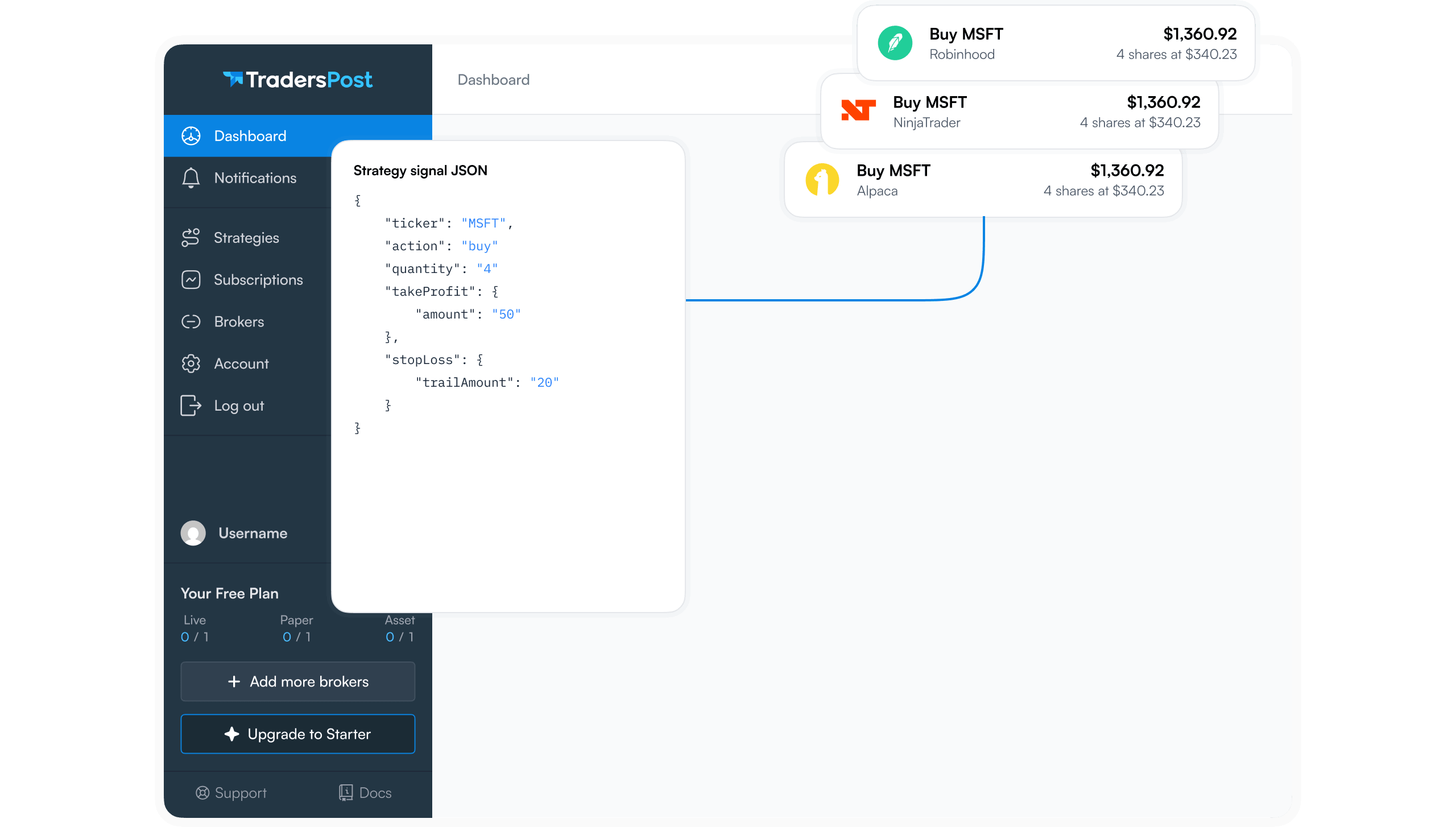
TradersPost offers a different deployment path. It receives trading instructions as JSON messages through a webhook URL and processes fields such as ticker, action, quantity, and orderType for connected-broker execution. This can remove the need to write a separate broker API integration when a validated strategy can emit compatible webhook messages.
That is a difference in deployment mechanics, not a claim that webhook routing produces a better backtest. Historical research quality still depends on data, assumptions, validation, and the strategy's implementation.
Backtrader vs No-Code Automation
When Backtrader Fits
Backtrader fits researchers who need custom Python logic. A developer can create an indicator by subclassing bt.Indicator, declaring its lines, and assigning calculations in __init__(). Strategies, indicators, analyzers, and data sources can be extended independently.21
This is valuable when a test requires unusual data transformations, multiple feeds, custom state, or specialized analysis. The tradeoff is ownership: the user must write, test, version, and maintain the Strategy classes and supporting environment.
Where TradersPost Fits Differently
TradersPost targets signal-to-order routing rather than building a Python historical simulation engine. A TradingView alert can send a webhook JSON payload containing fields such as ticker, action, quantity, orderType, takeProfit, and stopLoss.
This approach suits traders who already generate alerts and want to configure the execution layer without coding a broker integration. It does not replace the need to validate strategy behavior, execution assumptions, and alert timing.
Moving From Research to Execution
Backtrader's Cerebro loop is designed for historical simulation and indicator research in Python. A validated Strategy still needs a separate mechanism to produce live signals, send orders, and monitor actual account state.
The practical choice is where to write code. A researcher may keep the entire stack in Python, or use Python for research and translate the final rules into alerts. Another trader may start with an existing alert-based strategy and configure routing without maintaining a backtesting framework.
Bottom Line
- Backtrader combines data feeds, indicators, strategies, orders, brokers, and analyzers through the Cerebro engine.
- Its line model uses index 0 for the current value and negative indexes for previous values.
- Order status handling and realistic execution assumptions are as important as entry logic.
- The cloudQuant fork offers updated packaging, accelerated installation options, and expanded plotting and reporting.
- Historical simulation and live order routing are separate stages that require separate validation.
If your strategy already produces TradingView alerts, connect an alert to a broker through TradersPost and test the complete signal-to-order workflow in a paper account before considering live automation.
Frequently Asked Questions
Is backtrader free to use?
Yes. The community-maintained core is distributed as the open-source back-trader-python package under GPL-3.0. The accelerated back-trader-cpp wheel is provided as a separate installable package.
Does backtrader support live trading?
Yes. The original documentation covers Interactive Brokers, Oanda v1.0, and Visual Chart. Live operation pairs Strategy and Cerebro code with a broker-specific store implementation.
What Python version is required?
The cloudQuant fork requires Python 3.8 or later and notes that Python 3.11 can provide an approximately 15 percent performance improvement. It supports Windows, macOS, and Linux, with 4GB or more of RAM recommended.
What is the cloudQuant fork?
It is a community-maintained project based on the original engine. It adds performance optimizations, a pybind11 and C++ accelerated wheel, more data-source options, and expanded reporting and plotting features.
Can backtrader run without Python?
No. Creating a Strategy class, implementing next(), and configuring Cerebro require Python. Traders who do not want to code a broker integration can instead consider alert and webhook-driven execution after validating their strategy.
References
1 Backtrader Documentation
2 cloudQuant Backtrader Repository
3 Backtrader Documentation
4 cloudQuant Backtrader Installation
5 cloudQuant Backtrader Benchmarks
6 cloudQuant Backtrader Setup
7 cloudQuant Backtrader Requirements
8 Backtrader Quickstart Guide
9 Backtrader Quickstart Data Feed
10 cloudQuant Backtrader Data Sources
11 Backtrader Quickstart Broker Setup
12 Backtrader Quickstart Strategy
13 Backtrader Quickstart Orders
14 cloudQuant Backtrader Indicators
15 Backtrader Order Creation
16 Backtrader Order Statuses
17 cloudQuant Backtrader Visualization
18 cloudQuant Backtrader Optimization
19 cloudQuant Backtrader Analyzers
20 Backtrader Live Trading Documentation
21 cloudQuant Backtrader Architecture