Build Trading Strategies Without Complex Programming
Build automated trading strategies without writing code. Compare no-code builders, robustness testing methods, and how to move a validated strategy live.

Marketing

If you are asking, “how can I build trading strategies without learning complex programming languages?”, the practical answer is to use a no-code builder, a plain-English strategy generator, or an AI tool that creates inspectable strategy code. These tools can turn defined entry, exit, and risk rules into backtests without requiring you to write Pine Script or Python.
The workflow still requires disciplined research. You need precise rules, realistic assumptions, robustness testing, forward testing, and a reliable execution path. The goal is not to avoid technical thinking. It is to spend less time debugging syntax and more time evaluating whether a strategy can survive outside its original backtest.
Why No-Code Strategy Building Works
The Traditional Coding Barrier
Building and backtesting an automated strategy once required Pine Script, Python, or another programming language, even for a basic EMA crossover. Traders without those skills often relied on intuition, a small set of chart examples, or real-money experiments instead of testing explicit rules over a meaningful sample.1
Coding remains useful for custom data, unusual execution logic, and specialized research. It is no longer a prerequisite for testing a clearly defined trading idea.
What No-Code Tools Do Differently
Plain-English platforms translate written entry and exit rules into executable logic, then apply that logic to historical data. Visual builders use predefined blocks for indicators, price conditions, stops, targets, and filters.
AI tools take a third approach. LuxAlgo Quant converts natural-language instructions into Pine Script indicators or strategies, runs them on a chart, and can use chart screenshots as a starting point. The resulting script remains available for inspection rather than operating as an invisible black box.2
Who Uses These Tools
No-code research is not limited to beginners. Almost half of Build Alpha traders had no prior algorithmic trading experience, while its community includes small independent accounts, hedge funds, family offices, and registered investment advisers managing more than $100 million.3 The same workflow can support a first systematic test or a portfolio research process.
Core No-Code Strategy Approaches
Genetic Algorithm Strategy Generators
Genetic builders search large combinations of entries, exits, parameters, and risk rules. Build Alpha automatically generates and evaluates millions of combinations against trader-defined criteria. Its advertised library includes more than 5,000 signals covering categories such as price action, indicators, volume, volatility, and seasonality.4
StrategyQuant uses machine learning and genetic programming to create systems for forex, futures, and equities across different timeframes. It combines entry conditions, exit conditions, order types, and price levels, then ranks candidates using selected performance criteria.5
Plain-English Code Translators
TradeZella lets a trader describe entry, exit, direction, stop-loss, and filtering rules in ordinary language before running a backtest. LuxAlgo Quant instead creates Pine Script from a prompt or chart image. The first approach prioritizes direct testing, while the second produces code that can be reviewed and refined.
Neither approach can infer every important assumption. Specify the symbol, timeframe, signal timing, order size, commission, slippage, session, stop, target, and whether orders are evaluated intrabar or after a completed bar.
Visual Strategy Builders
Point-and-click builders let you select long, short, or both directions and combine predefined conditions. A controlled workflow can also require every candidate to include a stop loss and profit target.
LuxAlgo's Library provides ready-made market-structure, trend, and momentum tools that can be added to a chart and configured. Visual testing helps confirm that conditions trigger where expected before time is spent building a complete strategy.
Define Rules Before Automation
Five Required Strategy Elements
A testable description needs five elements. Missing any one can produce ambiguous signals or misleading results.6
- Entry conditions that identify the setup and trigger.
- Exit conditions for closing the position.
- A stated direction: long, short, or both.
- Stop-loss placement and sizing logic.
- Filters such as session windows or trend requirements.
Write each condition so that two people reviewing the same chart would reach the same answer. Replace “strong trend” with a measurable requirement, such as the close being above a specified moving average.
Why Fewer Rules Win
No-code generation workflows are often kept to two or three entry rules and one or two exit rules. Adding conditions creates more opportunities to fit historical noise rather than capture repeatable behavior.7
Begin with the smallest rule set that expresses the idea. Add a filter only when you can explain its market purpose and verify its effect on unseen data.
Stop And Target Logic
Common stops include percentage-based distances, ATR or volatility-based distances, and indicator exits such as channel breaks. ATR-based stops expand when movement increases and contract when markets become calmer. Targets can likewise use percentages, ATR multiples, fixed reward-to-risk ratios, or indicator levels.
Choose logic that matches the strategy. A volatility-sensitive breakout may need an adaptive stop, while a setup defined around a structural level may call for invalidation beyond that level.
Generate And Filter Candidates
Random And Genetic Generation
Candidate strategies can be created through random rule generation or genetic evolution. Genetic methods retain stronger candidates, vary their parameters, and repeat the process across generations. At this stage, the objective is breadth. Quality is established later through filtering and stress testing.
Apply Baseline Filters
Example baseline filters include a return-to-drawdown ratio near 4, a profit factor around 1.3-1.5, and at least two trades per month. These are screening thresholds, not universal standards or proof of future performance.8
Avoid demanding extraordinary returns from the generator. Extreme requirements encourage the software to search harder for combinations that explain the exact historical sample.
A Clean Backtest Proves Little
Generated strategies can display smooth equity curves because they were optimized on the same data used to judge them. Backtesting is therefore the beginning of validation, not the conclusion. The next stages should attempt to break the strategy through parameter changes, withheld data, adverse costs, and randomized trade paths.
Robustness Testing Before Trust
Test Parameter Ranges
A strategy should remain viable across nearby parameter values. If an RSI rule works at one precise threshold but fails immediately above and below it, the result is fragile. Broad areas of acceptable performance are more credible than one isolated optimum.9
Separate In-Sample Data
Use in-sample data to develop the strategy and reserve out-of-sample data for evaluation. Do not repeatedly revise the system after seeing the withheld results, because that gradually turns the out-of-sample period into another optimization set.
Both samples should cover different conditions where possible, including rising and falling markets plus high-volatility and low-volatility periods. A strategy tested in one narrow regime has not demonstrated adaptability.
Run Monte Carlo Tests
Monte Carlo testing reshuffles trade sequences to estimate adverse paths, losing streaks, and drawdowns that a single chronological backtest may hide. The resulting drawdown distribution can provide a more useful planning range than the original backtest maximum.
StrategyQuant can apply Monte Carlo simulations, walk-forward optimization, and system parameter permutations during its automated build process.10 A practical robustness sequence is:
- Test nearby parameter values.
- Evaluate untouched out-of-sample data.
- Increase commission and slippage assumptions.
- Run Monte Carlo trade-sequence tests.
- Compare results across regimes and related markets.
From Backtest To Live Trading
Export Code For Execution
Build Alpha exports automatable strategy code for platforms including TradeStation, NinjaTrader, Interactive Brokers, Python, MultiCharts, MetaTrader 4/5, and TradingView Pine Script.11 StrategyQuant exports full source code that can be loaded into a supported trading platform for demo or live operation.12
Retest exported code on its destination platform. Data feeds, session definitions, bar construction, fill assumptions, and fees can produce different results even when the strategy rules appear identical.
Forward Test At Reduced Size
After backtesting, practice the workflow in replay and then forward test with reduced exposure. TradeZella describes a graduated process beginning at 50 percent size, moving to 75 percent, and reaching full size only after live performance remains within roughly 15-20 percent of backtest expectations.13
Before increasing size, verify signal timing, duplicate-alert handling, rejected orders, partial fills, and the effect of actual spreads and slippage.
Route Signals To Brokers
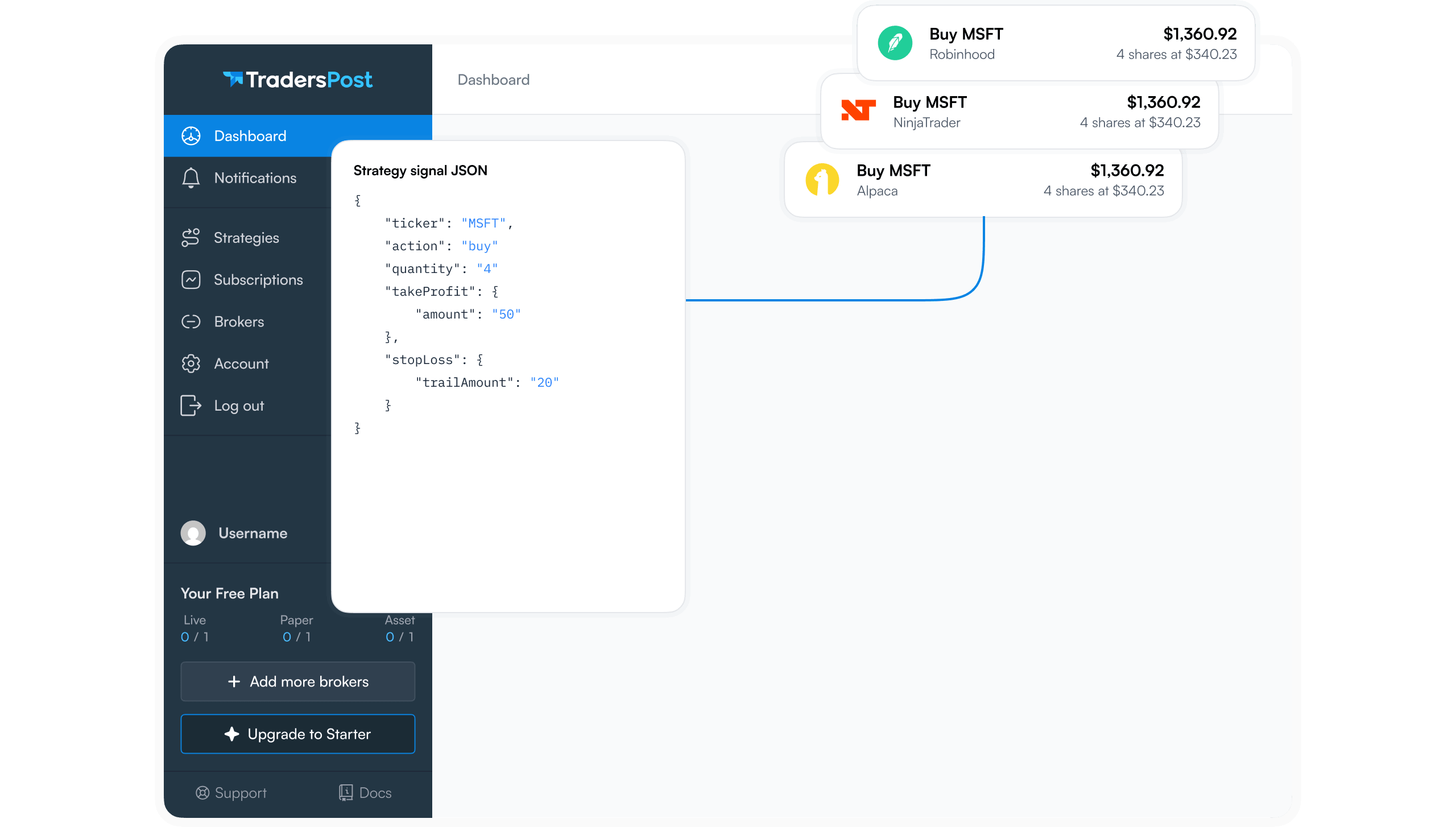
A strategy that generates an alert still needs an execution layer. TradersPost accepts JSON instructions through a webhook and processes fields including ticker, action, quantity, quantityType, orderType, stopLoss, and takeProfit. This allows a signal source such as TradingView to remain responsible for strategy logic while the execution workflow handles order instructions.
Next step: once your strategy has passed robustness and forward testing, create a TradersPost strategy, connect the intended broker account, build a valid JSON signal template, and test the complete alert path before enabling automatic order submission.
Manage A Strategy Portfolio
Size By Risk Of Ruin
Position sizing should reflect the strategy's win rate, payoff ratio, and expected losing streaks. One documented breakout framework uses a win rate near 40 percent, a reward-to-risk ratio around 2:1, and an average loss near 0.5 percent of capital allocated to that strategy.14
Risk should be calculated against the allocation assigned to the strategy, not automatically against the entire account. This prevents one system from consuming the portfolio's full risk budget.
Run Uncorrelated Strategies
A portfolio can spread exposure across strategies using different instruments, timeframes, and logic. Typical allocation in the cited framework ranges from 5-25 percent of the total account per strategy, depending on risk tolerance and expected drawdown.15
Correlation should be measured from strategy returns, not assumed because systems have different names. StrategyQuant's portfolio tools are designed to combine non-correlated strategies across markets and timeframes.16
Bench Weak Strategies
Do not remove a system after a short losing period that remains within tested expectations. Review it when drawdown approaches its expected maximum or when underperformance persists beyond the planned tolerance.
Responses can include reducing size or returning the strategy to simulation. Maintain an incubation pool of validated systems running in simulation so a replacement is available when a live strategy is benched.
Choose The Right Platform
Genetic Versus Plain-English Builders
Choose Build Alpha or StrategyQuant when you want software to search large signal libraries and generate many candidates. Choose TradeZella or LuxAlgo Quant when you already have an idea that can be described in plain English or shown on a chart.
The distinction is between discovery and translation. Genetic platforms search for candidate logic. Plain-English platforms translate trader-supplied logic into a testable form.
Check Before Committing
- Confirm that exported code runs on your destination platform.
- Look for Monte Carlo, walk-forward, and parameter permutation tests.
- Check available historical depth and supported markets.
- Review monthly AI credits, chart limits, and workspace limits.
- Confirm that commissions, slippage, sizing, and sessions are configurable.
For example, LuxAlgo plans differ by monthly Quant credits, charts per tab, saved workspaces, and historical bars. Its documentation also recommends retesting compatible code after moving it to TradingView because feeds and simulation assumptions can differ.17
Connect Strategy To Execution
Strategy creation and broker execution are separate layers. TradersPost sits after the no-code research process. It does not generate or backtest the strategy. It receives the resulting webhook instructions and processes order details, quantity types, stop-loss instructions, and take-profit instructions for a connected trading workflow.
Bottom Line
- Start with explicit entry, exit, direction, stop, and filter rules.
- Use genetic builders for discovery or plain-English tools for translation.
- Treat attractive backtests as candidates, not proof.
- Require parameter, out-of-sample, and Monte Carlo testing.
- Forward test the complete signal and execution path before scaling.
You can build an automated strategy without mastering a complex programming language, but you cannot automate away research discipline. Select a builder that matches your workflow, validate the strategy across adverse conditions, and test every step from alert generation through broker order submission before committing full size.
Frequently Asked Questions
Do I Need To Code?
No. No-code and AI-assisted platforms let you describe rules in plain English or combine prebuilt blocks. Almost half of Build Alpha traders had no prior algorithmic trading experience before using the software.18 Published TradingView strategies can also be connected to an automation workflow without writing the underlying Pine Script yourself.
How Many Trades Are Enough?
About 50 trades provide a rough statistical picture, 100 offer a stronger sample, and 200 or more allow useful sub-samples by session or day of week.19 More trades do not fix biased data or unrealistic assumptions, so sample size must be combined with sound testing.
Optimization Versus Robustness Testing?
Optimization searches for rule and parameter combinations that performed well. Robustness testing tries to make those results fail through parameter variation, unseen data, walk-forward analysis, and Monte Carlo simulation. Only candidates that survive several independent tests should advance toward live trading.
Can No-Code Strategies Trade Live?
Yes. Build Alpha and StrategyQuant can export strategy code for supported execution platforms. No programming is required to generate the code, but you must still compile or load it correctly, verify platform compatibility, and test the strategy in simulation before live deployment.
How Much Capital Per Strategy?
One portfolio framework allocates roughly 5-25 percent of total capital to each strategy and targets an average loss near 0.5 percent of that strategy's allocation. Those figures are examples, not universal limits. Your allocation should reflect tested drawdown, correlation, broker requirements, and personal risk tolerance.
References
1 Build and Backtest Trading Strategies Without Code
2 How to Build Trading Strategies Without Coding
3 Build Alpha
4 Build Alpha
5 StrategyQuant
6 Build and Backtest Trading Strategies Without Code
7 Algorithmic Strategy
8 Algorithmic Strategy
9 Algorithmic Strategy
10 StrategyQuant
11 Build Alpha
12 StrategyQuant
13 Build and Backtest Trading Strategies Without Code
14 Algorithmic Strategy
15 Algorithmic Strategy
16 StrategyQuant
17 How to Build Trading Strategies Without Coding
18 Build Alpha
19 Build and Backtest Trading Strategies Without Code