Backtest Forward Test Paper Trade Live Workflow
Learn a practical backtest, forward test, paper trade, and live trading workflow with TradingView alerts, TradersPost subscriptions, and broker accounts.

Marketing

Bottom Line
- The trading workflow consists of four stages: backtest, forward test, paper trade, and live trading, each addressing different aspects of strategy validation.
- Backtesting evaluates strategy rules against historical data, while forward testing checks real-time signal generation and execution consistency.
- Paper trading tests the complete automation chain without risking real capital, ensuring that alerts and order instructions align with the strategy plan.
- Live trading introduces real market conditions and should only begin after successful completion of prior stages to minimize financial risk.
- Key performance metrics to review include win rate, average win versus average loss, maximum drawdown, profit factor, and trade count.
A trading strategy is not ready for real money because a backtest looks impressive. It needs to survive a disciplined backtest forward test paper trade live workflow, where each stage answers a different question: Did the rules work historically? Do they hold up in current market conditions? Can the automation execute reliably? Can the position sizing and risk limits withstand real capital?
This post lays out a practical progression from validating a strategy in TradingView to monitoring it through forward testing, routing alerts into TradersPost subscriptions, paper trading execution, and finally connecting a broker account for live deployment. You will learn what to measure at every step, how to identify overfitting and execution gaps, and when the evidence is strong enough to move forward.
The goal is not to eliminate losses or find a flawless system. It is to build a repeatable process that exposes problems before they become expensive, so live trading is the final validation stage, not the first real test.
Why Backtest, Forward Test, Paper Trade, Then Live?
Use a staged validation process instead of jumping live
A reliable automated trading workflow moves through four distinct stages: backtest, forward test, paper trade, then live trading. Each stage answers a different question, and skipping a stage leaves a specific category of risk untested.
- Backtesting evaluates how the strategy rules behaved against historical price data. It can reveal whether the entry, exit, take-profit, stop-loss, position-sizing, and time-based rules produced acceptable historical results across different market periods.
- Forward testing evaluates whether the strategy generates signals correctly in real time. Historical chart calculations can differ from real-time behavior because a condition may change before a bar closes, alerts may be configured for an unintended frequency, or a signal may not occur when expected during live market hours.
- Paper trading exercises the automation path without placing live capital at risk. This is where the trader verifies that alerts reach the webhook, the webhook payload is interpreted as intended, and the resulting order instructions match the strategy plan.
- Live trading introduces actual market conditions, including real fills, spreads, liquidity constraints, and the financial consequences of every order. Begin only after the strategy and automation workflow have performed as expected in prior stages.
Strong backtest results are evidence of historical behavior, not proof of future performance. A strategy that performed well in a historical sample may be sensitive to changing volatility, trend conditions, spreads, or liquidity. It may also depend on assumptions that do not hold once alerts and order execution occur in real time.
Use the staged process to isolate failures before capital is involved. A disappointing backtest may indicate flawed strategy logic. A forward-test discrepancy may indicate an alert timing or chart configuration issue. A paper-trade mismatch may indicate a webhook, ticker, quantity, or order-instruction problem. These are different failures and should be diagnosed separately rather than discovered simultaneously in a funded account.
Separate strategy validation from automation validation
A chart backtest can validate the strategy concept while telling you very little about operational reliability. A strategy may show a profitable historical equity curve, yet still fail to trade as intended if the alert uses the wrong ticker, the quantity is incorrect, the action does not match the intended order direction, or the exit instructions are omitted or malformed.
Paper trading is the practical test of the complete automation chain: signal creation, alert triggering, webhook delivery, order placement, and exit handling. For example, a strategy may be intended to buy 100 shares when a long entry triggers, then attach a take-profit and stop-loss. During Paper trading, verify that the alert contains the intended ticker, action, and quantity, and that takeProfit and stopLoss produce the expected exit behavior.
Before starting a paper-trading period, document the expected behavior in concrete terms:
- What exact market condition should create an entry alert?
- Which ticker, action, and quantity should be sent?
- Should the entry occur immediately at the signal or only within specified Trading Windows?
- What should close the position: a strategy exit signal, takeProfit, stopLoss, expiration, or a combination?
- What should happen if a second entry signal occurs while a position is already open?
Compare each paper-trade event with this written specification. Do not advance to live trading until entries, exits, quantities, and protective instructions consistently match the intended workflow.
Step 1: Backtest the Strategy in TradingView
Define Clear and Repeatable Trading Rules
A TradingView backtest is only meaningful when every decision can be expressed as an objective rule. Replace discretionary statements such as “buy when momentum looks strong” with conditions that can be evaluated consistently on every bar.
Document the complete strategy specification before reviewing results:
- Market: Define the instrument or instrument universe, such as SPY, ES futures, or a specified group of liquid equities.
- Timeframe and session: State whether signals are calculated on 5-minute, hourly, or daily bars, and whether trades are allowed only during regular market hours.
- Direction: Specify long-only, short-only, or both long and short entries.
- Position size: Use a fixed number of shares, fixed dollar exposure, Percent of equity, or another defined sizing method.1
- Risk exits: Define the stop-loss distance and whether it is based on price, percentage, ATR, or another fixed calculation.
- Profit exits: Define the target, such as a fixed percentage, a prior price level, or a stated reward-to-risk multiple.
For example, a long strategy could enter when the 20-period moving average crosses above the 50-period moving average on a 15-minute chart during regular market hours. It exits if price reaches a 1% stop loss or a 2% profit target. The strategy does not enter again until the next qualifying crossover. Those rules are testable, automatable, and auditable trade by trade.
Review More Than Total Return
Total return can conceal poor risk characteristics, a small sample size, or gains concentrated in one favorable market regime. Review performance metrics together rather than treating any single number as decisive.
- Win rate: The percentage of profitable trades.
- Average win versus average loss: A 40% win rate can be viable when average winners materially exceed average losers.
- Maximum drawdown: The largest historical equity decline, which indicates the capital and psychological pressure the strategy may impose.
- Profit factor: Gross profits divided by gross losses.
- Trade count: A strategy with 12 trades has far less evidentiary value than one evaluated across hundreds of relevant trades.
- Underperformance periods: Identify how long drawdowns lasted and whether losses clustered in trendless, volatile, or event-driven markets.
Inspect individual entries and exits directly on the chart. Confirm that a crossover entry occurred when the stated conditions were met and that stop-loss and target exits align with the strategy rules. A high return percentage is not sufficient if the trade sequence reveals unintended entries, unrealistic fills, or excessive concentration in a brief historical period.
Avoid Common Backtesting Mistakes
Test the same rules across multiple market environments, including bullish trends, bear markets, high-volatility periods, and range-bound conditions. Do not repeatedly adjust moving-average lengths, stops, or targets until one historical window looks exceptional. That process creates overfitting: rules tailored to past noise rather than a repeatable market behavior.
Include commissions and use realistic position sizing.2 A strategy that trades frequently may appear profitable before costs but fail after commissions and execution friction. Historical chart fills are also approximations. A bar showing that price touched a stop or target does not prove that a live order would have been filled at that exact price, especially during gaps, rapid moves, or thin liquidity.
For automation, treat the TradingView backtest as a rule-validation stage, not proof of live execution quality. The next stages, forward testing and Paper trading, should verify that signals, order instructions, and actual market conditions produce results consistent with the strategy’s assumptions.
Step 2: Forward Test Signals in Real Time
What Forward Testing Adds After a Backtest
A backtest evaluates rules against completed historical bars. Forward testing evaluates the same rules while new bars are forming and closing, with no ability to interpret the chart after the outcome is known. This distinction matters because an automated strategy must produce a usable signal at the correct moment, not merely identify a profitable historical entry after the fact.
Run the strategy on the same chart symbol, timeframe, and indicator settings used in the backtest. Then observe each signal as market data develops. Confirm that the alert appears where the strategy logic says it should, particularly around moving-average crosses, breakout levels, session opens, and stop-entry conditions.
Forward test across multiple market regimes. A strategy that performed well in a historical uptrend may produce materially different signal frequency and quality during high volatility, a low-range consolidation, or a persistent downtrend. Record whether entries, exits, and signal spacing remain consistent with the assumptions used in the backtest.
- Trend condition: Verify that trend-following entries occur after the intended confirmation, not several bars later.
- Range-bound condition: Measure false breakouts and repeated reversal signals.
- High-volatility condition: Check whether rapid price movement causes alerts to arrive too late for the planned entry, stop loss, or take profit structure.
Create Alerts That Match the Strategy Rules
Build the alert from the exact strategy condition being tested and verify that it is attached to the intended chart symbol. A valid alert on the wrong symbol, timeframe, or indicator configuration is not a valid forward-test result.
Confirm alert timing before relying on the signal. If the strategy is designed to act only after a candle closes, configure and evaluate it on that basis. If the rules intentionally react while a bar is still developing, expect the condition to change before the close and document that behavior. Do not compare an intrabar alert to a backtest that assumes confirmed bar-close entries.
During the Paper trading stage, use a controlled, easy-to-review quantity. For example, if a strategy normally uses 100 shares, forward test with 1 share or another small fixed quantity. The purpose is to validate signal behavior and order intent, not to maximize simulated profit.
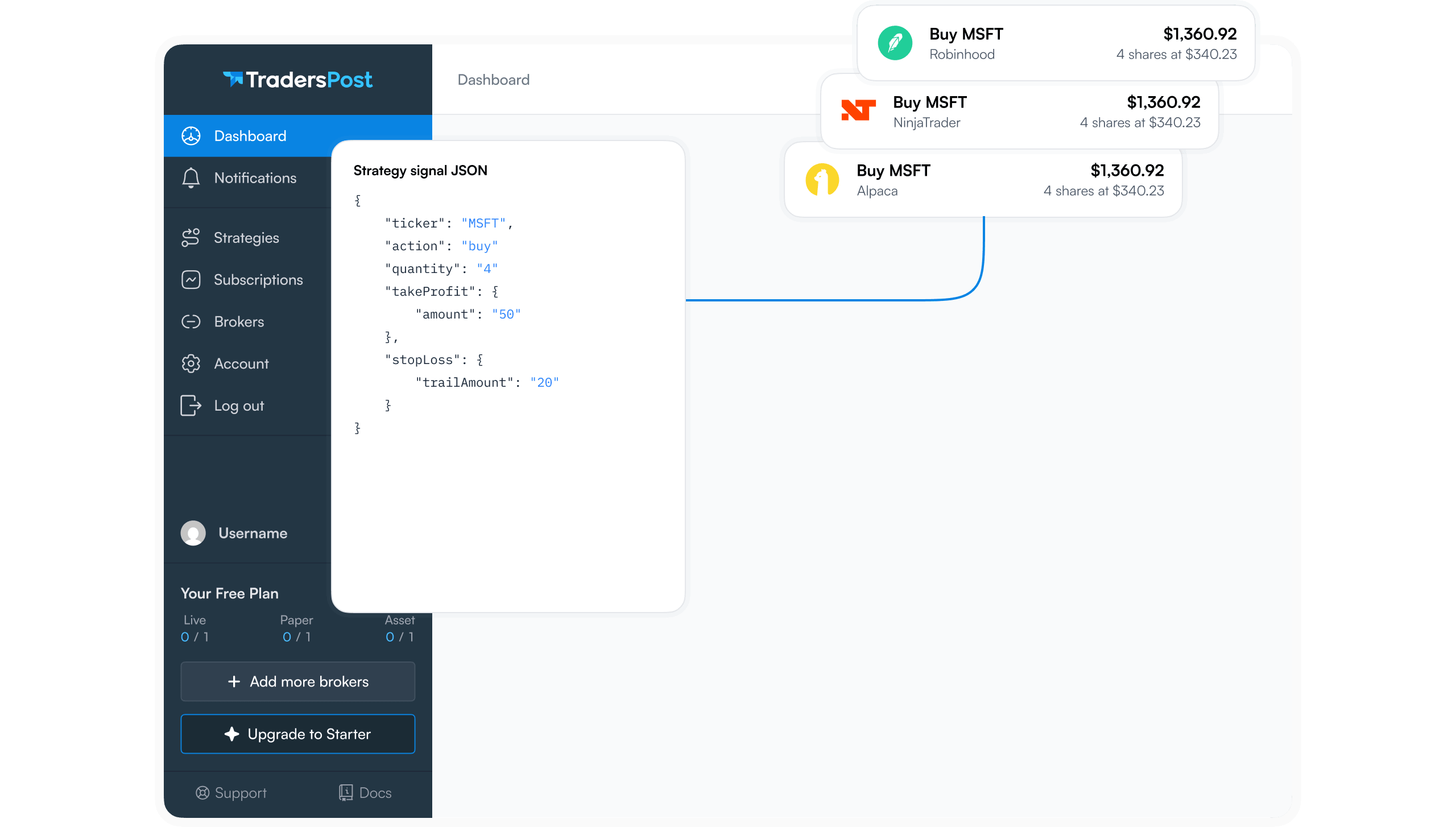
For each alert, verify the intended order details before progressing: the symbol, direction, quantity, planned entry logic, stop loss, and take profit. If the workflow uses webhook fields such as ticker, action, quantity, stopLoss, and takeProfit, compare the alert payload with the planned trade specification.3
Keep a Forward-Testing Journal
Maintain a journal for every expected setup, including setups that do not generate an alert. A complete record makes it possible to distinguish a strategy-rule issue from an alert configuration issue or an assumption that was not represented accurately in the backtest.
- Date and market session
- Symbol and chart timeframe
- Expected signal and the price or condition that should trigger it
- Actual alert time and bar status, intrabar or bar close
- Intended entry, planned stop loss, and planned take profit
- Whether the signal matched the original backtest assumption
- Notes on volatility, trend direction, range conditions, and unusual market events
Investigate every missed, duplicate, late, or unexpected signal before moving from Paper trading to live trading. For example, if a breakout alert arrives one bar after the backtest entry, determine whether the backtest assumed intrabar execution while the alert waits for bar confirmation. If duplicate alerts occur, identify whether the strategy condition remains true across multiple bars when the intended rule requires only one entry. Forward testing is complete only when the observed real-time signals consistently match the rules that produced the backtest results.
Step 3: Paper Trade Through TradersPost
Choose TradersPost Paper or a Broker Paper Account
For this stage, select the paper-trading environment that best matches the live deployment you intend to use. Traders can test with TradersPost Paper or with a supported broker’s paper account.4 The right choice depends on the execution workflow and asset type you plan to trade when capital is at risk.
If you expect to trade through a specific broker in a particular asset class, using that broker’s paper account can make the test environment more representative of the eventual live setup. If your immediate objective is to validate alerts, subscription behavior, and order instructions without tying the test to a broker paper environment, TradersPost Paper provides a practical simulated-account workflow.
Paper trading is an execution and integration test. It can verify that alerts are delivered, instructions are interpreted correctly, and simulated orders are generated as intended. It is not proof that live fills, spreads, liquidity, order acceptance, or realized performance will match paper-trading results.
Set the Subscription to a Paper Account
Before enabling automated alerts, configure the TradersPost subscription to use a Paper account. Confirm the selected account on the subscription itself, then enable the TradingView or TrendSpider alert. This prevents a test alert from being directed to an unintended account.
The objective is to test the complete automated path:
- The TradingView or TrendSpider alert is triggered.
- The alert reaches the TradersPost subscription.
- The subscription routes instructions to the selected Paper account.5
- The Paper account records the simulated order activity.
Review each test in sequence. If no simulated order appears, first confirm that the alert triggered and that the subscription is assigned to the intended Paper account. Do not begin troubleshooting bracket instructions, position sizing variations, or time-sensitive conditions until a basic entry has completed the full path.
Use a Simple Webhook Payload Before Adding Complexity
Begin with the smallest useful instruction set: ticker, action, and quantity. For example, an entry test might specify a ticker such as SPY, an action of buy, and a quantity appropriate for the selected Paper account and instrument.
Keep the first test deliberately controlled. Use a ticker that is valid for the account and matches the instrument you intend to automate. Use a quantity that is realistic for the account type and your planned live workflow. Avoid changing the ticker, quantity, and alert logic simultaneously, because a failed test becomes harder to isolate.
- First, verify that a basic entry is received and processed as expected.
- Next, add takeProfit and stopLoss to test exit instructions.
- Use expiration only when it is relevant to the order instructions being tested.
This staged approach isolates failures. Once the simple entry behaves correctly, each added field can be tested independently before the strategy moves to a more complex paper-trading workflow.
Understand Paper Trading Limitations Before Going Live
Simulated Fills Are Not Live-Market Fills
Paper trading is a useful forward-testing step, but it does not reproduce every condition that determines whether a live order is filled, and at what price. A simulation cannot fully replicate available liquidity, changing bid-ask spreads, partial fills, price movement while an order is being processed, or the order priority that applies in a live market.
This distinction matters most when a strategy trades instruments with limited liquidity, enters on short-lived signals, or uses tight profit targets and stop levels. A strategy may appear smooth in Paper trading because its entries and exits are consistently simulated near a favorable reference price. In a live account, the same order may receive a less favorable fill, be partially filled, or encounter a wider spread during a volatile period.6
- Stress-test the expected edge: If a strategy targets a $0.10 move, assess whether normal spread costs and adverse fill movement could consume most of that target.
- Use conservative sizing at launch: Transition from Paper trading to live trading with smaller position sizes than the strategy's maximum intended allocation.
- Review execution-sensitive rules: Strategies using narrow stops, rapid reversals, or frequent entries require particular caution because small fill differences can materially change results.
Know How TradersPost Paper Simulations Work
TradersPost Paper trading simulations can generate fills around the clock in the simulated environment. This is important when reviewing automated strategies because a simulated fill may occur at a time when live-market trading conditions would be different, restricted, or unavailable for the instrument being evaluated.
By default, simulated fills use the bid-ask midpoint. The midpoint is the price halfway between the current bid and ask, not necessarily the price a live market order would receive. A live buy order generally must transact against available offers, while a live sell order generally must transact against available bids. The difference can be meaningful when spreads are wide or moving quickly.
For example, if an option quote is $2.00 bid and $2.40 ask, the midpoint is $2.20. A simulated fill near $2.20 can look materially better than a live buy fill near $2.40 or a live sell fill near $2.00. Treat Paper trading results as a signal-validation tool, then apply a realistic execution allowance before approving the strategy for live deployment.
Account for Options and Futures Simulation Differences
Simulated options and futures positions do not expire. This means a Paper trading position can remain open beyond the contract's real expiration date unless the strategy closes it. Traders must manually account for expiration-related behavior when evaluating options or futures strategies in simulation.
For options, evaluate whether the planned exit occurs before expiration and whether the strategy depends on time decay, changing liquidity, or expiration-week price behavior. For futures, confirm that the strategy has a defined exit process rather than assuming a simulated position will reflect contract expiration or rollover behavior.
- Review open position status regularly.
- Verify that planned exits are triggered before the relevant expiration date.
- Do not assume simulated positions reflect all real-world contract behavior.
Step 4: Validate Entries, Exits, and Risk Instructions
Test One Trade Path at a Time
Validate the automation sequence in small, observable steps. Begin with one long entry in Paper trading. Send an alert with the intended ticker, action, and quantity, then compare those values with the resulting Paper account position. Do not introduce a short entry, reverse signal, take-profit instruction, and expiration limit in the same first test.
For example, if the strategy is intended to buy 10 shares of a stock, first confirm that the alert specifies the correct ticker, an entry action, and a quantity of 10. Review the Paper account after the order behavior has completed. Confirm that the position direction and size match the strategy plan before moving to the exit test.
- Alert fired: Confirm the chart or strategy generated the expected signal.
- Subscription received the alert: Confirm the alert reached the intended subscription.
- Order behavior matched the strategy plan: Verify the intended entry or exit instruction was applied.
- Position status was reviewed: Check the Paper account for the resulting position direction and quantity.
After the long entry is correct, test the corresponding exit behavior independently. Only then repeat the same process for short-side workflows, if the strategy trades short. Separating paths makes it much easier to identify whether an issue originates in the entry alert, exit alert, position state, or strategy logic.
Validate Take-Profit and Stop-Loss Instructions
Test takeProfit and stopLoss instructions separately from the initial entry whenever the workflow allows it. The objective is to confirm that each risk instruction contains the intended price level and that the level matches the strategy calculation at the time the alert is generated.
For example, a long strategy may enter at 100 with a takeProfit of 104 and a stopLoss of 98. Verify that those exact values appear in the alert, rather than assuming the chart labels, plotted levels, or backtest values were transmitted correctly. Then review whether those levels make sense for the instrument and order behavior under test.
- Confirm that takeProfit and stopLoss values match the strategy's calculated prices.
- Check that the levels are appropriate for the ticker being tested and its expected price movement.
- Test the intended exit logic under Paper trading before relying on it in a live workflow.
- Avoid combining multiple competing exit conditions until each condition has been validated independently.
Test Expiration Only When Your Workflow Uses It
Include expiration only when the intended order instructions require a time limit. If the strategy does not use expiration, omit it during initial tests. A smaller alert payload is easier to inspect and troubleshoot because every included field has a defined purpose.
When expiration is part of the workflow, verify that the expiration value in the webhook alert matches the strategy's intended time limit. Test it as a distinct scenario after the basic entry and exit path is working. This prevents an unnecessary expiration instruction from obscuring whether a failed test was caused by the entry, the risk instructions, or the time limit itself.
Step 5: Move From Paper Trading to Live Trading Carefully
Set Readiness Criteria Before Switching Accounts
Do not move from Paper trading to a live account because a strategy produced a handful of profitable trades. Require a meaningful forward-tested sample across the market conditions the strategy is designed to trade. For example, a trend-following system should be observed during directional sessions, choppy sessions, opening volatility, and lower-volume periods rather than only during a favorable multi-day trend.
Before enabling live automation, review every part of the order workflow against the original strategy rules:
- Each alert uses the intended ticker, action, and quantity.
- Entries occur only when the strategy's conditions are present.
- Exit alerts, including takeProfit, stopLoss, and time-based exits where applicable, produce the expected position changes.
- Position tracking remains accurate after partial exits, reversals, skipped signals, and consecutive signals in the same direction.
Evaluate the results using realistic live assumptions. A paper-traded entry filled at the signal price may be unachievable when spreads widen or the market moves quickly. Include expected commissions, bid-ask spread, slippage, and execution uncertainty in the review. A strategy with a $0.05 average edge per share may not remain viable if live fills are routinely $0.03 to $0.08 worse than expected.
Switch the Subscription From Paper to the Intended Live Account
When the strategy meets its readiness criteria, carefully review the account selected on the subscription before allowing live orders. Confirm that the subscription is no longer configured for Paper trading and that the selected account is the intended live brokerage account. This should be a deliberate account-level decision, not an assumption based on the alert source or strategy name.
Review existing test alerts, duplicate alerts, and older strategy versions before the switch. Disable alerts that were used for testing, or verify that they cannot send unintended orders to the live subscription. A previously forgotten alert that sends a valid ticker, action, and quantity can create a live position even if the current strategy is behaving correctly.
Begin with intentionally reduced size. If the eventual plan is 100 shares per trade, start with 10 or 20 shares. If sizing is based on Percent of equity or Risk percent, use a materially smaller setting during the initial live-validation period. The objective is to test execution and operational reliability while keeping financial consequences limited.
Continue Monitoring After Going Live
Treat the first live trades as an additional validation sample, not as proof that the automation is complete. For each early trade, compare the original strategy signal, the alert details, and the executed order. Confirm that the direction, quantity, entry timing, and exit behavior match the documented strategy rules.
- Record the expected price at the time of the alert and the actual fill price.
- Measure the delay between the alert and execution, especially during volatile periods.
- Identify whether spreads, slippage, or partial fills materially change trade expectancy.
- Verify that the resulting position matches the intended position after every entry and exit.
Do not alter strategy rules after one disappointing live fill or one unusually strong trade. Collect enough live data to distinguish a recurring execution issue from normal market variation. If actual execution differs materially from the paper-traded assumptions, pause live automation, investigate the cause, and return to paper testing or reduced-size validation before increasing exposure.
A Practical Backtest-to-Live Example
Example Workflow for an Automated Stock Strategy
Start with one narrowly defined strategy rather than a portfolio of ideas. For example, test a TradingView strategy on SPY using a 15-minute chart: enter long when a 20-period moving average crosses above a 50-period moving average and price closes above the session VWAP; exit when the 20-period average crosses back below the 50-period average. Define the rules completely before reviewing results, including trading hours, position size, entry conditions, and exit conditions.
Backtest the strategy over multiple market regimes, then forward test it by allowing new TradingView alerts to occur in real time. Monitor the alerts for several weeks or until the strategy has generated a meaningful number of signals. The objective is not merely to see whether the signals remain profitable. Confirm that the alert timing, symbol, direction, and order instructions match the tested rules.
Next, send alerts to a TradersPost subscription connected to a Paper trading account. A basic entry alert can include ticker, action, and quantity. For example, a long entry instruction might specify SPY as the ticker, buy as the action, and 10 shares as the quantity. Initially, validate that entries are received and simulated as intended. Once entry behavior is consistent, add takeProfit and stopLoss values to test the complete planned exit workflow.
Example Paper-Trading Checklist
- Confirm that the correct TradingView or TrendSpider alert is active and corresponds to the intended strategy, symbol, and timeframe.
- Confirm that the TradersPost subscription is set to the intended Paper trading account before allowing alerts to trigger.
- Review every instruction sent with the alert. Verify ticker, action, and quantity, then verify takeProfit, stopLoss, and expiration only when those fields are required by the trade plan.
- Check that values are expressed as intended. A stop loss placed too close to the entry, an incorrect quantity, or an unnecessary expiration can materially change the trade outcome.
- Review simulated fills with appropriate skepticism. Paper fills can occur around the clock and use the bid-ask midpoint by default, so they do not represent a guarantee of executable live prices.
What a Responsible Live Transition Looks Like
A strong paper record is a reason to proceed cautiously, not a reason to immediately deploy full size. Begin live trading with smaller quantities than the strategy’s paper results would suggest. This limits the financial effect of unexpected alert behavior, market gaps, wider bid-ask spreads, and differences between theoretical and executable prices.
Expect live execution to differ from both the backtest and simulated paper trading. Continue reviewing alerts, order instructions, and actual trade outcomes after the transition. Compare each live trade with the strategy’s intended rule set, and investigate discrepancies before increasing size. The automation process requires ongoing validation, especially after strategy edits, alert changes, or changes to the instruments being traded.
Frequently Asked Questions
What is the difference between backtesting, forward testing, and paper trading?
Backtesting evaluates a strategy using historical market data to see how its rules would have performed in the past. Forward testing evaluates strategy signals as new market data arrives in real time, without relying on future knowledge. Paper trading simulates order execution without risking live capital. It is especially useful for validating the complete automated workflow, including how alerts are received, interpreted, and converted into simulated orders.
Should I paper trade before using TradersPost with a live account?
Yes. Paper trading is recommended before connecting a TradersPost subscription to a live brokerage account. It lets you validate alert messages, subscription settings, selected accounts, ticker symbols, quantities, entry instructions, and exit instructions. You can assign a TradersPost subscription to a Paper account and test the full webhook-to-order workflow before real money is involved. This helps identify setup errors before they can affect a live position.
Can I use TradingView or TrendSpider alerts with TradersPost paper trading?
Yes. TradersPost can receive webhook alerts from TradingView or TrendSpider and use them to automate paper trades. During testing, connect your subscription to a Paper account rather than a live broker account. This allows you to confirm that alerts are firing correctly, payloads contain the intended values, and alert-driven orders behave as expected. Once the workflow is validated, you can switch the subscription to a live broker account.
How are TradersPost Paper fills simulated?
TradersPost Paper simulated fills can occur around the clock and use the bid-ask midpoint by default. This provides a practical way to test automation and strategy logic, but paper results may not match live trading results. Real-market execution can be affected by changing spreads, liquidity, price movement, slippage, order-routing delays, and uncertainty about whether an order will fill. Treat paper results as workflow validation rather than a guarantee of live performance.
Do simulated options and futures positions expire in TradersPost Paper?
No. Simulated options and futures positions do not expire in TradersPost Paper. When testing options or futures strategies, you should account for expiration-related behavior separately. This includes contract expiration, assignment risk, settlement, rollover decisions, changing liquidity, and time-sensitive pricing effects. Paper trading remains useful for validating alerts and order automation, but it may not fully model the lifecycle of an expiring option or futures contract.
Conclusion
A durable trading workflow is built through evidence, not optimism. Backtesting helps identify whether a strategy has historical merit, forward testing reveals how it performs under current market conditions, and paper trading confirms that alerts, entries, exits, sizing, and broker automation work as intended. Each stage addresses a different source of risk, from flawed assumptions in the strategy logic to execution errors that can appear only in real time.
Before committing capital, create a TradersPost subscription, connect a Paper account, and validate your TradingView or TrendSpider alerts through realistic paper-trading conditions. Review results across enough trades and market environments to confirm the process remains reliable. When your strategy and automation consistently behave as designed, you can approach live trading with clearer expectations, stronger controls, and greater confidence. Take the next step with TradersPost and build a workflow you can trust.
References
1 TradersPost Docs, Position Sizing
2 TradingView, Strategy Properties
3 TradersPost Docs, Webhooks
4 TradersPost Docs, Paper Trading
5 TradersPost Docs, Subscriptions
6 TradersPost Docs, Order Behavior