Difference Between Mark And Last In TOS
Mark price and last price mean different things on trading platforms. Learn how each is calculated, why they diverge, and which to use for stops.

Marketing

The difference between mark and last in TOS comes down to what each number represents. Last price is the most recent executed trade for an instrument on a specific venue. Mark price is a calculated reference value used to estimate fair value, value open derivatives positions, and determine liquidation.
That distinction matters when configuring stop-loss triggers, reviewing unrealized profit and loss, or automating orders. A chart can show a survivable last price while the mark price has already reached liquidation, or it can print a sharp last-price wick without causing liquidation.
The term “mark” also depends on context. Derivatives exchanges usually calculate mark from an index and basis adjustment. In TradersPost market-price calculations, the default mark price means the midpoint between bid and ask. Always confirm how the platform displaying the field defines it.
Understanding Mark And Last Price
What Last Price Means
Last price, also called last traded price, is the price of the most recent trade completed for that instrument on the venue you are viewing. It reflects activity in that venue’s order book rather than a composite of the wider market.1
Trading platforms commonly use last price to draw candles, display recent trading activity, and determine the execution value that becomes realized profit or loss when a position closes. Because every venue has its own participants and order book, the same contract can have different last prices across platforms at the same moment.
What Mark Price Means
Mark price is a theoretical estimate of fair value, not an executed trade. Derivatives venues typically derive it from an external index with a basis or funding adjustment. The exact calculation differs by platform.2
Its primary uses are different from those of last price. Mark price can value open positions, calculate margin requirements, determine unrealized profit and loss, and trigger forced liquidation. This makes it the critical reference for leveraged position risk, even when the chart emphasizes last price.
Where Index Price Fits In
Index price is a weighted composite of spot prices from multiple external exchanges. Higher-weighted constituents exert more influence, helping anchor a derivatives contract to the broader spot market instead of one local order book. Index price can also feed funding calculations and serves as the starting point for many mark-price formulas.3
- Last price describes the latest local transaction.
- Index price describes the wider spot market.
- Mark price estimates the contract’s fair value.
How Mark Price Gets Calculated
The Basic Mark Price Formula
A common formula is mark price equals index price plus the moving average of the basis. Basis is calculated from the contract midpoint minus the index price, with the contract midpoint derived from the best bid and best ask.4
In simplified form:
Contract midpoint: (best bid + best ask) / 2
Basis: contract midpoint - index price
Mark price: index price + moving average of basis
A moving average prevents every short-lived order book movement from passing directly into the mark. This smoothing can reduce unnecessary forced liquidations caused by abnormal short-term volatility.5
Why Calculations Vary By Platform
There is no universal mark-price formula. Binance uses a median construction involving a funding-adjusted index, an index-plus-basis value, and the contract price. Hyperliquid uses inputs that include a validator-computed oracle and a 150-second exponential moving average of its local basis. Bybit applies a clamped blend of contract and index prices to a defined symbol set.6
These differences affect how quickly each venue’s mark responds to a fast move. An identical contract can therefore display different mark prices across venues, even if their index inputs remain close. Traders should read the calculation methodology for the venue where the leveraged position actually exists.
How Last Price Gets Calculated
Last Traded Price Mechanics
Last price requires no fair-value formula. It is simply the price of the most recent filled trade for that specific instrument. A new execution updates it, while bid and ask changes without a trade do not necessarily change the last price.7
A derivatives contract may derive economic value from an underlying asset, but its last price does not have to equal the asset’s current spot price. Contract demand, local liquidity, basis, and the timing of the latest transaction can produce a difference.
Why Last Price Can Be Skewed
A large market order can move through several price levels and leave the most recent execution far from the earlier market, particularly in a thin order book. A large participant could also attempt to move the last price on one venue without producing the same movement across external spot markets.
For that reason, derivatives venues generally use mark price rather than last price for liquidation. Last price remains important because the actual closing execution determines realized profit and loss.8
Why Mark And Last Diverge
Volatility And Thin Order Books
During a sharp move, trades on one venue may occur before its index constituents or mark-price smoothing mechanism fully respond. That can produce a temporary gap between last and mark. Thin liquidity magnifies the gap because one order can move the local last price through multiple levels without producing an equivalent change in the wider market.
The gap can also move in the opposite direction. External spot markets may move while the local contract book lags, causing mark price to approach liquidation even though the last-price candle still appears farther away.
How Mark Resists Sudden Spikes
Because mark price incorporates multiple sources and smoothing, it is less susceptible to momentary moves caused by one trader or one venue. This provides protection when a local last-price wick does not represent the broader market.9
On deep, actively traded markets, mark and last often remain close and divergences tend to be brief. On lower-liquidity contracts, traders should treat the current mark-to-last spread as part of the position’s risk buffer.
Mark And Last In PnL
Unrealized Profit And Loss
Unrealized profit and loss represents how an open position is valued before it closes. Derivatives platforms commonly calculate it using the difference between entry price and mark price. The detailed formula depends on whether the contract is crypto-margined, USDT-margined, or USDC-margined.10
Using mark price prevents a momentary local trade from causing the displayed position value to swing as sharply as last price might. It does not guarantee that the position could close at the displayed mark because execution still depends on available liquidity.
Realized Profit And Loss
Realized profit and loss is based on the actual execution price when the position closes, not the theoretical mark. A favorable mark value is therefore not a promise of an equivalent exit fill.11
- Entry price establishes the position’s cost basis.
- Mark price values the position while it remains open.
- Closing execution price determines realized profit or loss.
Which Price Triggers Liquidation
Why Liquidation Uses Mark Price
Major derivatives venues use mark price rather than last traded price to trigger liquidation. This reduces the influence of isolated order book spikes and attempted manipulation on one venue.12
For a leveraged position, the mark-to-liquidation distance is more important than the apparent chart-to-liquidation distance. If the chart plots last price, watching only the candle can hide the reference used by the venue’s risk engine.
The Risk With Last-Price Stops
A stop-loss configured to trigger on last price may not activate before liquidation if mark price reaches the liquidation level first. The risk increases when the stop is placed close to liquidation because only a small mark-to-last divergence is required.13
A last-price stop is not guaranteed to protect a position from mark-price liquidation. Leave enough distance for normal divergence, order transmission, trigger processing, slippage, and the time required to execute the closing order.
Choosing A Trigger Price Type
Pros And Cons Of Last Price
A last-price trigger corresponds closely to the transaction prices traders see on a conventional chart. Depending on liquidity, the resulting execution may stay closer to the expected chart level. Its weakness is that liquidation can occur first if the venue monitors mark price while the stop monitors last price.14
Last-price triggers can be appropriate when matching chart-based logic is the priority and the instrument has a deep order book with a consistently narrow mark-to-last spread.
Pros And Cons Of Mark Price
A mark-price stop can align the stop trigger with the same reference used for liquidation, reducing the chance that a configured stop remains dormant while mark approaches the liquidation threshold. However, the order still executes against the order book. Its fill can differ from the mark trigger level.15
Mark-price triggers deserve consideration for thin or volatile instruments where individual trades can produce anomalous last-price movements.
Factors To Weigh Before Choosing
- Measure the instrument’s typical mark-to-last spread.
- Review how the spread behaves during fast markets.
- Confirm which reference triggers liquidation.
- Confirm which reference triggers stop-loss and take-profit orders.
- Keep the stop meaningfully clear of liquidation.
The correct selection is venue-specific. A trigger configuration tested on one platform should not be assumed to behave identically on another because mark-price calculations, order books, and stop trigger rules can differ.
Setting Price Type On Your Platform
Checking Your Broker’s Default
Check the venue’s order documentation and order ticket before deploying a strategy. Platforms can define different trigger references for stop-loss and take-profit orders, and the selected stop reference may not match the liquidation reference.
Record the setting as part of the strategy configuration rather than relying on memory. For automated trading, test the full path from signal generation through order submission and confirm the order shown at the destination has the intended type, stop level, and trigger behavior.
How TradersPost Uses Market Price Type
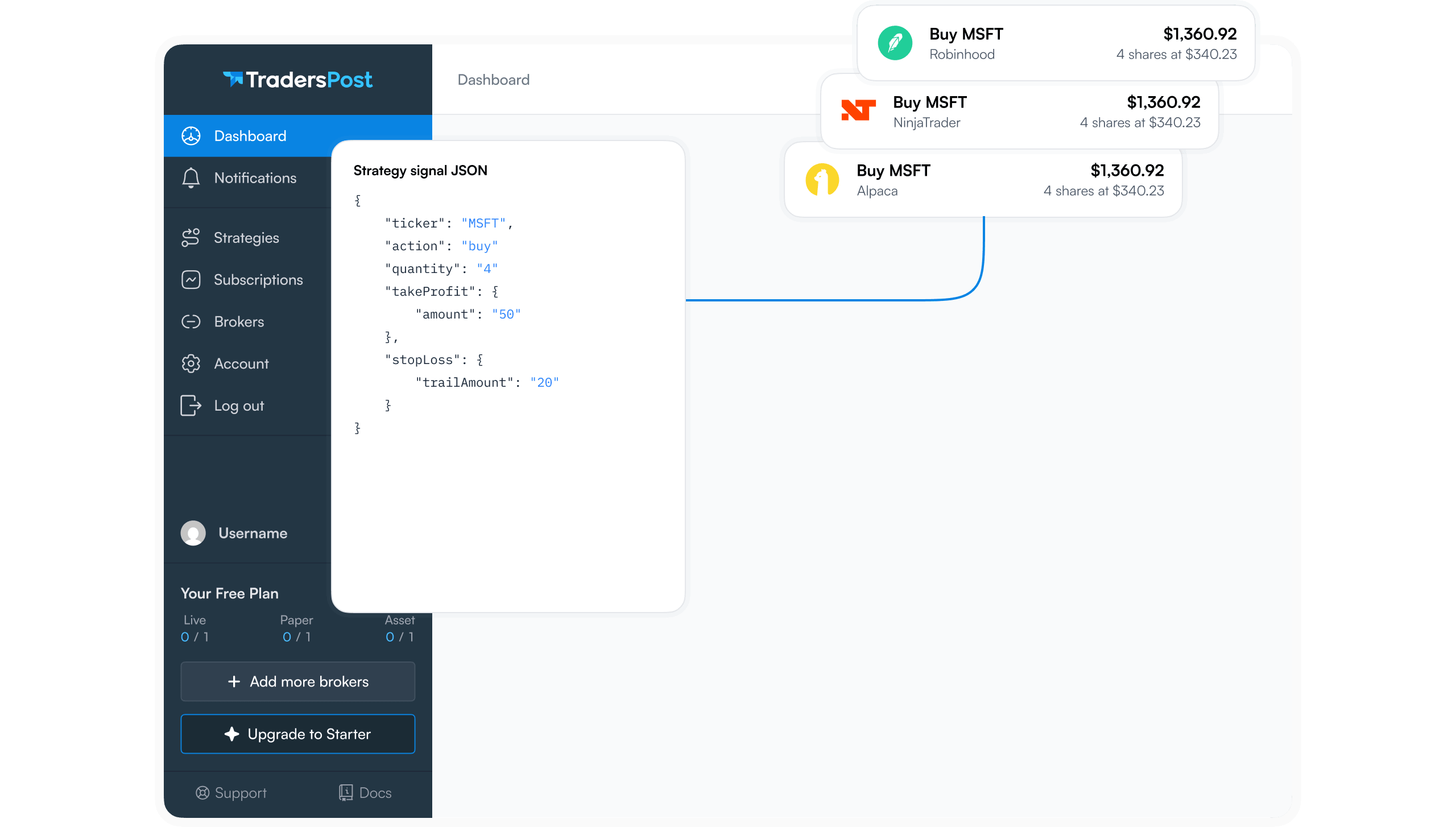
The TradersPost webhook payload includes a marketPriceType field that selects which quote price is used when a market price is needed for calculations. When omitted, it defaults to mark, meaning the bid-ask midpoint in this context.
This is not necessarily the same as a derivatives exchange’s index-based liquidation mark. The field affects calculations that require an estimated market price. Traders can also send price with the market price observed when an alert triggers, which supports slippage measurement against the eventual fill.
When dynamic quantity or price calculations depend on a current quote, document whether the automation uses midpoint, last, bid, or ask. That prevents a webhook’s calculation reference from being confused with the separate price reference used by a derivatives venue for liquidation.
Conclusion
The difference between mark and last in TOS is operational, not cosmetic. Last price records the latest local execution and ultimately affects realized results. Mark price estimates fair value and commonly controls unrealized PnL and liquidation. A strategy must account for both when its stop trigger and liquidation engine use different references.
Bottom Line
- Monitor mark price when managing leveraged liquidation risk.
- Use last price when chart alignment is the main concern.
- Expect wider divergence during volatility and thin liquidity.
- Do not place a stop directly beside liquidation.
- Verify every platform’s definitions before automating.
Before sending a live automated order, run a controlled test and inspect the resulting order at the connected broker or exchange. TradersPost users can include the intended market-price type and signal price in the webhook, then review execution logs to confirm that pricing and slippage behave as expected.
Frequently Asked Questions
What Differentiates Mark And Last?
Last price is the most recent executed trade on a specific venue. Mark price is a calculated fair-value reference commonly derived from an external index plus a basis or funding adjustment. Last price affects actual execution and realized PnL, while mark commonly drives unrealized PnL and liquidation.
Which Price Triggers Liquidation?
Major derivatives platforms use mark price rather than last traded price. Traders should monitor the distance between mark price and liquidation instead of relying only on a last-price chart.
Can Stops Trigger On Mark?
It depends on the platform and order configuration. Where the venue offers a trigger-price selection, a stop may use mark or last. Check the order ticket and documentation, then leave a meaningful buffer between the stop and liquidation.
Does Mark Affect Realized PnL?
No. Mark price values an open position and can determine liquidation. Realized PnL comes from the actual price at which the closing order executes.
Why Does The Chart Differ?
Charts usually plot trades from the venue’s local order book, while mark price is smoothed and anchored to broader reference data. Volatility, thin liquidity, and differences between local and external markets can make the two diverge.
References
1 Last Price vs. Mark Price: Understanding Crypto Futures
2 Last Price vs. Mark Price: Understanding Crypto Futures
3 Three Prices, One Liquidation: Mark, Index and Last Price Explained
4 Mark Price and Last Price
5 Mark Price and Last Price
6 Three Prices, One Liquidation: Mark, Index and Last Price Explained
7 Mark Price and Last Price
8 Last Price vs. Mark Price: Understanding Crypto Futures
9 Last Price vs. Mark Price: Understanding Crypto Futures
10 Mark Price and Last Price
11 Three Prices, One Liquidation: Mark, Index and Last Price Explained
12 Three Prices, One Liquidation: Mark, Index and Last Price Explained
13 How to Choose Last Price or Mark Price for TP/SL
14 Last Price vs. Mark Price: Understanding Crypto Futures
15 How to Choose Last Price or Mark Price for TP/SL