Automated Trading Q&A: TradersPost Features
Live Q&A covering automated trading setup, bracket orders, crypto exchange integration, and discretionary trading features in TradersPost

Marketing

Setting up automated trading can raise many technical questions, from understanding bracket orders to integrating multiple crypto exchanges. This comprehensive guide addresses the most common questions traders ask about automating their strategies with TradersPost and TradingView.
Understanding Bracket Orders in Automation
One of the most frequently asked questions in automated trading concerns bracket orders and their limitations. A bracket order combines three components into a single command: an entry order, a stop loss, and a take profit level. When the entry fills, both protective orders are automatically placed as One-Cancels-the-Other (OCO) orders.
The Bracket Order Limitation
Here's the critical limitation every automated trader must understand: you cannot create a bracket order on an existing position. Bracket orders are designed exclusively for new entry orders. This design is intentional and exists across most broker APIs and trading platforms.
When your TradingView alert triggers and sends a signal to TradersPost, if you're entering a new position, you can include entry, stop loss, and take profit instructions all at once. However, if you're already in a position and want to add protective orders, you'll need to place them as separate limit orders rather than as a bracket.
Working with Existing Positions
If you've entered a position and want to add stop loss or take profit levels afterward, you have several options:
Set individual stop loss and take profit orders manually or through separate alerts. These won't be linked as OCO orders, but they'll still provide protection.
Configure subscription-level settings in TradersPost that apply default stop loss and take profit parameters to all trades. This works well for consistent risk management across strategies.
Use discretionary trading features that allow you to set price levels on your chart that trigger automated orders when price reaches those zones.
Crypto Exchange Integration
Trading crypto through automated systems presents unique challenges, particularly around order types and exchange limitations. Many traders want to know how to implement stop losses and take profits when trading on exchanges like Coinbase or Robinhood.
Exchange-Specific Limitations
Not all crypto exchanges support the same order types. Coinbase, for example, doesn't support bracket orders in the traditional sense. This means when you send an entry order, you cannot automatically attach stop loss and take profit orders that execute as a linked group.
For exchanges with these limitations, TradersPost offers subscription-level settings where you can configure default stop loss and take profit parameters. These settings apply rules like "close position when profit reaches 5%" or "exit when loss hits 2%". While not true bracket orders, these settings provide automated risk management across your crypto trades.
Managing Multiple Crypto Accounts
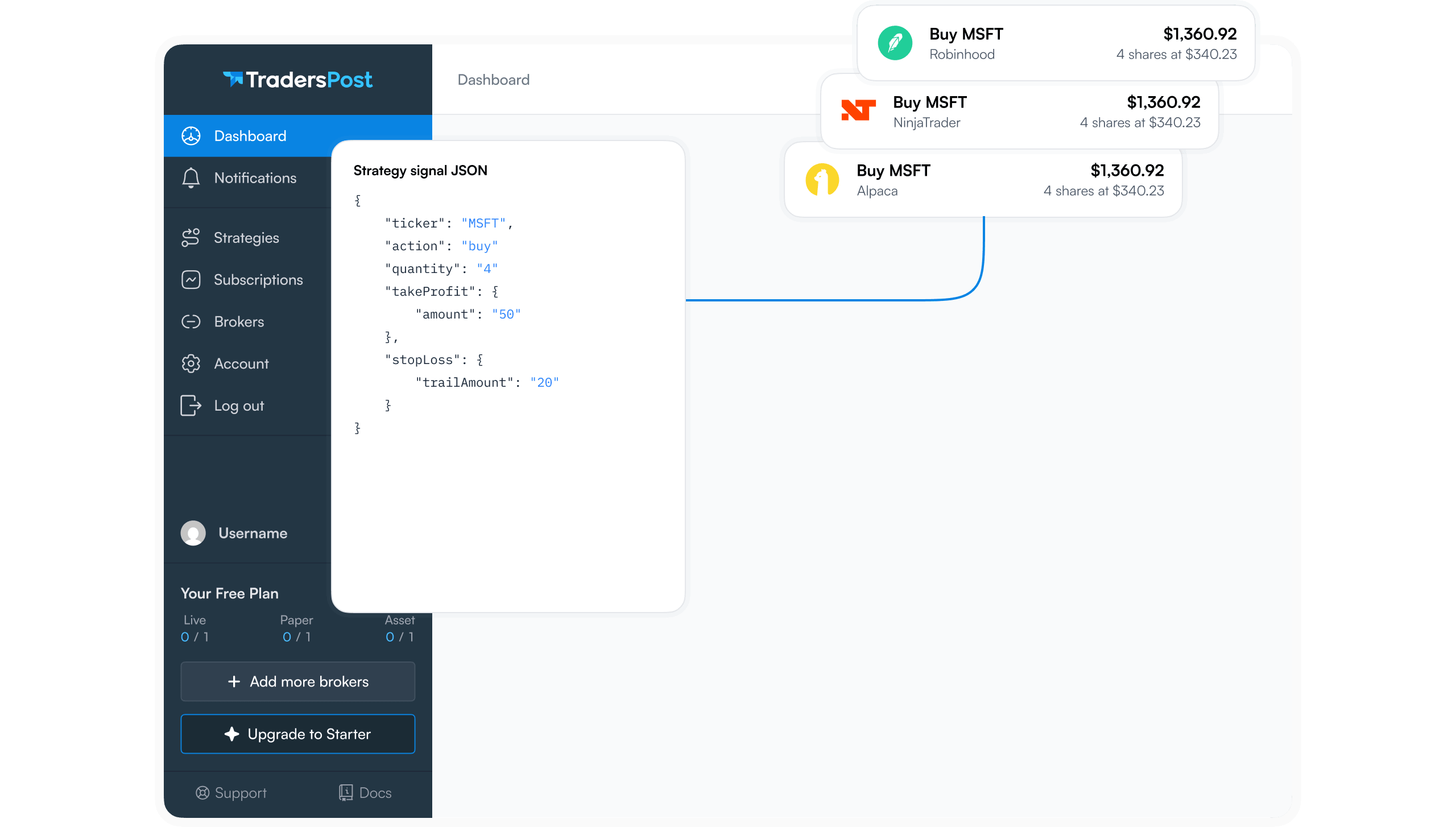
One powerful feature of automated trading platforms is the ability to manage multiple exchange accounts simultaneously. With TradersPost, you can set up alerts in TradingView that trigger trades across three, four, or even more crypto exchanges at once, each with slightly different parameters if needed.
This approach is particularly valuable for traders who want to:
Diversify execution across multiple exchanges to reduce concentration risk Test the same strategy across different exchanges to compare fill quality and fees Scale position sizes across multiple accounts while managing them from a single alert
Discretionary Trading with Automation
Not every trader wants to run fully automated strategies. Many prefer a hybrid approach where they make discretionary decisions but leverage automation for execution across multiple accounts. TradersPost supports this workflow through alert-based discretionary trading.
How Discretionary Automation Works
The concept combines manual analysis with automated execution. You analyze charts, identify your entry, stop loss, and take profit levels manually, then set price alert lines on your TradingView chart. When price reaches these levels, the alerts trigger and TradersPost executes the orders across your connected accounts.
This approach offers several advantages:
You maintain control over trade selection and timing through manual analysis Automation handles the execution mechanics, reducing emotional decision-making Orders propagate across multiple accounts, prop firms, or exchanges simultaneously You can manage different account sizes with proportional position sizing
A new indicator currently in development takes this concept further by allowing traders to draw order lines directly on their charts. Set your entry at a specific price, your stop loss below, and your take profit above. When price crosses your entry line, the alert fires and your full trade setup executes automatically.
Extended Hours Trading Limitations
Traders often want to exit positions at any price during pre-market or after-hours sessions. Unfortunately, most brokers don't allow market orders outside regular trading hours. This is primarily due to lower liquidity in extended sessions, which could result in extreme slippage.
Extended Hours Workarounds
Since market orders aren't available in extended hours, you're limited to limit orders. You could set multiple limit orders at different price levels to increase the likelihood of a fill, but this requires manual cancellation once one order fills.
A better approach is to configure market-on-open orders. If you need to exit a position urgently but regular hours haven't opened, you can send a market order that executes at the opening bell. This ensures your order fills at the first available opportunity with normal market liquidity.
Recalculate After Orders Fill
When using TradingView strategies, you may notice a setting called "Recalculate After Orders Fill." This setting changes how your strategy calculates entries and exits based on actual fill prices rather than theoretical prices.
Impact on Automated Trading
This setting affects only your TradingView backtest results, not the actual automated trading execution through TradersPost. When you enable recalculation after fills, your strategy recalculates its logic based on the confirmed fill price, which usually produces more realistic backtest results.
For automated trading, TradersPost receives alerts only after all TradingView calculations are complete. Whether you have recalculation enabled or not, the signal we receive is the same. The setting helps you see more accurate backtests, but it doesn't change the alerts sent to your automation platform.
Understanding Signal Latency
Every automated trading system introduces some latency between signal generation and order execution. With TradersPost, signal processing typically takes milliseconds. The more significant delays occur in:
Alert transmission from TradingView to TradersPost (usually under 1 second) Order routing from TradersPost to your broker (a few milliseconds) Broker order processing and fill confirmation (variable, depends on market conditions)
This latency exists in any automated system. The key is understanding that small time differences between your chart price and your fill price are normal and usually result from bid-ask spread and market movement rather than platform delays.
Exporting Trade History
Many traders want to export their trade history from TradersPost for analysis in Excel or other tools. While this feature isn't currently available, it's high on the development priority list.
Why Trade Export Is Complex
Building a robust trade export system involves several technical challenges:
Different traders run vastly different numbers of trades (some have 50 trades, others have 50,000) Various export formats serve different needs (CSV, JSON, PDF statements) Server load considerations when generating large exports Time range limitations (exporting years of data requires different handling than exporting a month)
The planned implementation will likely include export capabilities as part of an enhanced analytics package. This package is in development and will provide detailed performance metrics, drawdown analysis, and strategy comparison tools along with the ability to export your complete trade history.
Pre-Market and Post-Market Considerations
Extended hours trading through automated systems requires understanding broker-specific rules. Most retail brokers restrict order types during pre-market (4:00 AM - 9:30 AM ET) and after-hours (4:00 PM - 8:00 PM ET) sessions.
Limit Orders in Extended Hours
During extended hours, you're typically limited to limit orders. This means you must specify the exact price you're willing to accept. While this protects you from extreme slippage, it also means your order might not fill if the market moves away from your limit price.
For automated strategies, this creates a challenge. If your strategy generates an exit signal during extended hours, a market order will be rejected. You'll need to either:
Configure your strategy to send limit orders during extended hours with appropriate price buffers Wait for regular hours to open and use market-on-open orders Set wider limit order prices during extended hours to increase fill probability
Managing Partial Fills in Automated Strategies
When you run automated strategies, partial fills can create complications. Understanding how TradersPost handles these scenarios helps you design more robust strategies.
The Partial Fill Scenario
Imagine your strategy enters a position with 10 contracts of MNQ (Micro Nasdaq futures). Market conditions are volatile, and you decide to manually take profit on 5 contracts, leaving 5 contracts running. What happens when your automated strategy sends an exit signal?
The behavior depends on how your exit signal is structured:
If your signal simply says "exit position," TradersPost exits whatever position size remains (5 contracts in this example) If your signal specifies "exit 10 contracts," and you have side swapping enabled, you could unintentionally go short 5 contracts If your signal specifies a quantity but side swapping is disabled, it will exit only the remaining 5 contracts and bring you flat
Configuring Safe Partial Fill Handling
The safest approach for strategies where you might take partial profits manually is to:
Use exit signals that close the entire position rather than specifying quantities Disable side swapping if you don't trade both long and short simultaneously Enable the setting that prevents orders from exceeding your current position size
This configuration ensures that manual intervention doesn't create unintended positions when your automated strategy sends exit signals.
Building Custom Pine Script Indicators
For traders interested in creating custom indicators that work with TradersPost automation, Pine Script offers powerful capabilities. The process of building indicators that combine multiple conditions can seem complex, but breaking it down into components makes it manageable.
Combining Multiple Conditions
A popular approach is building "confluence" indicators that require multiple technical conditions to align before triggering a signal. For example, you might want a long signal only when:
RSI crosses above 30 (indicating oversold recovery) Price crosses above the 50-period EMA (indicating trend direction) Volume exceeds the 20-period average (indicating commitment)
Building this in Pine Script involves setting up condition checks for each requirement, then using logical AND operators to confirm all conditions are true simultaneously. When all conditions align, the indicator triggers an alert that TradersPost receives and executes.
Using AI Coding Assistants
Modern AI coding tools like Cursor and GitHub Copilot have revolutionized custom indicator development. Even traders with limited programming experience can now build sophisticated indicators by:
Describing the desired indicator behavior in plain English to the AI Reviewing the generated Pine Script code Testing the indicator on TradingView charts Iterating with the AI to refine behavior and fix bugs
These tools understand Pine Script syntax and can help debug compilation errors, explain existing code, and suggest optimizations. For traders willing to invest a few hours learning the basics, custom indicator development is more accessible than ever.
Consensus 2025 and Crypto Trading Evolution
The crypto trading landscape continues to evolve rapidly. Events like Consensus 2025 in Toronto bring together traders, developers, and platform providers to discuss emerging trends in automated crypto trading.
Spot Crypto Automation Trends
The focus in crypto automation is shifting from purely algorithmic strategies to hybrid approaches that combine:
Discretionary analysis for market context and opportunity identification Alert-based automation for consistent execution across multiple exchanges Position management automation for disciplined risk control
This evolution reflects the reality that most successful traders combine human insight with automation's consistency and speed. Rather than trying to automate every decision, the trend is toward automating the mechanical aspects while preserving discretionary control over strategic decisions.
Prop Firm Integration
Many traders now use prop firms to access larger capital without risking personal funds. Automated trading platforms like TradersPost support prop firm integration, allowing you to:
Connect multiple prop firm accounts to the same strategy Scale your trading across several funded accounts simultaneously Manage risk consistently across all accounts through centralized settings
The key advantage is efficiency. Rather than manually executing trades across five prop firm accounts, you set up one alert in TradingView that propagates to all accounts automatically. Position sizing can be proportional to each account's size, ensuring appropriate risk management across different capital bases.
Documentation and Video Tutorials
One challenge with rapidly evolving platforms is keeping documentation current. When features change monthly, video tutorials can quickly become outdated. However, this shouldn't discourage you from seeking educational resources.
Finding Current Information
The best sources for current TradersPost information include:
The official documentation site, which updates with each feature release Live Q&A sessions like office hours, where you can ask specific questions Discord community discussions where experienced users share solutions YouTube tutorials, keeping in mind that very recent releases are most accurate
When watching older tutorials, focus on conceptual understanding rather than exact button locations. The underlying principles of automated trading remain constant even as interface details evolve.
Getting Started with Automated Trading
If you're new to automated trading, the path forward involves several key steps:
Start with Paper Trading
Every automated trading platform, including TradersPost, offers paper trading modes. Use this feature extensively before risking real capital. Paper trading helps you:
Understand how alerts trigger and orders execute Test your strategy logic without financial risk Verify that order sizes, stop losses, and take profits behave as expected Build confidence in your automation setup
Learn from Market Cycles
Discretionary trading experience provides invaluable context for automation. Before automating a strategy, trade it manually through at least one complete market cycle. This experience helps you understand:
How the strategy performs in trending markets versus ranging markets Where the strategy struggles and how to recognize warning signs What position sizing and risk management rules actually work for your psychology How to recognize when market conditions no longer suit your strategy
Test Robustly Before Going Live
Backtesting is valuable but limited. Historical data doesn't include the emotional component of watching real money at risk. A more complete testing process includes:
Backtesting on historical data to verify the strategy's mathematical edge Paper trading in current market conditions to verify execution mechanics Small live capital testing to experience the emotional reality Gradual scaling as you gain confidence and verify consistent performance
Platform Features and Limitations
Understanding what your automation platform can and cannot do helps you design better strategies and avoid frustration.
What TradersPost Handles Well
TradersPost excels at:
Receiving alerts from TradingView and other platforms Routing orders to multiple brokers and exchanges simultaneously Managing position sizing across accounts with different capital levels Enforcing risk management rules like maximum position sizes and daily loss limits Providing execution logs and performance tracking
What Requires Alternative Approaches
Some needs require working outside TradersPost or combining it with other tools:
Complex multi-leg option strategies may need broker-specific platforms High-frequency strategies requiring sub-second latency need dedicated infrastructure Custom backtesting with advanced statistics may require Python or R Detailed trade journals with notes and screenshots need separate tools
The Future of Trading Automation
Automated trading continues to evolve rapidly, driven by:
Improved broker APIs providing more sophisticated order types Better data access for backtesting and strategy development AI tools making custom strategy development accessible to more traders Cloud infrastructure reducing latency and improving reliability
For retail traders, these advances level the playing field that was once dominated by institutional traders with custom infrastructure. Platforms like TradersPost democratize access to sophisticated automation capabilities that would have required a development team just a few years ago.
Taking Action
The best way to learn automated trading is through hands-on experience. Start with a simple strategy—perhaps just automating entries while managing exits manually. As you gain confidence, gradually add automation for exits, position sizing, and risk management.
Join communities where other automated traders share experiences. The TradersPost Discord, TradingView forums, and various trading subreddits provide spaces to ask questions, share strategies, and learn from others' successes and failures.
Remember that automation amplifies both good strategies and bad ones. A profitable discretionary strategy may become more profitable through automation's consistency. But a losing strategy will lose money faster when automated. Always verify your edge before committing significant capital to automation.
Automated trading isn't about removing human judgment—it's about making your judgment scale efficiently and execute consistently across multiple markets, accounts, and time frames. Start small, learn continuously, and scale gradually as your experience grows.