Retail Call Buying AI Stocks: 2026 Surge
Learn why retail traders are buying AI stock calls in 2026, how IV and theta affect returns, and how to automate disciplined options rules safely with alerts.

Marketing

Bottom Line
- In 2026, retail traders are heavily investing in call options for AI stocks like NVIDIA, AMD, and Microsoft, driven by ongoing spending on AI infrastructure and technology.
- A call option allows a trader to control 100 shares with a defined downside risk equal to the premium paid, making it a capital-efficient way to express a bullish view.
- For example, if NVIDIA is trading at $150, a call with a $5 premium and a $155 strike requires a $500 investment, with a breakeven at $160.
- Retail call volume should not be seen as mere speculative bullishness, as it may involve complex strategies like call debit spreads or covered-call adjustments.
- Options activity in AI stocks is influenced by catalysts such as earnings reports and AI-chip demand forecasts, with liquid options chains and tight bid-ask spreads making them attractive for traders.
Retail traders are piling into AI stock calls in 2026, chasing upside in names tied to chips, data centers, model infrastructure, and enterprise software. But retail call buying AI stocks is not simply a bet on whether a company rallies. It is a bet on timing, implied volatility, option expiration, and how much premium can decay before the anticipated catalyst arrives. A stock can rise and a call can still disappoint.
This guide breaks down what is driving the surge in AI call activity, where the trade can become structurally expensive, and how implied volatility and theta shape real-world returns. You will learn how to distinguish a momentum setup from an overcrowded premium trade, choose expirations with a clearer risk framework, and define exits before emotion takes over. We will also cover practical ways to automate disciplined options rules with price, volatility, and position alerts, so you can monitor risk without turning every AI headline into an impulse trade.
Why Retail Call Buying in AI Stocks Is Surging in 2026
The AI Rally Is Pulling Retail Traders Into Options
Continued spending on AI infrastructure, advanced semiconductors, hyperscale cloud capacity, data centers, networking, and enterprise software has kept AI-linked equities at the center of retail trading activity in 2026. NVIDIA (NVDA), AMD (AMD), Palantir (PLTR), Broadcom (AVGO), Microsoft (MSFT), and related infrastructure and software names frequently attract attention when they report earnings, announce capital-expenditure plans, break above technical resistance, or revise revenue guidance.
For retail traders, call options offer a capital-efficient way to express a bullish view when a high-momentum stock is making new highs or emerging from a consolidation. Instead of purchasing 100 shares, a trader can buy a call contract with defined downside equal to the premium paid. That leverage is attractive, but it also means a correct directional view can still lose money if the stock moves too slowly, implied volatility contracts, or expiration arrives before the move develops.
Elevated retail call volume should not be interpreted as a simple measure of speculative bullishness. Public options-flow feeds may show small-lot calls trading near the ask, but those contracts may be part of call debit spreads, short-stock hedges, covered-call adjustments, stock replacement positions, or multi-leg orders whose other components are not immediately visible. Automated systems should treat flow as a screening input, not a standalone trading signal.
This section focuses on the mechanics behind retail call activity, the specific risks of paying elevated premiums in AI names, and a rules-based participation process. A robust automated workflow should evaluate trend strength, earnings dates, implied volatility percentile, expected move, option liquidity, spread width, and the probability that the underlying can reach the trade’s breakeven before expiration.
What “Retail Call Buying” Actually Means
A long call gives its buyer the right, but not the obligation, to buy 100 shares of the underlying stock at a specified strike price on or before expiration.1 The buyer pays a premium upfront. That premium is the maximum loss for a standalone long call, while potential upside increases as the stock rises above the strike price.
For example, assume NVDA is trading at $150 and a trader buys one call with a $5 premium. Because each standard equity option controls 100 shares, the cost is $500 plus fees. If the call has a $155 strike, the expiration breakeven is $160, calculated as the $155 strike plus the $5 premium. If NVDA closes at or below $155 at expiration, the call expires worthless and the trader loses the full $500. Even a rise to $158 produces a loss at expiration because the intrinsic value is only $3 per share.
- Outright long call: A single purchased call, generally used for bullish exposure with limited capital at risk.
- Call debit spread: Buy one call and sell a higher-strike call in the same expiration. This reduces premium outlay and vega exposure, but caps upside.
- Covered call: Own 100 shares and sell a call against them. This is an income or yield-enhancement position, not call buying.
- Cash-secured put: Sell a put while reserving enough cash to buy shares if assigned. It is a bullish-to-neutral short-premium strategy, not a long-call trade.
- Institutional block trade: A large transaction that may be customer-driven, dealer-facilitated, or part of a complex hedge. Size alone does not establish directional intent.
Public flow classifications are inherently imperfect. A small-lot call marked as customer buying may indicate retail demand, but it does not reliably disclose whether the buyer is opening, closing, hedging, or executing one leg of a larger strategy. For automation, require confirmation from price trend, volume, open-interest changes, and risk-defined entry rules before acting on apparent retail call demand.
What the 2026 Options-Flow Data Says About Retail Activity
Use Credible Sources for the Retail Options Narrative
Retail-options claims require source-level precision. Before publishing a statement that retail call buying has increased in AI stocks, identify the publisher, publication date, underlying data provider, measurement period, and unit of measurement. Cboe Data Shop datasets can distinguish between total options volume, single-stock options volume, exchange-specific activity, contract count, premium, and notional exposure. Vanda Research commentary may instead describe estimated retail net buying in shares or dollars, which is not interchangeable with options volume.
Do not convert a high-options-volume statistic into a retail statistic unless the source explicitly identifies retail participation. Likewise, avoid describing activity as “record” or “largest ever” unless the cited Bloomberg, Cboe, or Vanda source makes that comparison and specifies its historical sample. For automated research, store the article URL, publication timestamp, data period, ticker universe, and methodology alongside every signal used in a model.
How to Read Call Volume, Put-Call Ratios, and Options Flow
Call volume is the number of call contracts traded during a session. Open interest is the number of contracts still outstanding after clearing. Neither statistic independently proves that traders opened new bullish positions. A call can be bought or sold, opened or closed, and it may hedge a short stock position or form one leg of a multi-leg spread.
- Compare volume with existing open interest: unusually high volume followed by a next-day open-interest increase is more consistent with new positioning, although it still does not reveal trade direction with certainty.
- Review execution location: prints near or above the offer can suggest buyer urgency, while prints near the bid can suggest selling. This is an inference, not proof, because quotes can change between execution and reporting.
- Use put-call ratios in context: a low put-call ratio indicates call-heavy activity, but it should be compared with the ticker’s own normal range, implied volatility, and broader market conditions.
- Measure premium as well as contracts: 20,000 far-out-of-the-money calls priced at $0.10 represent $200,000 of option premium before the contract multiplier, while 1,000 near-the-money calls at $8.00 represent $800,000. Contract count alone can exaggerate speculative interest.
For event-driven systems, flag strike clusters that expire immediately after earnings. Concentrated upside call volume near a known earnings date can reflect directional speculation, covered-call replacement, or volatility trading. Confirm with implied-volatility changes and post-trade open interest.
Why AI and Semiconductor Names Attract So Much Options Interest
NVDA, AMD, AVGO, and PLTR repeatedly attract options activity because their valuations react sharply to identifiable catalysts: quarterly earnings, AI-chip demand forecasts, hyperscaler capital-expenditure guidance, product announcements, export restrictions, government policy, analyst target revisions, and index rebalancing. These names also have liquid options chains, relatively tight bid-ask spreads, substantial displayed depth, and frequent weekly expirations.
That liquidity makes them practical for systematic screening, but not automatically attractive call purchases. Large daily price ranges raise implied volatility, and higher implied volatility raises call premiums. A trader can correctly predict that NVDA will rise after earnings yet still lose if the move is smaller than the premium-implied move or if post-event volatility collapses. Automation should therefore rank flow alongside implied-volatility percentile, expected move, spread width, days to expiration, strike distance, and earnings timing rather than treating call volume as a standalone bullish signal.
Why Traders Buy Calls on Momentum AI Stocks
Calls Offer Defined Upfront Risk and Leveraged Upside
Retail traders often buy calls on momentum AI stocks because the maximum loss is known when the order is entered: the premium paid, plus commissions and fees. This can be more capital-efficient than buying 100 shares outright, particularly when a high-priced AI stock is moving sharply after earnings, a product announcement, or a major customer win.
For example, if a trader is bullish on a $150 AI stock, buying 100 shares requires $15,000 of capital. A call option controlling 100 shares may cost a fraction of that amount. If the stock rises quickly, the call can produce a substantially larger percentage gain than the shares because the option premium has embedded leverage. A $6.00 call costs $600 per contract, so a rise from $6.00 to $9.00 is a 50% gain, while a move in the underlying from $150 to $156 is only a 4% stock gain.
The trade-off is severe: stock ownership has no expiration date, while a long call loses value from time decay and can expire worthless. A technically correct bullish thesis can still lose money if the move occurs after expiration or is smaller than the option market already priced in. Defined risk per contract is also not the same as appropriate account risk. Buying 20 contracts at $600 each creates a potential $12,000 loss, even though each individual contract has capped downside.
Momentum Traders Want Fast Exposure to Breakouts
Momentum traders typically use calls when they expect a directional move over several days or weeks, rather than a purely intraday scalp. Common triggers include a break above a multi-week high, a daily close above a key moving average, a high-volume breakout from consolidation, a reclaim of VWAP after a selloff, or continuation following a strong earnings gap.
For automated traders, these conditions can be converted into explicit filters. A scan might require the stock to close above its 20-day high, trade at least 150% of its 30-day average volume, remain above VWAP for two consecutive sessions, and show relative strength versus the Nasdaq-100. The stock signal, however, is only the first layer. The option contract must also be tradable.
A bullish AI stock can still have a poor call setup if implied volatility is elevated, the bid-ask spread is wide, open interest is thin, or expiration is too close. For instance, buying a weekly call immediately before earnings may expose the buyer to an implied-volatility crush even if the stock rises modestly after results. Many momentum buyers therefore prefer liquid, near-the-money or slightly in-the-money calls with enough time for the thesis to develop.
- Confirm trend: Define the breakout level, moving-average condition, and invalidation price.
- Confirm catalyst: Identify earnings, AI product news, analyst revisions, or sector strength.
- Check liquidity: Favor high open interest, meaningful daily volume, and narrow bid-ask spreads.
- Review implied volatility percentile: Avoid blindly paying extreme volatility premiums.
- Select expiration: Allow sufficient days for the expected move, not just the cheapest premium.
- Select strike: Compare delta, breakeven, and expected stock target.
- Set maximum loss: Cap total premium at a predefined percentage of account equity before entry.
The Hidden Cost of Buying Calls: Implied Volatility and Theta
Implied Volatility Can Make Bullish Calls Expensive
Implied volatility (IV) is the market’s expectation of future price movement, expressed through option premiums. Higher IV raises the price of both calls and puts because the market is pricing a wider expected trading range before expiration. For AI leaders such as NVIDIA, AMD, Broadcom, Microsoft, or Palantir, IV often rises ahead of earnings, product launches, investor days, major cloud spending updates, or semiconductor demand data.
This creates IV-crush risk. A stock can report strong results, open higher, and still produce a losing long-call trade if the actual move is smaller than the move already embedded in premiums. For example, if an AI stock’s weekly options imply a 10% post-earnings move and shares rise 5%, a call purchased immediately before earnings may lose value as IV collapses after the event.
- Compare current IV with the stock’s own historical IV range before entering.
- Use IV percentile or IV rank to identify whether current IV is elevated relative to the past year. A high reading does not prohibit a call purchase, but it requires a larger realized move or more favorable timing.
- For automated scans, flag contracts when IV rank is elevated and the option’s implied move exceeds the expected move from your price model.
Theta Decay Punishes Late and Far-Out-of-the-Money Calls
Theta is time decay: all else equal, a long option loses value as expiration approaches. This loss is not linear. It generally accelerates during the final weeks, particularly for out-of-the-money (OTM) options with little intrinsic value.
OTM AI calls are especially vulnerable when the underlying stock stops advancing. A broad bullish narrative around AI infrastructure, data centers, or enterprise software does not protect an individual option from decay. Consider a trader who buys a one-week OTM AMD call after a sharp rally. If AMD trades flat for three sessions, theta can materially reduce the premium. If post-rally IV also compresses, the option may lose substantial value even without a decline in AMD shares.
Short-dated calls are cheaper in dollar terms, but they require the stock to move quickly and in the correct direction. Longer-dated calls cost more upfront, yet provide more time for a thesis to develop and reduce dependence on an immediate catalyst. A systematic strategy should define the maximum holding period, profit target, and loss threshold before entry rather than waiting for expiration to force a decision.
Strike and Expiration Selection Should Match the Trade Thesis
Strike selection determines how much of the trade depends on stock direction versus time and volatility.
- At-the-money calls: Usually offer roughly 0.50 delta, balanced directional exposure, and meaningful theta sensitivity.
- Slightly in-the-money calls: Typically carry higher delta, higher premium cost, and more intrinsic value. They often better suit traders expecting a modest continuation rather than an explosive move.
- OTM calls: Cost less, have lower delta and lower probability of expiring profitable, and can decay rapidly. They are not efficient substitutes for a disciplined bullish thesis.
For a multi-week AI-stock swing, consider contracts with enough time to expiration to absorb normal consolidation, while maintaining a defined exit plan. Also screen liquidity: favor tight bid-ask spreads, adequate daily volume, and meaningful open interest. A theoretically attractive contract can become costly if automated entries and exits repeatedly cross wide spreads.
A Disciplined Framework for Trading AI Stock Calls
Build a Rule-Based Entry Checklist
Automated call-buying systems should require every entry condition to be true before an order is submitted. A practical breakout template for an AI stock might require:
- Price confirmation: the stock closes above a defined resistance level, such as a 20-day high or a prior swing high at $185.
- Participation: relative volume exceeds a preset threshold, such as 1.5 times the stock's 20-day average volume.
- Market alignment: the S&P 500, Nasdaq 100, or relevant semiconductor index is above its chosen trend filter, such as the 50-day moving average.
- Event filter: no earnings release occurs within the system's restricted window, for example, five trading days before earnings through one trading day after.
- Option liquidity: the bid-ask spread meets a rule, such as no wider than $0.10 or 5% of the option mid-price, with sufficient open interest and daily volume.
Define exactly when signals are evaluated: intraday, at the close of a specified candle, or after the daily close. A rule stating that a stock “breaks resistance” is not executable until the system specifies whether it means a five-minute print above resistance or a confirmed daily close. Avoid entries after parabolic advances unless the strategy has separately tested pullback or continuation rules. No checklist eliminates risk, but it reduces impulsive decision-making and makes results measurable.
Set Position Size Before the Alert Fires
Set maximum loss per trade before the system generates an alert. This can be a fixed dollar amount or a small percentage of account equity based on risk tolerance.2 For long calls held without a stop-loss guarantee, many retail systems treat the full premium paid as maximum risk.
Calculate contract quantity as:
Contracts = maximum premium at risk ÷ premium per contract, rounded down.
For example, if maximum risk is $300 and a call costs $1.40, each contract requires $140 in premium. The system can buy two contracts for $280, excluding commissions and fees. It cannot buy three contracts because $420 exceeds the risk limit.
Apply portfolio-level limits as well. Cap total premium at risk across correlated AI, cloud infrastructure, and semiconductor names. Nvidia, AMD, Broadcom, Marvell, and AI software leaders can decline together during a sector de-risking event. Five separate call positions may therefore operate like one oversized thematic bet, not five independent trades.
Define Exits for Profit, Loss, and Time
Every automated call entry should have three exit definitions: a premium-based loss limit, an underlying-price invalidation level, and a time stop. For example, a system might take partial profits after a 50% option gain, move the remaining contracts to a risk-reduction rule, and close the balance if the underlying stock closes below the breakout level.
- Premium stop: exit if the option loses a predefined amount, such as 35% of premium paid.
- Technical invalidation: exit if the stock closes below the breakout level, prior swing low, or another tested support level.
- Time stop: exit if the trade does not produce expected price progress within a defined period, such as three to five trading sessions.
Rigid percentage stops on options can be distorted by bid-ask spreads, implied volatility contraction, and time decay. For that reason, many systems use the underlying stock's technical invalidation level as the primary signal and the option premium stop as a secondary risk control. Do not average down on decaying out-of-the-money calls unless the system contains a pre-tested scaling rule with defined maximum exposure.
Automating AI Call Strategies With TradersPost
Turn TradingView Alerts Into Repeatable Options Workflows
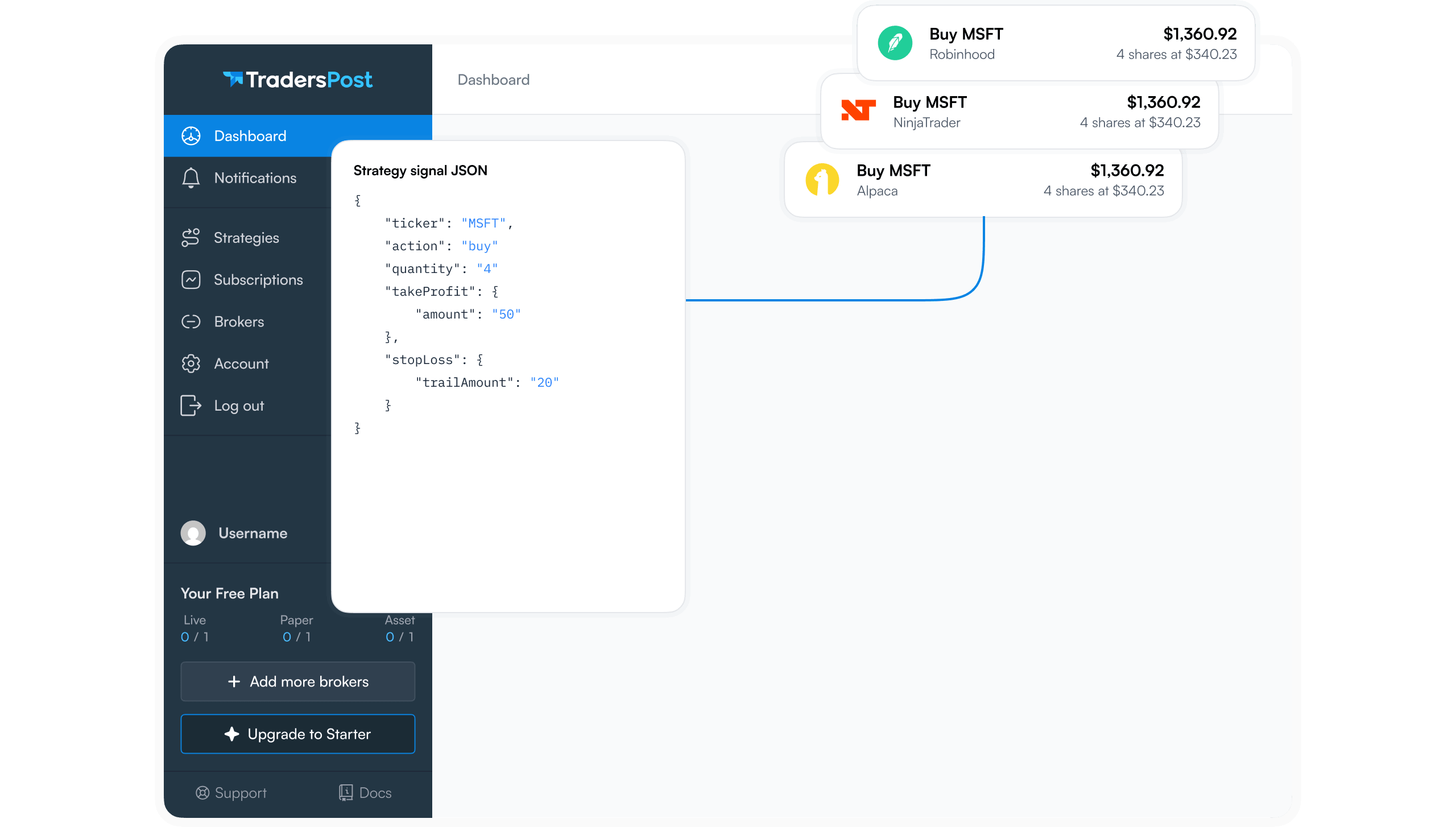
A reliable automation sequence starts with a TradingView indicator or strategy whose conditions are fully defined. Create the alert at the exact point the signal should be evaluated, usually bar close for swing-oriented call buying, then send a structured webhook payload to TradersPost.3 TradersPost can route the alert to a connected broker account according to the automation and order configuration you have defined.
For example, an AI stock workflow might require: the stock closes above its prior 20-day high, its relative-strength ratio versus the Nasdaq-100 is above its 20-day moving average, and the stock is above its own 50-day moving average. When those conditions are true at the daily close, TradingView sends a webhook alert that triggers a pre-defined bullish-options action, such as opening a selected call contract or a defined-risk call spread, subject to the broker and platform configuration.4
- Use objective inputs only: closing price, moving averages, breakout levels, volume thresholds, relative-strength ratios, and time-based filters.
- Specify whether signals are evaluated intrabar or only after the bar closes. A breakout that disappears before the close should not create an unintended order.
- Define position size, maximum premium at risk, expiration range, strike-selection rule, and exit logic before enabling automation.
- Verify broker-supported option capabilities, contract symbol formatting, order types, account permissions, buying-power treatment, and TradersPost-specific settings before live deployment.
Use TrendSpider Alerts for Multi-Factor Technical Setups
TrendSpider is useful when the setup depends on automated trendlines, support and resistance levels, moving-average alignment, or several technical conditions occurring together. Rather than alerting on every price movement in volatile AI names, require a complete setup.
A practical momentum template is: price closes above identified resistance, the 20-day moving average remains above the 50-day moving average, volume is at least 150% of its 20-day average, and relative strength versus a chosen benchmark is positive. Only then should the alert initiate the options workflow. This reduces alerts caused by low-volume resistance probes or broad-market noise.
Every automated alert requires an explicit response matrix. Define what opens a position, what closes it, which alerts are ignored because a position already exists, and how duplicate alerts are handled. For example, a second breakout alert while a call is open may be ignored, used to trail a stop, or allowed to add exposure only if the original position is profitable and portfolio risk remains within limits.
Paper Test Before Trading With Real Capital
Paper test the complete signal-to-order workflow before committing capital.5 Call buyers are exposed to bid-ask spreads, slippage, partial fills, delayed execution, and accelerating time decay near expiration. A chart signal that appears profitable can fail after realistic option execution assumptions are applied.
Test the workflow through strong uptrends, sideways consolidation, earnings-related volatility, AI-sector selloffs, and broad risk-off sessions. Track more than win rate:
- Average winner, average loser, expectancy, and maximum drawdown.6
- Percentage of option premium lost on losing trades.
- Performance by days to expiration, strike distance, and holding period.
- Skipped trades, rejected orders, partial fills, and alerts received during existing positions.
Review results after incorporating realistic spreads, commissions, regulatory fees, and fill assumptions. If the strategy only works with midpoint fills or ignores trades that could not be executed, it is not ready for live capital.
When Retail Call Buying Becomes a Warning Sign
Crowded Call Activity Can Increase Reversal Risk
Heavy retail call buying is not an automatic sell signal. AI stocks can continue rising while bullish options activity expands, particularly when earnings revisions, enterprise demand, or major infrastructure announcements validate the underlying narrative. A stock with persistent call volume at the $200, $220, and $250 strikes may remain strong if spot price, volume, and fundamental catalysts continue to support the move.
The warning appears when options enthusiasm accelerates faster than the stock’s ability to meet elevated expectations. Rapidly rising call volume, implied volatility well above its own recent range, and concentrated demand for short-dated out-of-the-money calls can make the trade more fragile. For example, if an AI semiconductor stock rises 18% in two weeks, 14-day implied volatility moves from the 55th percentile to the 95th percentile, and retail traders concentrate in weekly calls 15% above spot, even a merely adequate earnings update can trigger a sharp reversal as premium buyers exit and implied volatility contracts.
Dealer hedging should not be reduced to a simple rule that call buying always forces dealers to buy stock. Gamma exposure depends on whether dealers are net short or net long the relevant options, strike concentration, time to expiration, open-interest changes, and whether customer flow consists of calls bought to open, calls sold to open, spreads, or closing transactions. A flow dashboard that labels contracts as “bullish calls” cannot establish dealer positioning on its own.
For automated traders, treat retail sentiment and options flow as contextual inputs rather than a standalone signal. A practical model can flag elevated reversal risk when all of the following occur: call-volume percentile exceeds 90%, implied volatility percentile exceeds 80%, short-dated out-of-the-money call open interest rises materially, and price is extended beyond a defined trend band. The flag should tighten entry criteria, reduce position size, or require confirmation, not mechanically short the stock.
Know When Not to Take the Trade
A robust AI-stock options process needs explicit no-trade rules. Skip the trade when one or more of the following conditions applies:
- Implied volatility is elevated relative to history without a defined catalyst: paying a 90th-percentile volatility level for calls is unattractive if there is no earnings release, product event, court decision, or macro data point that could justify the premium.
- Bid-ask spreads are too wide: avoid contracts where the spread consumes a meaningful portion of the option premium or exceeds the strategy’s permitted execution-cost threshold.
- The stock is extended above its trend reference: if price is materially above a 20-day moving average, anchored VWAP, or another pre-defined trend level, do not chase solely because call flow remains strong.
- Earnings are too close for the trade plan: do not enter a directional call intended to capture a multi-week trend two sessions before earnings unless the strategy explicitly models gap risk and post-event volatility crush.
- Portfolio AI exposure is already high: correlated positions in chipmakers, cloud platforms, data-center infrastructure, and AI software can create concentrated factor risk even when the tickers differ.
Automation is most valuable when it prevents forced participation. Require every entry to satisfy pre-established conditions for trend, volatility, liquidity, catalyst timing, and portfolio exposure. Do not override those rules because AI names are trending on social media or dominating financial news. The retail call-buying surge may create opportunity, but process, sizing, and automated discipline matter more than participating in every rally.
Frequently Asked Questions
Why are retail traders buying calls on AI stocks in 2026?
Retail traders are drawn to AI leaders and semiconductor stocks because they remain highly visible momentum names, often supported by earnings results, AI spending expectations, and major product or data-center catalysts. Call options provide defined upfront risk with leveraged upside exposure. However, they can expire worthless if the stock does not rise enough before expiration. Call volume should also be interpreted carefully, since it does not prove every trade is an outright bullish retail bet.
Are out-of-the-money AI stock calls a good strategy?
Out-of-the-money calls cost less upfront, but they usually have lower delta and can lose value quickly from theta decay when a stock moves sideways. They may fit a tested strategy with a realistic expected move, a defined maximum loss, and enough time until expiration. Avoid viewing cheap, short-dated OTM calls as low-risk simply because the premium is small. A low premium can still result in a 100% loss.
What is implied volatility crush in AI stock options?
Implied volatility crush happens when implied volatility falls after a known event, such as earnings, causing option premiums to decline. A call buyer can lose money even after a bullish event if the stock rises less than the options market had priced in. Before buying, compare current implied volatility with the stock’s historical volatility and assess whether the expected move is large enough to justify the premium paid.
How can I automate an AI stock options strategy with TradersPost?
Create objective entry and exit conditions in TradingView or TrendSpider, then send webhook alerts to TradersPost. Configure the workflow around your broker connection, risk limits, position-sizing rules, and supported options order capabilities. Paper test the complete process before using real capital. Verify alert timing, symbol mapping, order handling, fills, slippage, and exit logic so you understand how the automation performs under real market conditions.
How much should I risk on a single AI call trade?
Set a maximum dollar loss or percentage-of-account loss before entering, then size contracts so the total premium paid stays within that limit. Also consider your combined exposure across correlated AI, semiconductor, and technology positions rather than evaluating one contract in isolation. The appropriate risk amount depends on your account size, objectives, experience, and risk tolerance. Options involve substantial risk, and a long call can lose its full value.
Conclusion
Retail call buying in AI stocks can amplify gains when momentum, liquidity, and catalyst timing align, but it can also expose traders to rapid time decay, volatility compression, and sharp reversals. The most durable approach is not chasing every headline-driven breakout. It is defining entries, option expirations, position sizing, and exit rules before placing a trade, then validating those rules across changing market conditions.
Build and paper test your AI momentum alert workflow with TradersPost before putting real capital at risk. Connect structured alerts to a repeatable execution process, monitor results, and refine the strategy before scaling exposure.
For a lower-friction next step, explore TradingView and TrendSpider webhook automation to turn AI-stock signals into actionable, testable alerts. Disciplined automation can help transform retail enthusiasm into a more consistent options process. Start testing thoughtfully and trade with conviction backed by data.
References
1 The Options Industry Council, What is a Call Option?
2 TradersPost Docs, Position Sizing
3 TradersPost Docs, TradingView Signal Source
4 TradersPost Docs, Options Trading
5 TradersPost Docs, Paper Trading
6 Monster Trading Systems, Trading System Performance Metrics