Social Media Sentiment Trading in 2026
Learn how to trade social media sentiment in 2026 using Reddit and X signals, technical confirmation, risk rules, and automated execution with TradersPost.

Marketing

Bottom Line
- Social media sentiment trading in 2026 involves analyzing volume, tone, velocity, and reach of online discussions to identify market-moving interest.
- Automated traders should track mention growth against a rolling baseline, such as the prior 20 trading days or four hours for intraday systems.
- Velocity is crucial, as a rapid increase in mentions (e.g., from 20 to 400 in 15 minutes) carries significant information.
- Engagement quality and the influence of the discussion's originator are key factors in assessing sentiment.
- Price confirmation is necessary, such as checking if a stock is holding above volume-weighted average price or showing unusual options volume.
A Reddit thread can move a small-cap stock before the opening bell, while a burst of X posts can confirm that an earnings reaction has real momentum behind it. In 2026, social media sentiment trading is no longer about chasing viral tickers or treating likes as buy signals. It is about converting fast-moving crowd behavior into structured, testable trading inputs, then applying the same discipline used for any other market signal.
This guide explains how to identify actionable sentiment shifts on Reddit and X, separate meaningful conversations from noise and bot activity, and confirm social signals with price action, volume, volatility, and technical levels. You will learn practical risk rules for sentiment-driven trades, including position sizing, stop placement, and avoiding late entries after a move is already crowded. We will also cover how automated workflows with TradersPost can help turn defined alerts and confirmation rules into consistent execution, reducing the delay and emotion that often undermine discretionary sentiment trades.
What Is Social Media Sentiment Trading?
How Social Sentiment Becomes a Trading Signal
Social media sentiment trading uses the volume, tone, velocity, and reach of online discussion to identify potential market-moving interest before, during, or after a price move. The relevant signal is not simply the count of bullish versus bearish posts. Automated traders should measure whether ticker mentions are accelerating, who is driving the conversation, whether engagement is substantive, and whether market data confirms the narrative.
- Mention growth: Compare current ticker mentions with a rolling baseline, such as the prior 20 trading days or the prior four hours for intraday systems.
- Velocity: Measure the rate of change in mentions. A stock moving from 20 to 400 mentions in 15 minutes carries different information than 400 mentions spread across a week.
- Engagement quality: Weight comments, reposts, upvotes, and replies differently from low-effort ticker spam or bot-like reposting.
- Influence and reach: Distinguish discussion initiated by established analysts, large trading communities, company executives, or highly followed accounts from isolated retail posts.
- Ticker concentration: Determine whether attention is focused on one symbol or dispersed across an entire sector, theme, or basket.
- Price confirmation: Check whether the underlying is holding above volume-weighted average price, breaking a defined resistance level, or showing unusual options volume.
A sudden increase in mentions before a breakout can act as a leading indicator, particularly when the price remains near a well-defined technical level. Viral discussion after a stock has already gained 35% on the day is usually a lagging indicator, and may identify crowded, late-stage participation rather than a fresh entry. The same framework can be applied to equities, ETFs, cryptocurrencies, unusual options activity, and event-driven trades around earnings, FDA decisions, merger reports, or regulatory headlines.
Why Reddit, X, and Real-Time Social Flows Matter in 2026
Reddit communities, particularly WallStreetBets and adjacent trading forums, can concentrate retail attention around highly shorted, low-float, controversial, or catalyst-driven names. A rapid increase in posts about a small-cap stock with elevated short interest may precede sharp volatility, but it does not establish direction or durability. Traders should cross-check float, short interest, borrow cost, liquidity, halts, and options open interest before treating the discussion as actionable.
X remains central to breaking headlines, earnings reactions, analyst commentary, influencer opinions, and rapidly evolving ticker narratives. A single post may be irrelevant, while a cluster of credible posts combined with a news headline, rising volume, and a technical breakout can materially alter intraday order flow.
Because attention can shift in minutes rather than days, automated workflows need real-time social scanners, news terminals, and sentiment dashboards. Useful alerts include a 5x mention-rate increase, a rise in unique authors, a surge in engagement from verified or historically influential accounts, and concurrent relative-volume expansion. Faster information flow creates opportunity, but it also increases the risk of late entries, stale signals, spoofed narratives, and emotionally driven chasing.
Sentiment Is a Catalyst, Not a Complete Trading System
A viral post or surging ticker mention should generate a trade idea, not an automatic buy order. The execution layer must be defined independently of the social signal. For example, an automated strategy might require mention velocity above the 95th percentile, relative volume above 2.0, price above VWAP, and a five-minute close above the premarket high before entering long.
Every trade should also specify a stop-loss level, profit-taking rule, maximum position size, and time-based exit. A testable rule might risk 0.5% of account equity per position, exit if price closes below VWAP on a five-minute bar, take partial profits at 2R, and close any remaining position before the end of the session. This converts a social narrative into objective rules that can be backtested, monitored, and improved without relying on intuition.
The Wendy's Rally and the WallStreetBets Playbook
What the Wendy's Meme-Stock Rally Illustrates
The Wendy's rally showed how a relatively ordinary public company can become a high-volatility trading vehicle once a social narrative attaches to its ticker. During the meme-stock cycle, WEN gained visibility through retail discussion, comparisons with other heavily shorted names, momentum buying, and options activity.1 The move was not necessarily a market-wide reassessment of Wendy's long-term earnings power, competitive position, or valuation. It was a repricing of near-term attention, positioning, and expected order flow.
Read our breakdown of the Wendy's meme-stock rally and what traders can learn from it. That case study provides the historical context. For a repeatable sentiment-trading process, the important lesson is to measure whether attention is still accelerating rather than simply reacting to the fact that a ticker is already trending.
Meme-driven rallies attract traders because they offer momentum, elevated realized volatility, and the possibility of options-driven price dislocations. Those characteristics can create tradable setups, but they also create adverse entry conditions. By the time a ticker appears broadly across social feeds, financial headlines, and brokerage watchlists, early participants may already be reducing exposure while late participants are entering at expanded implied volatility and stretched prices.
- Track the rate of change in ticker mentions over 15-minute, hourly, and daily windows.
- Compare social acceleration with price, relative volume, borrow cost, short interest, and option volume.
- Treat a sharp price increase with decelerating mention growth as a possible late-stage momentum condition.
- Define exits before entry, particularly when spreads widen and implied volatility rises faster than realized volatility.
How WallStreetBets Activity Can Influence Price Action
WallStreetBets activity can amplify retail attention through high-conviction posts, repeated ticker mentions, screenshots of large positions, short-interest narratives, and discussion of specific calls or expiration dates. A post arguing that a stock has high short interest may attract readers looking for a squeeze. Screenshots of out-of-the-money call positions can focus attention on a particular strike or weekly expiration. Repetition matters because a ticker mentioned across many independent threads is more likely to enter scanners, watchlists, and retail trading flows.
The mechanism is reflexive. Rising discussion can increase trading volume and lift the share price. The price move then creates chart screenshots, gain posts, media coverage, and further ticker mentions. If call buying increases, market makers may hedge by purchasing shares, adding another source of demand. An automated model should therefore monitor social data alongside market microstructure data, including unusual call volume, open-interest changes, intraday relative volume, and the distance between spot price and heavily traded strikes.
Separate Attention From Actionable Sentiment
High post counts do not automatically indicate bullish conviction or coordinated buying. A surge in mentions may consist of sarcasm, arguments over valuation, loss screenshots, exit discussions, reposted headlines, or a trend that is already fading. Sentiment systems should classify message direction and confidence rather than relying on raw mention volume.
- Deduplicate reposts and quote chains before scoring a ticker.
- Weight original posts, engagement quality, and author history more heavily than simple comment counts.
- Flag contradictions, such as bullish language paired with profit-taking or put-option positioning.
- Require confirmation from liquidity and volume data before generating an execution signal.
For automated traders, social data is most useful as an early-warning and regime-detection input. It identifies where attention is concentrating. Price, options, and liquidity data determine whether that attention is producing a tradeable opportunity.
How to Track Social Media Sentiment Before a Trade
Monitor Mention Volume, Velocity, and Ticker Concentration
Mention volume is the number of social posts, comments, or replies discussing a ticker during a defined interval, such as the prior hour, trading session, or 24 hours. Raw volume is only useful relative to a baseline. A stock receiving 200 Reddit and X mentions in one hour may be routine for a mega-cap name, but highly unusual for a thinly followed small-cap.
Mention velocity measures how quickly discussion is changing. For example, a ticker that normally receives five mentions per hour but reaches 250 mentions in 30 minutes has experienced a meaningful attention shock. Automated traders can calculate velocity as the percentage change in mentions versus a rolling baseline, such as the median hourly count over the previous 20 trading days.
- Flag tickers with current hourly mentions above 3 to 5 standard deviations from their recent average.
- Track acceleration across consecutive intervals. A jump from 20 to 80 to 300 mentions is more relevant than a single isolated spike.
- Measure unique authors, repost rates, and account concentration alongside total mentions.
Ticker concentration distinguishes broad participation from artificial amplification. A thousand posts from 700 unique accounts is materially different from a thousand posts generated by 10 accounts reposting the same claim. A single viral post can create a temporary mention spike without producing sustained trading interest. Require confirmation across multiple communities, platforms, and independent accounts before treating social activity as actionable.
Evaluate Sentiment Quality, Not Just Bullish Language
Classify the reason behind the discussion before assigning a directional bias. Higher-quality posts usually reference a verifiable catalyst: earnings results, revised guidance, an FDA decision, a product launch, a takeover rumor reported by a credible outlet, short-interest data, or unusual options activity. For example, a surge in bullish posts after a company raises full-year revenue guidance deserves more attention than posts repeating “short squeeze” without data.
Separate original analysis and credible news distribution from reposts, unexplained chart screenshots, anonymous price targets, and promotional language. Review the bearish case as well. Counterarguments may identify dilution risk, lockup expirations, weak liquidity, upcoming earnings, or an options positioning issue that the bullish narrative ignores.
Automated sentiment scores require manual validation. Sarcasm, irony, bot activity, coordinated promotion, and ticker ambiguity can distort classification. For example, sentiment systems can misread “$AI is absurdly expensive” as positive because of the word “AI,” or incorrectly attribute discussion of a common word to a ticker symbol.
Use Sentiment Tools as a Watchlist Builder
Use social data to prioritize research, not to treat a score as a forecasting engine. Common inputs include Reddit and X mention trackers, social-listening platforms, news and sentiment terminals, unusual-options scanners, and custom watchlists that combine social, price, volume, and volatility data.
A practical automated workflow is:
- Scan for abnormal mention velocity, unique-author growth, and cross-platform discussion.
- Add qualifying tickers to a temporary watchlist rather than entering immediately.
- Review the underlying catalyst, source quality, float, short interest, scheduled events, and options liquidity.
- Wait for chart-based confirmation, such as a break above a defined resistance level on expanding relative volume, or a volatility contraction followed by a confirmed breakout.
- Define entry, invalidation, position size, and liquidity limits before sending an order.
The useful output of sentiment monitoring is a smaller, better-ranked universe of names that may experience elevated volume or implied-volatility changes. It is not a guarantee that price will follow the prevailing social narrative.
Turn Social Buzz Into a Rules-Based Trade Setup
Define a Sentiment-Plus-Technical Confirmation Framework
Convert social activity into a reviewable decision sequence rather than treating a ticker as tradable because it is “getting hot.” A robust automated framework should require five measurable conditions:
- Social interest rises: Mentions, unique authors, repost velocity, or sentiment-adjusted message volume exceed a defined baseline, such as a 3x increase versus the trailing 20-session median for the same time of day.
- A credible catalyst exists: Link the activity to an earnings release, filing, regulatory decision, product announcement, analyst action, merger report, or other verifiable event.
- Liquidity is sufficient: Set minimum thresholds for average daily dollar volume, current intraday volume, bid-ask spread, and options open interest if the trade uses derivatives.
- Price confirms: Require a breakout, reclaim of VWAP, trend alignment, or other predefined technical trigger.
- Risk is acceptable: Calculate stop distance, expected slippage, maximum position size, and reward-to-risk before entry.
Reject trades with no identifiable catalyst, spreads too wide for the intended holding period, weak liquidity, excessive opening gaps, or price already extended far beyond the planned trigger. Every filter should be recorded in the signal log so the strategy can be tested by catalyst type, platform, market-cap segment, and time of day.
Example Setup: Reddit Buzz Plus a Breakout Confirmation
A Reddit-driven long setup can begin with a watchlist rule, not an entry rule. For example, add a stock when its Reddit mention rate exceeds 300% of its trailing 20-day median hourly rate, at least 60% of classified posts are positive or catalyst-focused, and discussion references a confirmed event such as earnings, a contract award, or an SEC filing.
Entry requires market confirmation. A systematic rule could require price to break above the prior-day high or a defined intraday resistance level while five-minute volume exceeds 150% of the average volume for that interval over the prior 10 sessions. Avoid entering on the first isolated spike if the breakout immediately falls back below the level.
- Entry: Buy only after a five-minute bar closes above resistance with volume confirmation.
- Stop: Place a stop below the breakout level, the most recent swing low, or 1.25 times five-minute ATR, using the wider level where appropriate.
- Exit: Define a fixed target, such as 2R, or trail below a short-term moving average after price reaches 1R.
Thresholds should be backtested and adjusted for the instrument, session, holding period, and risk tolerance. Small-cap names may require materially higher liquidity and spread filters than large-cap stocks.
Example Setup: X-Driven News Reaction With Trend Confirmation
X activity often accelerates immediately after a breaking headline, earnings surprise, regulatory update, or analyst rating change. Treat this activity as an event-detection input. For example, trigger a candidate when verified-news and finance-account repost velocity exceeds a predefined threshold and the underlying headline is confirmed by a primary source or reputable wire.
For a continuation long, require the initial reaction to hold above the opening-range high, VWAP, or a rising moving-average trend filter. A rule set might require price to remain above VWAP for three consecutive five-minute bars after the headline, with cumulative volume above the stock’s normal volume profile for that period. The broad market and sector ETF should not be materially opposing the trade direction.
Do not enter solely because a topic trends. Price, volume, and market conditions must agree. Add a time-based invalidation rule: if price fails to make a new high within six five-minute bars after entry, or closes back below VWAP, exit or cancel the setup. This prevents a short-lived social-media burst from becoming an unplanned mean-reversion trade.
Technical Indicators That Can Confirm Social Sentiment
Price Levels and Volume Confirmation
Convert sentiment signals into trade candidates only when price confirms the narrative at a defined technical level. Map prior-day high and low, premarket high and low, the opening-range high and low, major support and resistance, and consolidation boundaries before the session begins. A positive social-media burst is more actionable when price reclaims VWAP and breaks the opening-range high, or when it clears a multi-hour consolidation with a sustained increase in participation.
Volume is the critical filter. High mention volume without meaningful traded volume often reflects attention rather than committed capital, and may not produce tradable follow-through. Use relative volume (RVOL), calculated as current cumulative volume divided by typical volume for the same time of day, to normalize activity across names. For example, a stock trading at 3.0x RVOL while breaking above the prior-day high is materially different from a stock with rising social mentions but only 0.8x RVOL.
- Require price to close above a breakout level for a defined interval, such as one or two 5-minute bars, rather than triggering solely on an intrabar print.
- Require RVOL above a tested threshold, such as 1.5x to 2.0x, adjusted by liquidity and time of day.
- Cancel long continuation signals when price breaks out on high volume but quickly closes back below the level.
Exceptionally high volume is not automatically bullish. After a parabolic social-media-driven move, extreme RVOL combined with failure to hold the breakout level can indicate exhaustion, distribution, or trapped late buyers. An automated strategy should distinguish between a clean hold above resistance and a high-volume rejection candle.
Trend, Momentum, and Volatility Filters
Use trend filters to determine whether price action agrees with the sentiment narrative. For intraday systems, VWAP and short moving averages are practical reference points. A bullish sentiment signal has better structure when price is above VWAP, the 20-period moving average is rising, and pullbacks hold above the breakout area. A bearish signal is stronger when price remains below VWAP and rallies fail near declining moving averages.
RSI and MACD should function as confirmation or divergence tools, not as standalone entry engines. For example, a stock making a new high above resistance while RSI makes a lower high may warrant smaller size, a tighter profit target, or no new entry. Conversely, momentum expansion after a level break can support continuation if volume and trend filters agree.
Use ATR to calibrate risk. Social-media names can move several ATRs quickly, making fixed-dollar stops unreliable. A system might place an initial stop 1.0 to 1.5 ATR below the entry or below the invalidation level, then size the position so the defined account risk remains constant. Indicators should reduce discretionary decisions and improve execution consistency, not create an overfit stack of conflicting signals.
Market and Sector Context
Evaluate the broader market, sector ETF, and peer group before acting on a sentiment-driven setup. A bullish small-cap signal may fail when index futures are weakening, risk appetite is deteriorating, or the relevant sector ETF is selling off. For example, a semiconductor stock receiving unusually positive attention has a stronger backdrop when the sector ETF and comparable chip names are also holding above VWAP and advancing on volume.
For small-cap and meme-stock candidates, add structural risk checks to the automation workflow:
- Short interest and float: Low-float, heavily shorted stocks can accelerate rapidly, but they can also reverse violently when buying pressure fades.
- Options liquidity: Review bid-ask spreads, open interest, and implied volatility before using options to express the trade.
- Trading halts: Build halt detection and order-cancellation logic, because volatility pauses can materially change execution risk.
- Liquidity conditions: Reject entries when spreads widen, displayed depth thins, or expected slippage exceeds the strategy’s risk budget.
Avoid Herd Behavior, Pump Dynamics, and Late Entries
Recognize Common Social-Media Trading Traps
Social engagement is a signal of attention, not a valuation model or a trade confirmation. Fear of missing out often appears when a stock has already made its largest intraday move and posts shift from analysis toward screenshots of unrealized gains. Confirmation bias then causes traders to favor bullish posts, option-flow screenshots, and selective charts while ignoring dilution risk, weak filings, failed resistance levels, or a lack of a verifiable catalyst.
Other frequent errors include recency bias, assuming a ticker will repeat its last viral move, and anchoring to widely shared price targets such as “$10 by Friday.” A viral target has no analytical weight unless it is tied to a defined catalyst, float structure, liquidity profile, and realistic market-cap implications. Treating likes, reposts, or comment volume as evidence of value is similarly flawed.
- Identical promotional language: Repeated phrases, hashtags, price targets, or catalyst claims across unrelated accounts can indicate coordinated promotion.
- Vague catalysts: Claims such as “major partnership imminent” or “short squeeze loading” without a filing, press release, or primary-source evidence require skepticism.
- Sudden attention in illiquid names: A low-float stock with thin average volume can move sharply on relatively small order flow.
- Unrealistic predictions and urgency: “Buy now before open” or “last chance” language is a behavioral trigger, not a trading thesis.
A high post count does not prove a coordinated pump. It should, however, raise the required standard of due diligence: verify the catalyst, inspect liquidity, review recent filings, and determine whether the move is already extended.
Plan for Volatility, Gaps, and Liquidity Risk
Meme-driven and sentiment-led stocks can gap through stop prices, trade with wide bid-ask spreads, trigger volatility halts, and reverse before an automated exit can obtain the expected fill. A stop order is a trigger mechanism, not a guaranteed exit price. For example, a trader using a $5.00 stop may be filled at $4.72 if the stock gaps below the stop or the available bid disappears.
Size each position for adverse execution, not for the ideal stop price. If a planned $0.25 risk could realistically become $0.60 during a halt or liquidity vacuum, calculate maximum share size using the larger loss assumption. Avoid positions where a poor fill would create an unacceptable dollar loss.
Use limit-order logic where appropriate, particularly when entering thin names or taking profits into sharp spikes. A limit order controls price but may not execute. A market order prioritizes execution but can produce severe slippage. Stop-limit orders can avoid an extreme fill but may leave the position open during a fast decline. No order type removes execution risk in volatile markets.
Risk disclaimer: Social-media sentiment trading is highly speculative and can result in substantial losses, including losses greater than the amount anticipated by a stop-based risk model. Traders should use only risk capital and ensure their automation includes position, exposure, and kill-switch controls.
Use a Pre-Trade Checklist to Reduce Emotional Decisions
Convert discretionary judgment into a repeatable pre-trade gate. An automated scanner can rank sentiment velocity, but it should not bypass validation rules.
- What is the catalyst, and is it verified by a primary source?
- Is the source credible, identifiable, and independent of promotional accounts?
- Is the stock liquid enough for the intended position size?
- What is the technical trigger: breakout, reclaim, pullback hold, or volume confirmation?
- Where is the stop, and what execution slippage is assumed?
- What is the maximum dollar risk if the exit fills worse than expected?
- What specific event, price level, or catalyst failure invalidates the thesis?
Set an extension threshold before the session begins. For example, if the planned entry is $4.00 and the rule prohibits entries more than 8% above that level, skip the trade above $4.32 rather than chasing a social spike. Journal screenshots of the posts, engagement pattern, source context, chart at entry, rationale, execution quality, and outcome. Over time, this record distinguishes durable sentiment signals from recurring promotional noise.
Automate Social Sentiment Trade Execution With TradersPost
Keep Sentiment Research Separate From Execution Triggers
Use social media as a discovery layer, not as the direct order trigger. Reddit discussions, X posts, Discord activity, influencer commentary, and mention-volume dashboards can identify tickers attracting unusual attention. They do not, by themselves, define a tradable entry, stop level, or reward-to-risk profile.
A more robust architecture separates the workflow into two stages:
- Discovery: Add symbols to a watchlist when social activity, sentiment change, or discussion velocity exceeds your research threshold.
- Execution: Allow an order only when independently defined chart conditions confirm the setup.
For example, a sharp increase in bullish discussion around a small-cap stock may place it on a momentum watchlist. A TradersPost automation should not buy because a post went viral. Instead, it might require price to break above the opening-range high, relative volume to exceed 2.0, price to remain above VWAP, and a stop location to be available below a recent pivot.
This structure prevents raw sentiment noise from becoming an untested trading signal. Once the rules are defined, automation also acts as a discipline tool: it can submit the planned entry without hesitation, place protective exits immediately, and reduce impulsive order changes after a position is open.
Build TradingView Webhook Alerts for Confirmed Setups
TradingView can generate webhook alerts from a Pine Script indicator or strategy when multiple conditions align.2 Build the alert around the technical setup that you have tested, rather than around a sentiment score alone. A momentum model, for example, could require a breakout above a defined resistance level, volume greater than 150% of its 20-bar average, a rising 20-period moving average, and a stop distance no greater than 3% from entry.
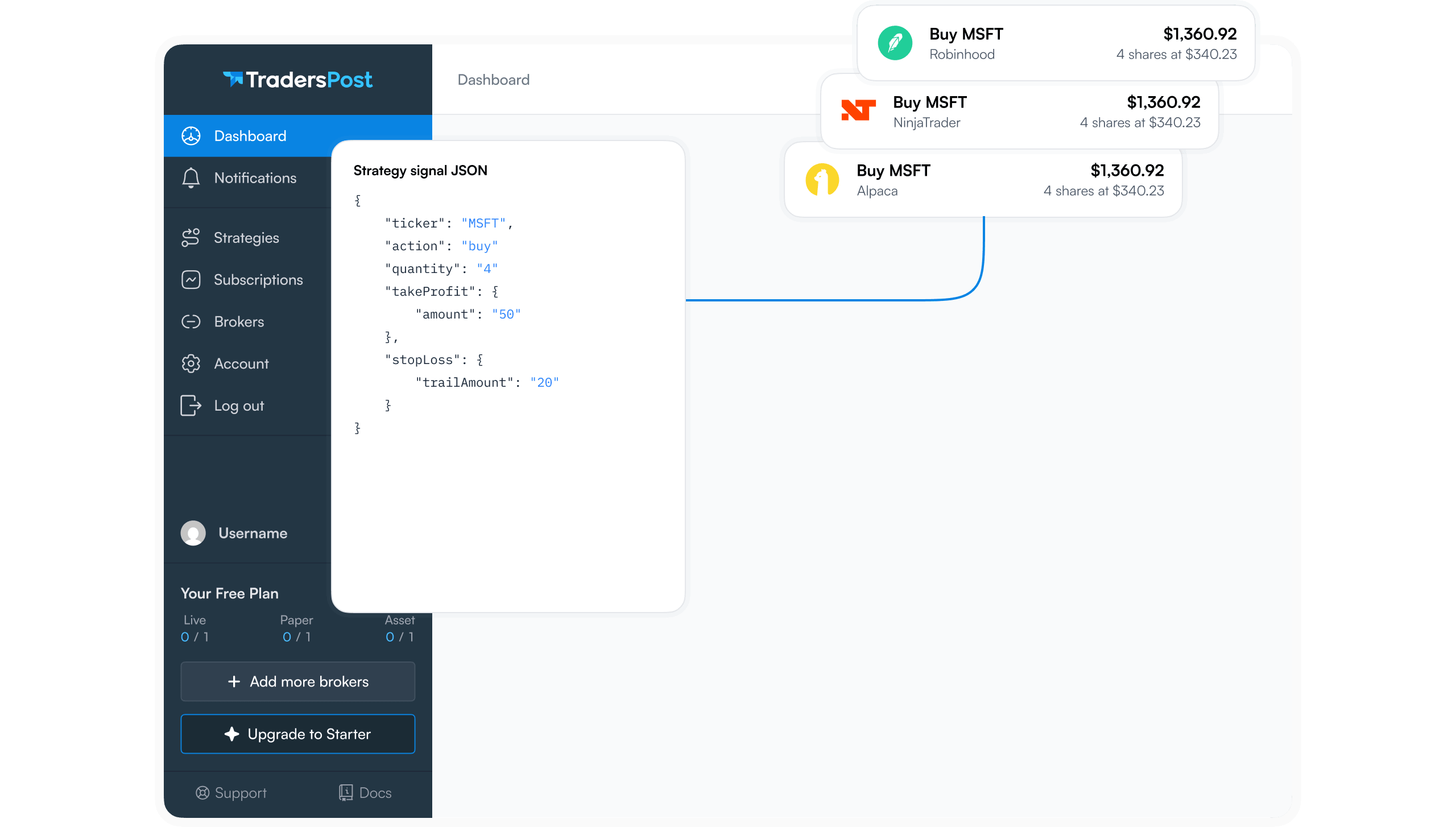
The webhook payload sent to TradersPost can include workflow-specific details such as:3
- Action: buy, sell, sell short, or buy to cover
- Ticker: the symbol confirmed by the chart
- Order type: market, limit, stop, or stop-limit where supported
- Strategy fields: entry price, stop price, profit target, position-risk amount, or setup identifier
Use unambiguous alert logic. A breakout condition that remains true for five bars should not create five entries. Design the script to alert only on the transition into a valid state, and include rules that prevent new signals while a position is already open. Test alerts during market hours using paper trading or a controlled environment, then review TradingView alert history, TradersPost logs, broker acknowledgements, fills, and rejected orders before enabling live capital.
Use TrendSpider Alerts for Multi-Factor Chart Conditions
TrendSpider is useful when the strategy depends on automated trendlines, multi-factor technical conditions, or rule-based chart analysis. A practical workflow is: a social scanner identifies a ticker with accelerating discussion, the symbol enters a focused watchlist, TrendSpider confirms a breakout through an automated resistance line with elevated volume and a qualifying trend condition, then a webhook alert routes the validated signal to TradersPost.
For instance, social interest may identify ABCD before the open. The technical alert could require a break above TrendSpider-detected resistance, volume above the 30-period average, price above the anchored VWAP, and a daily trend filter showing higher highs and higher lows. The social signal determines what to monitor. The technical strategy determines whether an order is sent.
Apply Position Sizing, Exits, and Safeguards Automatically
Size positions from defined dollar risk, not from conviction or social excitement.4 If maximum risk is $300, planned entry is $50.00, and the stop is $48.50, risk per share is $1.50. The maximum size is 200 shares, calculated as $300 divided by $1.50. Cap that quantity further if it exceeds your maximum position value or liquidity limits.
- Set a maximum dollar amount or percentage of equity per position.
- Set a maximum daily loss that disables new entries after the threshold is reached.
- Limit concurrent positions, especially for correlated momentum names.
- Block duplicate entries for the same ticker and direction.
- Define bracket-style exits: stop loss, profit target, and, where supported, time-based exits.5
Automation can enforce risk controls consistently, but it cannot rescue a poor rule set. A flawed entry condition, oversized risk parameter, or unrealistic stop can scale losses faster when connected to automatic execution. Validate each component through historical testing, forward observation, and small-size live verification before increasing allocation.
Paper Test a Social Sentiment Strategy Before Going Live
Test the Complete Workflow, Not Just the Chart Idea
A social sentiment strategy is only valid if the entire decision and execution chain works under realistic conditions. Paper trading should begin at the data source, not at the point where a clean chart setup is already visible. Test how posts are discovered, deduplicated, scored, and assigned to symbols. Then test watchlist creation, technical confirmation, alert routing, broker order logic, stop placement, and exit handling as one connected workflow.
For example, a Reddit mention-rate alert may identify a small-cap ticker at 10:12 a.m., but the strategy must specify whether it enters only after a five-minute breakout closes above VWAP, whether relative volume exceeds a threshold, and whether the spread remains below a defined percentage. Record the simulated fill at the price that would have been realistically available after the alert, not the last traded price shown at signal generation.
- Log alert timestamp, detection latency, confirmation timestamp, intended entry, simulated fill, bid-ask spread, and actual volume at entry.
- Test stop behavior during halts, rapid reversals, thin liquidity, and opening-range volatility.
- Track false positives, including symbols with surging mention volume that fail to break resistance, lose VWAP immediately, or reverse after an initial spike.
- Flag cases where the scanner identified the opportunity correctly but the trade was not executable at the modeled price or size.
Measure Performance by Setup Type
Do not combine all social signals into one performance statistic. Reddit-driven retail interest, X news-reaction signals, earnings-related sentiment shifts, and low-float momentum campaigns have different liquidity profiles, catalyst durability, and reversal risks. Maintain separate tags and performance reports for each setup type.
For every completed paper trade, record win rate, average win, average loss, expectancy, maximum drawdown, slippage, hold time, time of day, market capitalization, float, and market regime. Segment results by broad-market conditions such as index trend, elevated volatility, earnings season, and risk-off sessions. A strategy that performs well in a strong speculative tape may fail when liquidity contracts or short-sale constraints become binding.
Run a direct comparison between immediate social-signal entries and technically confirmed entries. For instance, compare buying at the first qualified X sentiment alert against waiting for a five-minute close above the premarket high with volume confirmation. The delayed entry may reduce headline-driven gains, but it can also materially lower false-positive frequency and improve average loss.
Use a broad sample across changing conditions. Ten profitable viral trades do not establish an edge. A practical minimum is enough observations within each setup category to evaluate whether the estimated expectancy remains positive after modeled slippage and adverse fills.
Create Clear Criteria for Moving From Paper to Live Trading
Define promotion criteria before reviewing results. Moving live should require consistent rule adherence, stable alert delivery, verified symbol mapping, acceptable simulated drawdown, and documented execution limitations. If the strategy depends on entering within seconds of an alert but the data pipeline, broker API, or order-routing logic cannot reliably meet that requirement, the paper result is not deployable.
- Require a predefined sample size and positive net expectancy after conservative slippage assumptions.
- Verify that stops, bracket orders, cancel-replace logic, and position reconciliation behave correctly during volatile sessions.
- Start live at reduced size, using the same entry, risk, and exit rules tested in simulation.
- Review results on a scheduled basis, such as monthly or after a fixed trade count, rather than rewriting rules after every loss.
Live deployment is a validation phase, not permission to abandon the test protocol. Keep paper and live logs side by side to identify where real fills, latency, and liquidity differ from the simulated workflow.
Frequently Asked Questions
What is social media sentiment trading?
Social media sentiment trading uses online discussion trends, post volume, engagement, and the tone of conversations to identify potential trading opportunities. Traders may monitor platforms such as Reddit, X, Discord, and Stocktwits to find stocks receiving unusual attention. Sentiment is most useful for generating watchlist ideas, not as a standalone buy or sell signal. Confirm ideas with price action, volume, trend direction, and clear risk-management rules.
Can Reddit and WallStreetBets move stock prices?
Yes, concentrated retail attention on Reddit and WallStreetBets can increase trading volume, options activity, and short-term volatility. This is especially common in heavily discussed stocks, low-float names, and securities with high short interest. However, a Reddit trend does not guarantee a sustained price move. Traders who enter after a stock has already surged may face significant reversal risk, slippage, or sharp losses.
How do traders confirm a social sentiment signal?
Traders commonly confirm sentiment-driven ideas with technical and market-based signals. Useful confirmations can include a breakout above defined resistance, expanding relative volume, price holding above VWAP, or alignment with key moving averages. Broader market and sector strength can also improve the quality of a setup. Before entering, define the entry trigger, stop-loss level, profit target, and position size so the trade follows a planned risk framework.
Can I automate a social sentiment trading strategy with TradersPost?
A practical approach is to use social sentiment for research and watchlist selection, then automate chart-based confirmations from TradingView or TrendSpider through webhook alerts. For example, sentiment may identify a stock to watch, while a breakout and volume rule triggers the actual trade. TradersPost can route rule-based alerts to a connected broker. Consider paper testing the workflow first to evaluate alerts, execution behavior, and risk settings before trading live.6
What are the biggest risks of social media sentiment trading?
Major risks include herd behavior, misinformation, coordinated pump dynamics, low liquidity, wide bid-ask spreads, trading halts, and sharp reversals. Sentiment can change quickly, and traders may enter after a move is already extended rather than near a defined setup. Strict position sizing, predefined exits, and paper testing can help manage these risks. However, no strategy or automation setup can eliminate losses or guarantee profitable results.
Conclusion
Social media sentiment can reveal shifts in crowd attention before they appear fully in price, but it is most useful as a confirming input rather than a standalone trading signal. In 2026, successful sentiment traders will focus on source quality, unusual changes in discussion volume, and whether sentiment aligns with trend, momentum, volatility, and defined risk parameters.
The goal is not to react to every viral post. It is to build a repeatable process that converts sentiment data into testable rules, then executes those rules consistently. Before committing capital, paper test your sentiment-plus-technical strategy with TradersPost and evaluate how it performs across different market conditions. When your rules are validated, TradersPost can help automate execution so you can act with greater speed, discipline, and confidence. Start testing your strategy today and take the next step toward a more systematic trading workflow.
References
1 Seeking Alpha, Wendy's (WEN) meme rally on WallStreetBets
2 TradersPost Docs, TradingView Signal Source
3 TradersPost Docs, Webhooks
4 TradersPost Docs, Position Sizing
5 TradersPost Docs, Order Classes
6 TradersPost Docs, Paper Trading