TradingView AI Chart Copilot Review
TradingView AI Chart Copilot is a free Chrome extension for conversational chart analysis, alerts, and scanning. Full review covering setup, features, and limitations.

Marketing

Bottom Line
- AI Chart Copilot is a free Chrome extension in public beta with 15 AI requests per day, no credit card required
- It reads your chart in real time and can run technical analysis, manage alerts, scan watchlists, and draw support/resistance lines via natural language
- The extension cannot place live trades or run backtests, but you can bridge that gap by pairing TradingView alerts with TradersPost for automated execution
- Independent reviews note that Pine Script code generation is unreliable in the current beta
- At zero cost it undercuts competitors like TrendSpider and Trade Ideas, though those platforms offer deeper analysis and backtesting capabilities
-
Current pricing places TrendSpider's annual-billing entry plan at about $82 rather than $52, so the competitor comparison now reflects that price while the rest of the guidance remains accurate.
TradingView AI Chart Copilot entered public beta on April 2, 2026, giving traders a way to interact with their charts using plain English instead of menus and mouse clicks.1 The tool is a Chrome browser extension that reads your current chart state and responds to natural-language questions about price action, indicators, and market data. It can also create alerts, draw support and resistance levels, and scan your watchlists for setups.
After spending time with the extension across multiple symbols and timeframes, this review covers exactly what AI Chart Copilot can and cannot do, how it compares to paid AI trading tools, and how to connect it to actual trade execution through automated trading platforms.
What Is AI Chart Copilot
AI Chart Copilot is a Chrome browser extension officially called "TradingView Remix: AI Chart Copilot." It was developed by a third-party team at tvremix.xyz and promoted on TradingView's official blog as part of the platform's broader push into AI-assisted analysis.1 The extension sits alongside your TradingView chart and provides a chat interface where you can ask questions, request analysis, or issue commands in natural language.
Unlike TradingView's built-in features, Chart Copilot is not a native part of the platform. It runs as a browser extension that reads your chart's current state in real time, including the active symbol, timeframe, applied indicators, and visible price range. TradingView has stated it plans to integrate the functionality natively after the beta period concludes.4
As of this review, the extension has approximately 10,000 installs on the Chrome Web Store with a 4.4 out of 5 rating from roughly 20 reviews.2
Setup and Compatibility
Getting started takes about 30 seconds. Install the extension from the Chrome Web Store, open any TradingView chart, click the Copilot icon in your browser toolbar, and sign in with your Google account. There is no separate account to create and no credit card required.2
The extension works on any Chromium-based browser, which includes Google Chrome, Microsoft Edge, Opera, Brave, and Vivaldi. It does not work on Firefox or Safari, which rules out a significant portion of Mac users who default to Safari.1
Free Beta Limits
The current beta offers 15 AI requests per day at no cost. The counter resets at midnight UTC. The native Copilot is available on Essential, Plus, Premium, and Ultimate plans and requires a separate paid add-on5.1 For casual analysis this daily allowance is workable, but active traders who want to query the AI across multiple symbols and timeframes throughout a session will burn through 15 requests quickly.
Core Features
Chart Copilot covers six main capability areas. Each one works through the same chat interface, so you type what you want in plain English and the extension responds with analysis, actions, or both.
Technical Analysis
You can ask Chart Copilot to analyze common technical indicators including moving averages, RSI, MACD, and support and resistance levels. The extension reads whatever indicators are already on your chart and incorporates them into its response. You can also ask it to identify patterns or summarize the current technical picture for a given symbol.
For example, asking "What does the RSI and MACD say about AAPL on the daily chart?" returns a summary of both indicators with an interpretation of whether momentum is bullish or bearish. The analysis is roughly equivalent to what a knowledgeable trader would produce by eyeballing the same chart, but it saves time when scanning across multiple tickers.
Chart Automation
Rather than clicking through menus, you can tell Chart Copilot to switch symbols, change timeframes, or add and remove indicators using natural language. Saying "Switch to TSLA 15-minute chart with Bollinger Bands" executes those changes directly on your TradingView chart.3
This is particularly useful during fast-moving market sessions when navigating TradingView's charting tools manually can feel slow. Voice-to-text combined with Chart Copilot could eventually make hands-free chart navigation practical, though the extension does not have voice input built in yet.
Alert Management
Chart Copilot can create, pause, and delete TradingView alerts through the chat interface. You can say "Set an alert when SPY crosses above 520" and the extension creates the corresponding alert without you opening the alert dialog manually.3
This is one of the most practically useful features in the extension. Alert creation on TradingView normally requires several clicks and field selections. Being able to create alerts conversationally, especially conditional ones with multiple criteria, removes friction from a task that traders repeat dozens of times per week.
News and Fundamentals
The extension can pull fundamental data like P/E ratio, earnings per share, and recent headlines for the symbol on your chart. Asking "What are the latest earnings for MSFT?" returns a summary without leaving the charting interface.2
This saves a tab switch to a financial data site, though the depth of fundamental data is limited compared to dedicated platforms. It works best as a quick sanity check rather than deep fundamental research.
Watchlist Scanning
You can ask Chart Copilot to scan your watchlist or screen for stocks matching certain criteria. Requests like "Which stocks in my watchlist are near 52-week highs?" or "Show me high-volume tech stocks" return filtered results based on the criteria you specify.2
The scanning is conversational rather than rule-based, which makes it more flexible than traditional screeners for ad-hoc queries but less precise for repeatable, quantitative screens.
Drawing Tools
Chart Copilot can draw support and resistance lines, Fibonacci retracements, and trendlines on your chart through natural-language commands. Saying "Draw Fibonacci retracement from the March low to the April high" places the drawing directly on your chart.3
This feature works well for standard S/R levels but can be inconsistent with more complex drawings. The AI sometimes picks slightly different anchor points than you would choose manually, so you may need to adjust the results.
What It Cannot Do
Understanding Chart Copilot's limitations is just as important as knowing its features, especially if you are evaluating it as a potential replacement for other tools in your workflow.
No Live Trading
Chart Copilot cannot place trades through any broker account. It is purely an analysis and charting tool. If you ask it to buy or sell a position, it will not execute any order.3 This is the most significant limitation for traders who want an end-to-end AI assistant.
No Backtesting
The extension cannot run backtests on strategies. It can analyze what indicators and price action show right now, but it cannot simulate how a strategy would have performed over historical data. For backtesting, you still need Pine Script strategies or external tools.
Unreliable Pine Script Generation
The Chrome Web Store listing mentions Pine Script assistance as a feature, and the extension will attempt to generate Pine Script code if you ask. However, independent testing by Pineify found that the code generation is unreliable in the current beta, producing scripts that often contain errors or do not compile without manual fixes.3 Traders should not depend on Chart Copilot for production-ready Pine Script code at this stage.
Browser Lock-In
The Chromium-only requirement means traders who use Firefox or Safari cannot access Chart Copilot at all. The TradingView desktop app and mobile apps are also unsupported since the tool runs as a browser extension. The native Copilot is also available in the TradingView desktop app5.1
Bridging the Execution Gap
Chart Copilot's inability to place trades does not have to be a dead end. The extension's alert management feature creates a natural bridge to automated execution. Here is how the workflow connects.
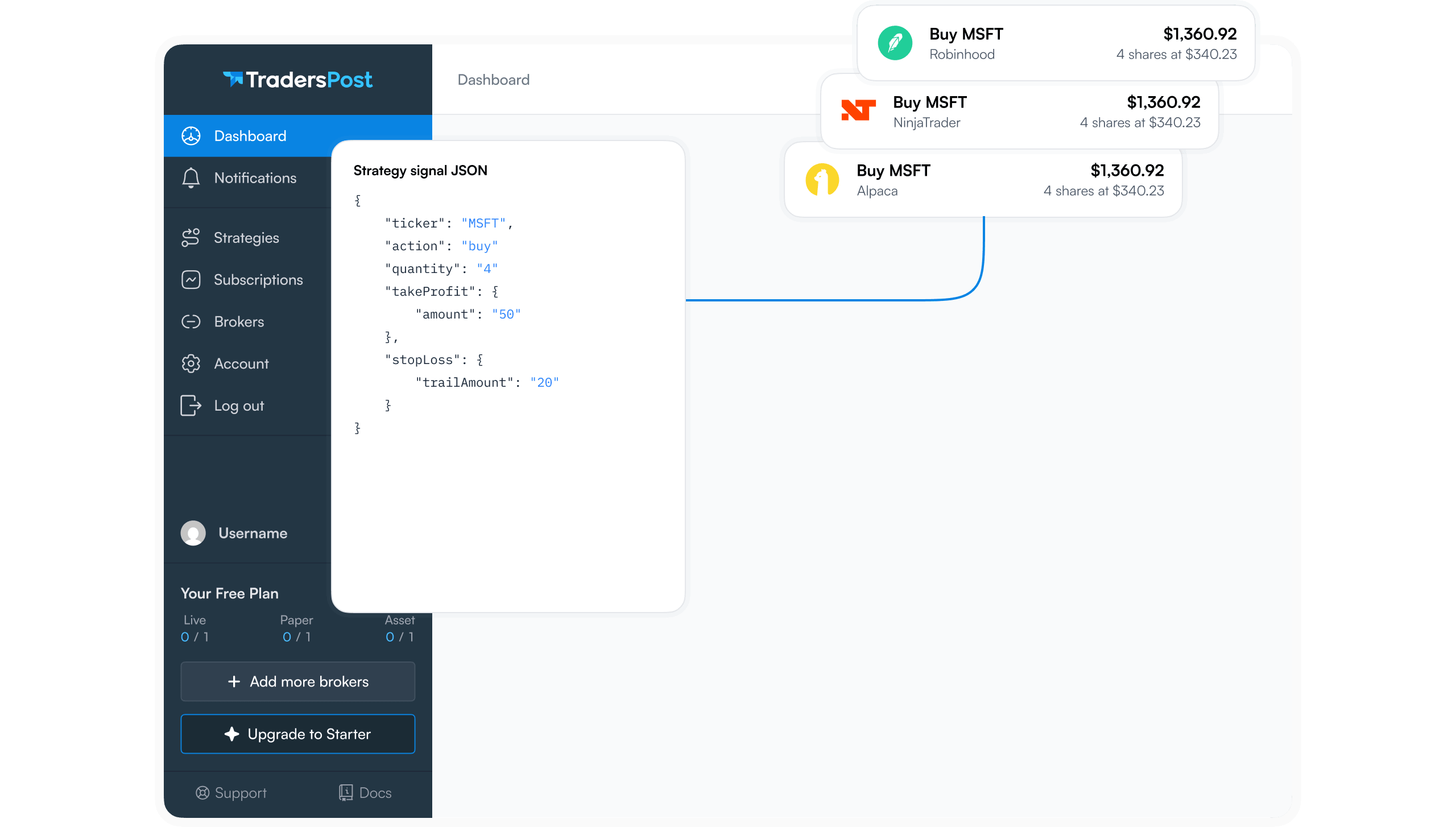
When you use Chart Copilot to create a TradingView alert, that alert can include a webhook URL. When the alert fires, TradingView sends the webhook payload to an automated trading platform like TradersPost, which then executes the corresponding order through your connected broker account. This means you can use Copilot's conversational interface to set up alerts and let the automation layer handle the actual buying and selling.
For example, you could tell Chart Copilot: "Set an alert when QQQ RSI drops below 30 on the 4-hour chart." Once that alert is created with a webhook pointed at TradersPost, the system will automatically execute your predefined strategy when the condition is met. The Copilot handles the analysis and alert creation, TradingView handles the monitoring, and TradersPost handles the execution.
This three-step chain solves the execution problem without requiring Chart Copilot to ever touch your brokerage account. It also means you can combine Copilot's natural-language alert creation with the full range of brokers that TradersPost supports, including those available through its AI-enhanced trading strategies.
Competitor Comparison
Chart Copilot is not the only AI-powered tool for traders, but it occupies a unique position in the market at its current price point of zero dollars.
TrendSpider
TrendSpider offers automated technical analysis including pattern recognition, multi-timeframe analysis, and automated trendline detection. Plans start at approximately $82 per month when billed annually6. TrendSpider provides backtesting capabilities and more sophisticated analysis than Chart Copilot, but it runs as a separate platform rather than sitting inside TradingView. Traders who already have TradingView workflows may not want to switch their entire charting setup.
Trade Ideas Holly AI
Trade Ideas uses an AI system called Holly that generates daily trade ideas based on backtested strategies. The Premium plan with full Holly AI access runs approximately $178 per month when billed annually. Holly AI is more opinionated than Chart Copilot. It tells you what to trade rather than answering questions about what you are already looking at. This makes it a better fit for traders who want AI-generated trade ideas rather than AI-assisted chart analysis.
How They Compare
- Chart Copilot is free (15 requests/day), TrendSpider starts at ~$82/month, Trade Ideas Premium is ~$178/month6
- Chart Copilot works inside TradingView; the others require separate platforms or subscriptions
- TrendSpider and Trade Ideas both offer backtesting; Chart Copilot does not
- Trade Ideas generates its own trade signals; Chart Copilot only analyzes what you ask about
- Chart Copilot is the only option that integrates directly with TradingView charts in real time
For traders already committed to TradingView, Chart Copilot is a low-risk addition that costs nothing to try. For traders who need deeper AI analysis, backtesting, or autonomous trade idea generation, the paid alternatives deliver more powerful capabilities at a correspondingly higher price.
Who Should Use It
Chart Copilot fits best into workflows where speed and convenience matter more than analytical depth. Here are the use cases where it adds the most value.
Discretionary traders who already use TradingView and want a faster way to check indicators, create alerts, and scan watchlists without clicking through multiple menus. The conversational interface removes friction from tasks they already perform manually.
Multi-ticker scanners who need quick technical summaries across a large number of symbols during market hours. Asking Chart Copilot for a 30-second summary of each ticker is faster than manually reviewing indicators on every chart.
Traders learning technical analysis who want an AI that explains what indicators are showing in plain language. The extension acts as a real-time tutor that references your actual chart rather than textbook examples.
Alert-heavy workflows where creating and managing dozens of alerts per week is part of the routine. The conversational alert creation is genuinely faster than the standard TradingView dialog, and it pairs naturally with webhook-based automation tools for execution.
Limitations to Watch
Beyond the feature gaps already covered, there are a few practical concerns to keep in mind during the beta period.
The 15-request daily limit can feel restrictive during active trading sessions. Each question, command, or analysis request counts toward the cap, so you need to be intentional about what you ask. Burning requests on trivial queries means you may not have capacity left when you need a real analysis during market hours.
The extension is developed by a third party, not TradingView itself. While TradingView has promoted it on their official blog, the long-term support and development roadmap depends on the tvremix.xyz team.1 TradingView's stated plan to bring the functionality in-house post-beta could mean the extension eventually becomes redundant or is replaced by a native feature with different capabilities.4
There is no paid tier announced yet, which means no guaranteed uptime, no SLA, and no premium support. This is fine for supplemental analysis but not something to build critical trading infrastructure around in its current state.
The Verdict
TradingView AI Chart Copilot is a useful convenience tool that does a few things well: quick technical summaries, conversational alert management, and basic watchlist scanning. It is not a replacement for proper backtesting, dedicated screening platforms, or execution systems. Its greatest strength is that it costs nothing and installs in 30 seconds, making it a zero-risk experiment for any TradingView user on a Chromium browser.
The most practical workflow combines Chart Copilot's analysis and alert creation with a webhook-based execution layer. Use the AI to monitor charts and set up alerts, then let those alerts trigger automated trades through TradersPost. This gives you the conversational convenience of AI chart analysis paired with the reliable execution that Copilot itself cannot provide.
As a beta product, Chart Copilot will continue to evolve. The current 15-request limit and Chrome-only availability are likely temporary constraints. Whether TradingView brings this functionality natively into the platform or the third-party extension matures into a more robust tool, the concept of conversational chart interaction is clearly the direction that trading platforms are heading.
References
1 TradingView Blog: AI Chart Copilot Public Beta
2 Chrome Web Store: TradingView Remix AI Chart Copilot
3 Pineify: TradingView AI Chart Copilot Independent Review
4 FX News Group: TradingView Introduces AI Chart Copilot
5 tradingview.com, Getting started with AI Copilot
6 daytradingz.com, TrendSpider vs Trade Ideas: Which Scanner Wins in 2026?