AI Agents and Agentic Trading Explained
Agentic trading in 2026: how Interactive Brokers, Robinhood, and Alpaca let AI agents trade, and where a deterministic execution layer fits in.

Marketing

Agentic trading uses an AI system to research markets, make decisions, or configure trade conditions while a separate execution system controls whether and how an order reaches a broker. FINRA describes AI agents as systems that can autonomously perform and complete tasks for a user, planning, making decisions, and acting toward goals without predefined rules or logic programming.1
This article reflects the market as of October 8, 2026. AI products changed quickly during 2026: Google shut down Project Mariner in May, and OpenAI's ChatGPT Atlas browser stopped working in August. Broker integrations, supported assets, and approval rules moved just as fast, so check current documentation before connecting an agent to a live account.
You will learn how broker-controlled agents differ from webhook-based automation, how Interactive Brokers, Robinhood, and Alpaca represent distinct execution designs, what an independent AI workflow can send to an execution layer, and which guardrails should remain outside the model.
What Agentic Trading Means Now
Defining Agentic Trading Simply
An AI agent does more than answer a prompt. It can choose tools, perform a sequence of tasks, inspect results, and adjust its next action. FINRA specifically identifies planning, decision-making, environmental interaction, and autonomous action as agent capabilities.1
In trading, that autonomy can cover research, screening, strategy configuration, or drafting an order. It does not have to include unrestricted brokerage access. A safer architecture separates the probabilistic decision layer from the deterministic execution layer. The model proposes an action, while another system validates fields, applies account settings, and submits or rejects the order.
Why 2026 Is Pivotal
Robinhood launched Agentic Trading and the Agentic Credit Card on May 27, 2026. Its trading product initially entered beta with equities, while options, crypto, event contracts, and futures were identified for later expansion.2 Alpaca also made direct agent access practical through an MCP server with 65 tools and paper trading enabled by default.3
Interactive Brokers announced its own agentic trading on June 1, 2026, through a direct Claude integration offered in Claude's certified connector marketplace, with no added fees for existing clients. On June 22, 2026, it added ChatGPT and Grok and extended coverage to options, futures, and futures options. Interactive Brokers and Robinhood both separate the AI layer from the order step, but they put the control in different places.
The Decide-Execute Split
The central design choice is where authority changes hands. One system interprets language or market data. Another system checks whether an order is permitted, properly formed, timely, and within the account's configured limits.
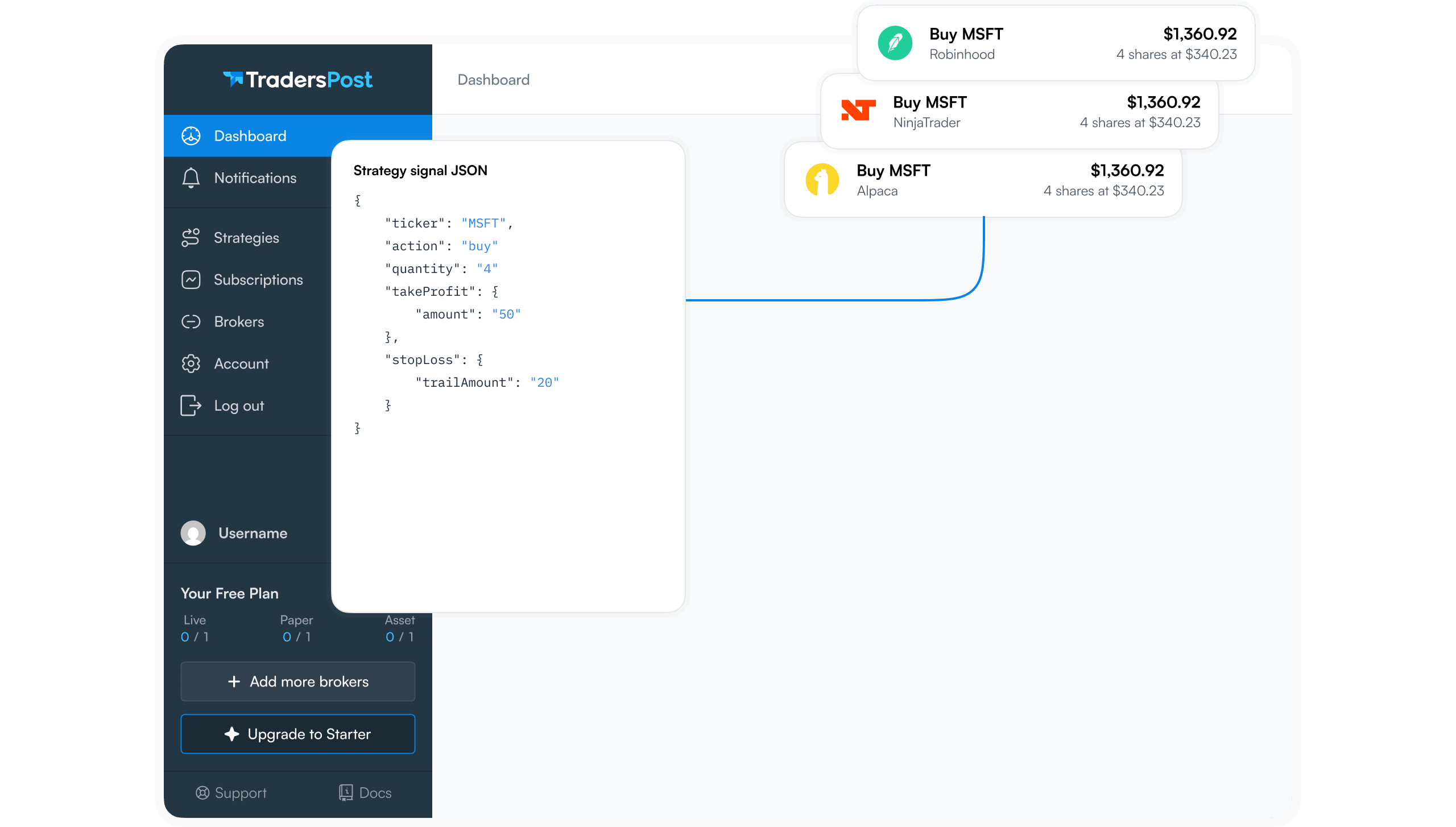
For independent traders, TradersPost can occupy the execution side of that split. A trader-operated AI tool sends a webhook signal, and the platform processes that signal for a connected broker. The agent does not need to receive the brokerage credentials used by the downstream connection.
This separation also makes failures easier to diagnose. A trader can distinguish between a bad model decision, a malformed signal, a rejected execution rule, and a broker response rather than treating the entire workflow as one opaque agent.
Two Broker Designs For AI Agents
Interactive Brokers' Approval Model
An approve-every-order model treats the AI as an instruction drafter rather than the final authority. At Interactive Brokers, AI-drafted instructions appear in a dedicated AI Instructions tab on the Orders and Trades page, and the client reviews and approves each one before it is submitted to the market. At launch this covered equities and ETFs with market and limit orders. After the June 22 expansion to more assistants and asset classes, every instruction still goes through the same tab.
Interactive Brokers also states that no API keys or passwords are shared with the AI provider. The approval step adds friction, but that friction is useful when an output could move capital. Confirm the current list of assistants, assets, and order types before you connect one.
Robinhood's Fenced-Account Model
Robinhood uses a different control boundary. Its launch design placed the agent in a dedicated agentic trading account, separate from the rest of the portfolio and limited to deposited funds. Users receive a push notification for agent trades, can inspect a real-time activity feed, and can disconnect the agent.2
The account fence does not equal narrow data access. Robinhood's current support page says a connected external agent can read all Robinhood accounts, account numbers, positions, balances, transactions, and order history, although it can place trades only in the dedicated agentic account. It can also trade without confirmation when instructed to act without asking.4
That makes the funding limit only one part of the risk review. Traders should separately evaluate trading authority, readable data, notification speed, and the process for disconnecting a malfunctioning agent.
Alpaca's Paper-Default MCP Server
Alpaca's V2 MCP server exposes 65 tools for account information, positions, stock, option and crypto orders, watchlists, and market data. Orders placed through those tools execute directly against Alpaca's Trading API.3
New configurations default to paper trading. Live use requires setting ALPACA_PAPER_TRADE=false and supplying live credentials. Alpaca advises users to review suggested orders before confirmation and never paste API keys into a chat.3
Toolset filtering offers another useful control. A trader can enable account and market-data tools without enabling trading tools, then add order capabilities only after the read-only workflow behaves as expected.
Three Routes To Agentic Automation
Local Models That Post Signals
A local model can evaluate trader-supplied data and send a small JSON message to a strategy webhook. It does not need direct broker access. The downstream system can determine position size, apply subscription settings, and decide whether to submit the order.
For example, the agent could produce:
{"ticker":"AAPL","action":"buy","test":true}This architecture is useful when data privacy or model control matters. See the companion guide to local AI models sending webhook signals for the complete workflow.
Voice Assistants Setting Conditions
A voice assistant or chatbot can translate a plain-language instruction into a watch condition. A charting platform or broker then monitors that condition. The assistant configures the rule, but a separate system determines when the condition becomes true.
This distinction prevents a casual conversation from becoming an immediate market order. See the guide to voice assistants and chatbot trade conditions for implementation patterns.
Chat Research Ending In Alerts
A trader can use a chat interface with market data to investigate a setup, then express the result as a Pine Script condition. The conversation supports research, but the TradingView alert becomes the machine-readable event that starts downstream processing.
This route preserves a testable boundary. The Pine condition can be inspected on the chart, run through TradingView's strategy report if it is written as a strategy, and changed without giving the research assistant order authority.
What TradersPost Accepts From AI
Minimum Payload Requirements
The minimum webhook payload contains ticker and action. Any trader-controlled tool capable of sending an HTTP POST can use that interface without a dedicated AI SDK. A local model, chatbot workflow, or conventional script can therefore produce the same signal format.
Optional fields can specify details such as quantity, order type, time, stop loss, or take profit. If quantity is omitted, it is calculated from the strategy subscription settings or defaults to one. Signal behavior still depends on the trader's configured subscription and connected broker.
Testing Before Going Live
Set test to true to process a test signal without sending orders to the broker. This verifies the endpoint, JSON structure, ticker, action, and processing path before capital is involved.
Where the connected broker integration offers paper mode, a paper account can test more of the pipeline. The sequence should be payload validation, test signals, paper execution, manual review, and only then a deliberately limited live rollout.
Guarding Against Stale Signals
The rejectAfter field sets a maximum signal age of 1 to 30 seconds. Age is measured from the ISO-8601 time field when supplied, or from webhook receipt otherwise. The field requires signal overrides or the matching per-field override in the strategy subscription.
This check prevents an agent decision from being executed after delays in model processing, networking, or an upstream job queue. It is not a substitute for strategy logic, but it creates a hard limit on how old an actionable message may be.
Webhook traffic is limited to 60 requests per minute and 500 per hour. The interface is intended for strategy automation, not high-frequency order flow.
To test the complete pattern, connect your own AI tool to a TradersPost strategy webhook and send a signal with test set to true. Inspect the result before enabling any broker submission. The AI agentic traders use case provides a practical starting point.
Guardrails For Every Agentic Route
Never Share Broker Credentials
Credentials should live in an environment variable, operating-system secret store, OAuth flow, or downstream execution system. They should not appear in prompts, chat history, logs, or model memory. Alpaca explicitly instructs users never to paste API keys into chat.3
OWASP recommends minimizing extension permissions and executing actions in the user's own authorization context. It also recommends enforcing authorization in downstream systems instead of trusting the model to decide whether an action is allowed.5
Start On Paper First
Paper trading should test the full sequence, not merely whether the model can generate valid JSON. Check duplicate signals, malformed symbols, stale decisions, unexpected retries, rejected orders, partial fills, exits, and behavior after a restart.
FINRA recommends robust testing of generative AI tools for privacy, integrity, reliability, accuracy, capabilities, limitations, and performance before operational reliance.1
- Record every prompt, decision, signal, and response.
- Test invalid and adversarial instructions.
- Set narrow allowed symbols and sides.
- Verify a manual kill switch.
- Rehearse recovery from duplicate submissions.
Keep A Human Approval Step
OWASP recommends human approval before high-impact actions and notes that approval can be implemented in the downstream system rather than inside the model application.5 This is stronger than asking the model to verify its own answer. The Interactive Brokers AI Instructions tab is an example of approval built into the broker rather than the model.
Robinhood permits trading without per-order confirmation when the user instructs the agent to act without asking. Its alternative controls include the dedicated account, notifications, an activity feed, and disconnection.4 Traders choosing that design should keep the account allocation small enough to match the risk they intentionally delegate.
Regulatory Context For AI Agents
FINRA's New Agent Definition
FINRA's 2026 report identifies autonomy without human validation, action beyond intended scope, hard-to-trace multi-step reasoning, sensitive data handling, and insufficient domain knowledge as agent-specific risks. It asks firms to consider human-in-the-loop oversight, action tracking, access monitoring, and guardrails that restrict agent behavior.1
For an independent trader, the practical lesson is similar: define exactly what the agent may read, what it may propose, and what it may execute. Log the model version and inputs so an unexpected order can be reconstructed later.
OWASP's Excessive Agency Risk
OWASP defines Excessive Agency as the ability of an LLM-based system to perform damaging actions after unexpected, ambiguous, or manipulated output. The main causes are excessive functionality, excessive permissions, and excessive autonomy.5
Applied to trading, an agent that only needs quotes should not receive order tools. An agent intended to trade one strategy should not receive unrestricted account functionality. Permission boundaries must be enforced outside the prompt because prompts can be misunderstood or manipulated.
CFTC Warnings On AI Bots
The CFTC warns that AI cannot predict the future or sudden market changes. It also identifies promises of unreasonably high or guaranteed returns as warning signs in AI bot and signal promotions.6
Its Mirror Trading International case study describes a scheme that stole more than $1.7 billion in bitcoin from at least 23,000 people while promoting a proprietary trading bot and guaranteed returns.6 Agent connectivity changes execution mechanics. It does not make a strategy predictive or eliminate market risk.
Where Agentic Trading Is Headed
TradingView's MCP Server Beta
TradingView launched its MCP Server public beta on September 16, 2026. It works with MCP-compatible clients and requires an Essential or higher plan. The tools can retrieve quotes and price history, run screeners, analyze fundamentals and documents, and manage watchlists and alerts.7
The beta is scoped, with delayed market data, a limited tool list, and possible daily request limits. The announcement describes creating and managing alerts, not placing orders. It also does not publicly establish whether an MCP-created alert can include a webhook URL and custom JSON payload.
Broker Agent Integrations Expanding
Robinhood said at launch that it planned to expand beyond equities to options, crypto, event contracts, and futures.2 Its current support documentation lists a broader collection of agent tools than the original launch post.
This pace makes static comparison tables fragile. Before connecting an agent, recheck supported AI clients, asset classes, order types, approval requirements, data access, and account boundaries.
What To Check Before Connecting
- Does every order require approval, or can the agent trade autonomously?
- Is authority fenced by account, asset, symbol, side, or deposited funds?
- Can the complete workflow run in test or paper mode?
- Which accounts, balances, positions, and histories can the agent read?
- Where are credentials stored, and how can access be revoked?
- Are prompts, signals, approvals, and broker responses logged?
Robinhood illustrates why trading authority and data authority must be reviewed separately. Its agent may trade only in the dedicated agentic account while retaining read access across all Robinhood accounts and transaction history.4
Bottom Line
- Agentic trading separates AI research or decision-making from controlled order execution.
- Approval-based and fenced-account designs manage autonomy in different ways.
- Credentials, permissions, sizing, and final authorization should remain outside the model.
- Every workflow should pass through test mode, paper trading, and logged review before live use.
- A practical first step is sending a test webhook from your own AI tool and inspecting the result without submitting a broker order.
The useful question is not whether an AI can generate a trade idea. It is whether the surrounding system can reject stale, malformed, unauthorized, or excessive actions consistently. Build that control layer before granting an agent live authority.
Agentic Trading FAQ
What Is Agentic Trading?
Agentic trading uses an AI system to plan or complete trading-related tasks, such as research, condition setup, portfolio analysis, or order drafting. In a controlled design, a separate execution system validates and places the order.
Is Agentic Trading Safe?
It carries execution, model, data, and market risk. Robinhood warns that agentic trading can result in loss of the entire investment and that users assume the risk for agent-executed trades. Least-privilege access, paper testing, account limits, and human approval can reduce operational risk but cannot remove trading risk.
Do E*TRADE Or Fidelity Offer It?
As of October 8, 2026, we found no official agentic trading program from E*TRADE or Fidelity comparable to the Interactive Brokers AI Instructions tab or Robinhood's Agentic Trading. Interactive Brokers and Robinhood are the two retail brokers with public, broker-run agent programs covered here. Confirm current availability directly with each broker, because agent integrations are changing quickly. E*TRADE is a supported TradersPost connection, so a trader can still route webhook signals from their own tools to their own E*TRADE account.
Can AI Create TradingView Alerts?
TradingView's MCP Server beta lets a compatible assistant create and manage alerts from a conversation. The public announcement does not document order placement or confirm that MCP-created alerts can include webhook URLs and custom JSON messages for downstream execution.
What If An Agent Trades Badly?
The trader remains exposed to the resulting loss. Robinhood says users are responsible for monitoring positions and account activity and assume the risk for agent trades. Reduce the risk beforehand with narrow permissions, funding limits, test environments, approval requirements, monitoring, and a tested disconnect process.
References
1 FINRA: GenAI, Continuing and Emerging Trends
2 Robinhood Is Now Open to Agents
3 Alpaca Trading API MCP Server
4 Robinhood Agentic Trading Overview
5 OWASP LLM06:2025 Excessive Agency
6 CFTC: AI Won't Turn Trading Bots Into Money Machines
7 TradingView MCP Server Public Beta