Automated Dip Buying Strategy: Build It for 2026
Build an automated dip buying strategy with clear entry rules, sizing, stops, and webhook execution through TradingView, TrendSpider, and TradersPost.

Marketing

Bottom Line
- An automated dip buying strategy uses predefined rules to identify pullbacks, such as a 3% to 7% decline from a 20-day high or a 1.0 to 2.0 ATR drop from a recent swing high.
- Key components of the strategy include a trend filter, entry trigger, invalidation level, and maximum risk allocation, with examples like buying above a rising 200-day moving average and setting a stop 1.5 ATR below entry.
- ATR-based pullback rules define a dip as a 1.0 to 1.5 ATR decline from the highest high of the prior 10 bars, rejecting signals if the decline exceeds 2.5 ATR.
- Moving-average retest rules may require price to pull back to the 20-period EMA and close back above it, with broader indices like SPY needing to stay above their 200-day moving averages.
- RSI thresholds are used as filters, not triggers, with setups like buying when RSI(2) is below 10 and the next bar closes above the prior high, provided the price is above the 200-day moving average.
Buying a dip is easy to describe and hard to execute when prices are falling, volatility is expanding, and every red candle looks like either an opportunity or a warning. An automated dip buying strategy replaces impulse with predefined rules: what qualifies as a pullback, where an order enters, how much capital is committed, and when the trade is invalidated.
This guide breaks down how to build that system for 2026, from selecting signals such as moving-average pullbacks, RSI thresholds, or support tests to defining position sizing, stop-loss logic, profit targets, and cooldown periods. You will also learn how to turn a chart-based idea into an executable workflow using TradingView or TrendSpider alerts, webhooks, and TradersPost for automated order routing.
The goal is not to buy every decline. It is to create a repeatable process that targets high-quality pullbacks while controlling downside risk when a dip becomes a trend reversal. By the end, you will have a practical framework for testing, refining, and automating entries without surrendering risk management to the algorithm.
What Is an Automated Dip Buying Strategy?
Define a Dip Before You Trade It
A dip is not any red candle or percentage decline. It is a measurable pullback within a defined market and trend context. An automated strategy must distinguish a temporary retracement from a breakdown, a trend reversal, or a persistent downtrend. If the definition cannot be calculated from price, volume, volatility, or indicator data, it cannot be reliably automated.
Common objective dip definitions include:
- Percentage pullback: price declines 3% to 7% from a 20-day high while remaining above a long-term trend filter.
- ATR-based pullback: price declines 1.0 to 2.0 ATR from a recent swing high, accounting for the normal volatility of the symbol.
- Moving-average retest: price returns to, or slightly below, a rising 20-day or 50-day moving average.
- Oversold momentum condition: RSI(2) falls below 10, RSI(14) falls below 35, or a short-term z-score reaches a predefined negative threshold.
For example, a rule might define a valid dip as: price is above the rising 200-day moving average, has declined at least 1.25 ATR from its 10-day high, and closes within 0.5% of the 20-day exponential moving average. The core principle is simple: automation requires rules that can be calculated and repeated without discretionary interpretation.
Why Systematic Dip Buying Beats Emotional Averaging Down
Planned dip buying is fundamentally different from averaging down after an unplanned losing trade. A systematic entry begins with a thesis: the broader trend is intact, the pullback meets quantified conditions, and the strategy has a predefined point at which the thesis is invalidated.
Every automated dip-buying setup should specify four controls: a trend filter, an entry trigger, an invalidation level, and a maximum risk allocation. Without these controls, repeated purchases can increase exposure precisely as evidence against the original trade strengthens.
Consider two cases. In the first, a stock trades above a rising 200-day moving average and pulls back to its rising 20-day moving average after a 6% advance. A system buys only if RSI(2) is below 15 and the next session closes above the prior day’s high. The stop sits 1.5 ATR below entry, and risk is capped at 0.5% of account equity. In the second, a stock breaks below its 50-day and 200-day moving averages, loses major support, and continues making lower lows. Repeatedly buying that decline is not dip buying. It is uncapped averaging down against a deteriorating trend.
The Components of a Repeatable Automated System
A deployable system needs explicit inputs and outputs for every decision. At minimum, define:
- Market and symbol universe: for example, liquid US equities with average daily dollar volume above $20 million.
- Trend filter: such as close above the 200-day moving average and 50-day moving average above the 200-day moving average.
- Dip definition and confirmation: a 1 ATR pullback to the 20-day EMA, followed by a bullish close or volume-confirmed reversal.
- Position size: fixed dollar allocation, volatility-adjusted shares, or a risk-based calculation using stop distance.
- Stop-loss and profit-taking rule: for example, exit below 1.5 ATR, scale out at the prior swing high, or trail a 10-day low.
- Alert automation: scanner conditions, platform alerts, webhook payloads, and broker-side order handling.
The strategy must also define when not to buy dips: during low-liquidity sessions, immediately before earnings, after abnormal gap-down news, or when a broad market filter such as the S&P 500 below its 200-day moving average is bearish. These exclusions are part of the system, not optional discretion.
Choose a Rule-Based Definition of a Dip
ATR-Based Pullback Rules
Average True Range, or ATR, measures recent price movement in the instrument’s own volatility units. This makes it useful for defining whether a pullback is substantial enough to qualify as a dip without applying the same percentage threshold to every market. A 2% decline may be routine for a crypto asset but unusually large for a broad-market ETF.
A concrete swing-trading rule could be:
- Require the close to be above a rising 50-period moving average.
- Calculate the highest high of the prior 10 completed bars.
- Consider a long setup only when the current low is 1.0 to 1.5 ATR below that 10-bar high.
- Reject the signal if the decline from the 10-bar high exceeds 2.5 ATR.
The maximum-pullback rule is important. A 1.2 ATR retracement may be normal profit-taking within an uptrend, while a 3 ATR decline can indicate a broken trend, earnings shock, liquidation event, or regime change. For automation, calculate ATR using a fixed lookback, such as ATR(14), and define whether the trigger uses intrabar lows or completed-bar closes.
Moving-Average Retest Rules
Moving averages can define both the trend condition and the expected retracement zone. For example, an automated long rule might require price to trade above a rising 50-period simple moving average, pull back to the 20-period exponential moving average, then close back above the 20 EMA. The retest identifies a potential dip, while the close above the EMA confirms that buyers regained short-term control.
- Require the 20 EMA to remain above the 50 SMA.
- Require the broader index, such as SPY, to close above its 200-day moving average.
- Ignore entries when the 50 SMA is flat or declining.
Buying the first touch of the moving average produces earlier entries but exposes the strategy to continued downside. Waiting for a bullish reclaim candle, such as a close back above the 20 EMA after trading below it, sacrifices some entry price in exchange for confirmation. These are distinct setups and should be tested separately.
RSI Threshold and Momentum Rules
RSI is most useful as a short-term exhaustion filter within an established uptrend. An oversold reading alone is not a long signal, because RSI can remain depressed while an asset trends sharply lower. Combine it with higher-timeframe structure and a price-based confirmation.
A specific daily mean-reversion rule is: buy only when the daily close is above the 200-day moving average, RSI(2) closes below 10, and the next daily bar closes above the prior bar’s high. The 200-day average filters for long-term trend alignment, RSI identifies an unusually weak short-term move, and the breakout above the prior high provides a defined momentum trigger.
For automated execution, treat RSI as a filter rather than the entry trigger. The trigger should be an observable price event, such as a reclaim of the prior day’s high, a close above a short moving average, or a limit order at a predefined support level.
Select One Primary Setup Before Adding Complexity
Start with one unambiguous dip definition. Do not combine ATR distance, multiple moving averages, RSI thresholds, volume rules, and index filters before establishing whether the core setup has an edge. Each added condition reduces trade frequency and increases the risk of fitting rules to historical noise.
Match the setup to the intended holding period: use moving-average pullbacks for intraday systems, ATR-based retracements for multi-day swing trades, or daily RSI mean-reversion rules for end-of-day entries. Evaluate the chosen setup over enough trades to cover bullish, bearish, high-volatility, low-volatility, and gap-driven market regimes before adding filters or deploying capital.
Add Trend Filters and Confirmation for Better Dip Entries
Use a Higher-Timeframe Trend Filter
Dip buying has a materially better expectancy when the instrument is in an established primary uptrend. Without a trend filter, an automated strategy can repeatedly buy apparent support during a sustained decline, turning a mean-reversion system into a series of premature long entries.
For daily strategies, require one or more objective conditions before enabling dip entries:
- Closing price is above the 200-day moving average.
- The 50-day moving average is rising over the last 10 to 20 sessions.
- The daily chart has printed higher swing highs and higher swing lows.
- The stock's 20-day moving average is above its 50-day moving average.
For intraday automation, use the entry chart for timing and a higher timeframe for direction. For example, allow a 5-minute pullback entry only when the hourly close is above a rising 20-period moving average and the daily close remains above the 200-day moving average. This will reduce trade frequency, but it can prevent the strategy from continuously buying into broad market liquidation.
Wait for Price Confirmation Instead of Catching Every Low
A support level alone is not evidence that selling has ended. A rule that enters on the first touch of a moving average, prior low, or VWAP band often receives the best nominal price, but it also captures many failed pullbacks. Add a confirmation condition to require evidence that buyers have regained short-term control.
Useful confirmation rules include:
- A bullish engulfing candle at the support zone.
- A close back above the 9-period or 20-period moving average.
- A break above the high of the prior bar after a pullback low.
- A reclaim of intraday VWAP after trading below it.
Consider a stock that declines to its rising 20-day moving average. A first-touch system buys immediately at the average. A confirmation-based system waits for the next bar to close above the prior bar's high, then enters on a stop order above that high. The confirmed entry may be 0.3% to 1.0% worse, but it avoids some cases where price simply slices through support. The appropriate choice depends on whether your testing shows that entry quality or early positioning contributes more to returns. See the related discussion on whether to buy the dip or wait for confirmation before selecting the rule set.
Use Market and Sector Filters
Individual stock dip signals are less reliable when the broad market is weak. Disable or reduce long entries when the relevant benchmark, such as the S&P 500 or Nasdaq-100, is below its 200-day moving average, below a declining 50-day moving average, or experiencing unusually high realized volatility. A practical automation rule is to cut position size by half when 20-day index volatility exceeds its 90th percentile, and suspend new long entries when the benchmark closes below its 200-day average.
Sector-relative strength can further improve selection. Favor stocks trading above their sector ETF, such as XLK for technology or XLE for energy, or stocks making 20-day relative-strength highs versus that ETF. A technology stock pulling back 3% while still outperforming XLK is generally a stronger candidate than a stock falling faster than its peers.
Finally, add event exclusions. Do not initiate a new dip-buy position shortly before company earnings, Federal Reserve decisions, CPI releases, or employment reports unless the strategy is specifically designed and tested for event risk.
Build Position Sizing and Stop-Loss Rules Into the Strategy
Set Risk Per Trade Before Calculating Share Size
Define the maximum amount the strategy can lose on a single trade before calculating quantity. This is fixed-risk position sizing: the system first establishes dollar risk, then derives share size from the distance between the planned entry and the stop-loss.1
Position size = maximum dollar risk ÷ (entry price - stop price)
For example, a $25,000 account with a 0.5% risk limit has a maximum risk of $125 per trade. If the automated strategy enters at $100 and places its stop at $97.50, risk per share is $2.50. The correct position size is 50 shares:
- Maximum dollar risk: $25,000 × 0.005 = $125
- Risk per share: $100 - $97.50 = $2.50
- Position size: $125 ÷ $2.50 = 50 shares
If the stop must be wider because the asset is more volatile, the position size must decrease. A 5% stop should not receive the same share quantity as a 1% stop. This prevents volatile symbols from consuming disproportionate account risk. For short positions or options structures, use the equivalent defined loss per contract or per unit.
Choose an Invalidation-Based Stop-Loss
A stop-loss should mark the point where the dip-buying thesis is invalidated, not the amount of drawdown that feels uncomfortable. The automation should identify this level before submitting the entry order and size the trade accordingly.
- Place the stop below the recent swing low when the setup depends on that low holding.
- Use a stop 1 ATR below entry when the system is designed around volatility-normalized pullbacks.
- Exit below the 50-day moving average when the strategy requires an intact intermediate uptrend.
- Place the stop below the support zone that triggered the dip entry, with a defined buffer.
Account for bid-ask spread, typical intraday range, and the asset's normal volatility. A stop placed inside routine price noise will create avoidable churn and distorted backtest results. Include estimated slippage in testing, especially for small-cap stocks, leveraged ETFs, and symbols trading during high-impact news. Verify whether the broker treats stops as stop-market or stop-limit orders, and understand how each order type can execute during gaps or fast-moving markets.
Define Profit Targets and Exit Conditions
Automated dip buying requires exit logic that is as explicit as entry logic. Valid rules include targeting the prior swing high, exiting at 1.5R or 2R, trailing a stop below a short moving average, or closing when RSI reaches a specified overbought threshold. Here, R is the initial dollar risk per trade.
A partial-exit rule can reduce exposure while preserving upside participation. For example, sell 50% of the position at 1R, move the stop on the remainder to breakeven only if that rule has been tested, then trail the remaining shares below a 10-period moving average. The system must specify exact quantities, indicators, thresholds, and order types.
Do not allow discretionary target changes based on emotion, headlines, or social-media commentary. If a target adjustment is desirable, define the condition in code, test it across historical regimes, and apply it consistently.
Turn Your Dip-Buying Rules Into TradingView or TrendSpider Alerts
Translate the Setup Into Boolean Conditions
A dip-buying strategy must be expressed as a set of unambiguous true-or-false conditions before it can be automated. A practical long-entry checklist might be:
- Trend filter: the closing price is above the 200-period simple moving average.
- Pullback location: the current bar’s low touches or crosses below the 20-period exponential moving average.
- Oversold condition: RSI(2) is below 15.
- Confirmation: the current bar closes above the prior bar’s high.
In Boolean form, the entry condition is:
close > SMA(200) AND low <= EMA(20) AND RSI(2) < 15 AND close > high[1]
This definition removes subjective interpretations such as “a healthy uptrend” or “a convincing reversal candle.” Each component is observable from historical OHLCV data, testable in a backtest, and reproducible in live execution. Define similar conditions for exits, including profit targets, stop losses, trailing stops, time-based exits, or trend failures.
Document exactly when signals are evaluated. If confirmation depends on a candle close, the signal should only be valid after the bar closes. An intrabar alert can fire when price temporarily exceeds the prior high, then disappear before the candle closes.2 That behavior can create live trades that do not appear in a bar-close backtest.
Create TradingView Alerts for Automated Entries and Exits
TradingView can generate alerts from a Pine Script indicator or strategy.3 A strategy is useful for testing entries, exits, commissions, slippage, and position rules. An indicator can be preferable when the script’s sole purpose is producing webhook signals for an external execution system.
For a bar-close dip-buying model, configure the alert frequency as Once Per Bar Close. This aligns the alert with a condition such as close > high[1] and prevents multiple intrabar signals from the same candle. Use intrabar alerts only if the tested strategy explicitly enters intrabar and your data, broker routing, and backtest assumptions support that behavior.
Use structured alert messages that downstream automation can parse reliably:
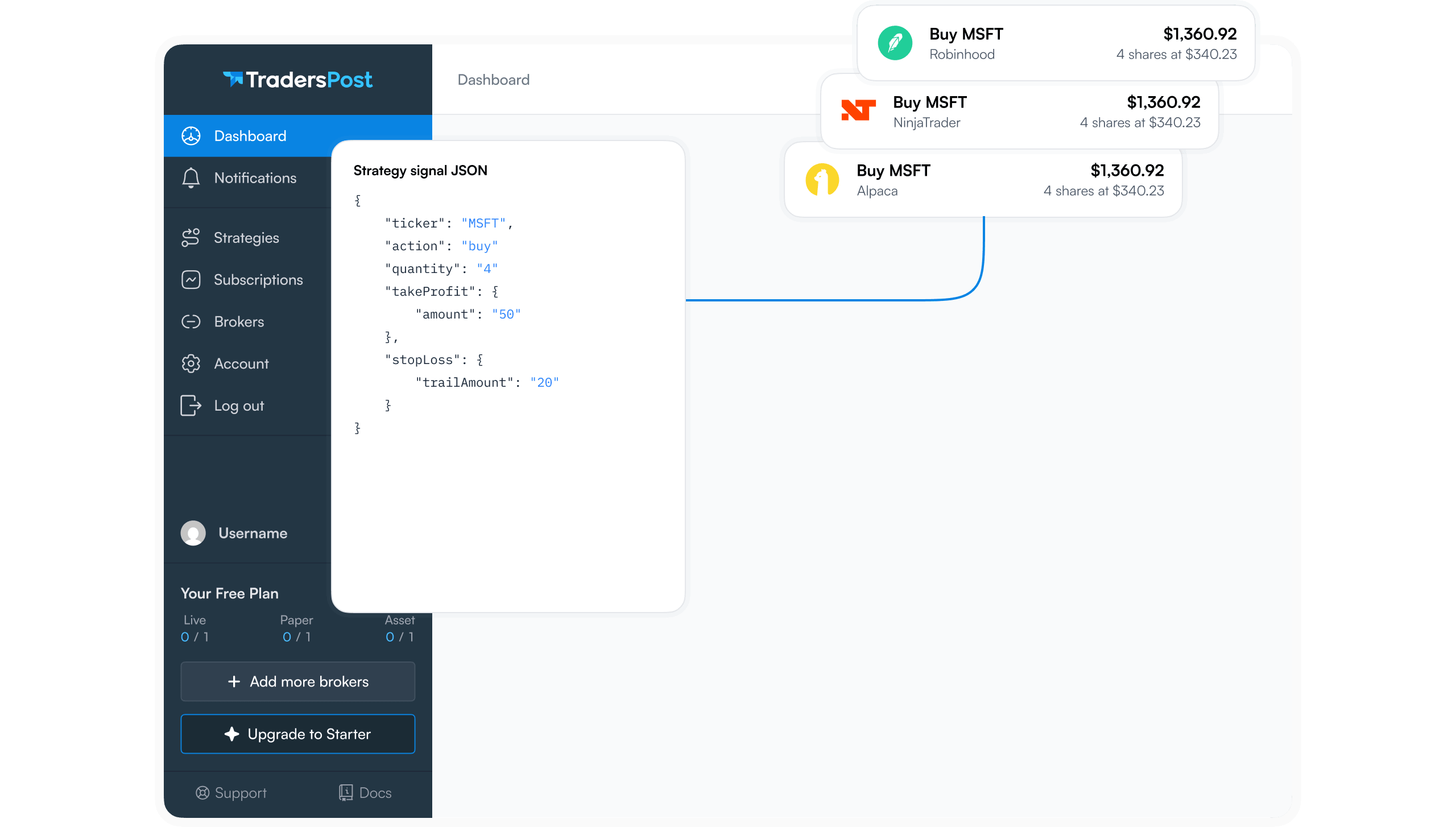
{"strategy":"DipBuy_200SMA_20EMA","ticker":"{{ticker}}","action":"BUY","qty":"100","price":"{{close}}","time":"{{time}}"}
Include a unique strategy name, ticker, action, quantity or position-sizing instruction, and timestamp. If your execution platform supports it, also include a signal ID to prevent duplicate orders. Test entry and exit alerts independently. Confirm that a buy alert opens the intended position, a stop alert closes it correctly, and an exit alert cannot accidentally reverse the position.
Use TrendSpider Alerts for Rule-Based Dip Setups
TrendSpider can scan and alert on a rule-based dip setup using trend filters, indicator thresholds, and defined price levels. Build a multi-factor condition rather than alerting on every red candle or every touch of a moving average. For example, require price above the 200 SMA, a low at or below the 20 EMA, RSI(2) below 15, and a close above the prior session high.
Use the same timeframe and indicator settings used in your testing. A daily strategy should not be alerted from a 15-minute chart, and an alert based on intrabar price movement should not be compared with a backtest that evaluates only completed candles. Before deploying capital, compare several live or simulated alerts against the strategy checklist to verify that TrendSpider’s condition logic and alert timing match the tested rules.
Configure Automated Execution With TradersPost
Connect Signals to a Broker Execution Workflow
A practical automated dip-buying workflow has four components: a charting or scanning platform identifies the setup, the platform sends a webhook alert, TradersPost interprets the alert against the configured strategy, and the connected broker receives the resulting order. For example, a TradingView strategy might detect an ETF closing below its 20-day moving average while RSI falls under 35, then send a DIP_BUY_SPY_V1 webhook when price reclaims an intraday trigger level.
Automation does not improve an unprofitable signal. Its value is consistent execution of rules that have already been tested, including entry timing, position sizing, stop placement, and exit logic. If historical testing shows that a setup should enter only once per symbol per pullback, the automation should enforce that restriction rather than rely on discretionary judgment after an alert arrives.
Assign each dip-buying model a dedicated strategy or signal name. Do not route a mean-reversion ETF strategy, an oversold large-cap stock strategy, and a breakout-after-dip strategy through the same generic alert logic. Distinct names such as ETF_DIP_RECLAIM, STOCK_DIP_RSI, and DIP_BREAKOUT_CONFIRM make it easier to apply separate sizing rules, order types, and risk limits.
Specify Order Details and Safety Guardrails
Select the order type based on the tested behavior of the setup. A market order is appropriate when immediate participation matters more than a small amount of price uncertainty, such as an entry triggered after a liquid ETF reclaims a key level. A limit order provides price control, but it can miss the trade if the market moves quickly. A stop order can be useful when the dip-buying thesis requires confirmation, such as buying only if price breaks above the prior bar's high after an oversold pullback.
- Set a maximum position size in shares, dollars, or portfolio percentage.
- Set a maximum number of open positions for the strategy and account.
- Define whether duplicate alerts for the same ticker should be ignored, added to an existing position, or treated as an error.4
- Use strategy-specific exposure limits, so a malformed alert cannot allocate capital intended for another model.
- Verify ticker mapping between the signal source and broker, especially for index symbols, share classes, crypto pairs, and futures contracts.
- Confirm fractional-share availability, extended-hours permissions, and whether the selected broker supports the intended asset class.
For example, an ETF_DIP_RECLAIM strategy might cap each position at $5,000, allow no more than four concurrent positions, and ignore repeated buy alerts while a position is already open. Those controls reduce the chance that alert duplication or a scripting error creates unintended exposure.
Handle Entries, Stops, and Exits as One System
Automating only the entry creates an incomplete process. A trader may enter consistently, then hesitate to close a losing position manually when the dip continues into a trend reversal. Build the entry, protective stop, profit target, and trailing-exit conditions as coordinated components of the same strategy.
Use separate, unambiguous signals for each action, such as ENTRY_LONG, STOP_EXIT, TARGET_EXIT, and TRAIL_EXIT. Confirm that every exit signal closes the intended position quantity and does not accidentally submit an order that reverses a long position into a short position. This is especially important when a broker treats sell orders differently depending on whether the account supports short selling.
Before deployment, review broker-specific order behavior, including stop-order handling, extended-hours restrictions, partial fills, order rejection rules, and fill assumptions used in backtesting. A simulated stop at a fixed price is not a guarantee of that fill during a gap, rapid selloff, or thin liquidity period.
Paper Test and Improve Your Automated Dip Buying Strategy
Backtest the Rules Across Different Market Conditions
Test an automated dip-buying strategy across distinct regimes, not just the period that produced the most attractive equity curve. Segment results into bullish trends, sideways or choppy markets, high-volatility selloffs, and sustained bear markets. A rule set that buys a 1.5 ATR pullback above a rising 50-day moving average may perform well during persistent uptrends but repeatedly enter failed bounces when the broader trend has turned lower.
Evaluate more than win rate. Track the following metrics for each market regime:
- Average win and average loss: A 65% win rate is not useful if occasional losses are several times larger than typical gains.
- Profit factor: Gross profits divided by gross losses. Review it by regime, not only for the entire sample.
- Maximum drawdown: Measure both percentage drawdown and the time required to recover.
- Expectancy: Calculate average profit or loss per trade after all estimated costs.
- Maximum consecutive losses: Use this to assess whether the strategy can be funded and followed during adverse periods.
Inspect the trade distribution. If two large winners account for most net profit, or if performance exists only in a narrow date range, the strategy may be fragile. Use realistic assumptions for commissions, bid-ask spreads, slippage, partial fills, and alert-to-order delay. For liquid ETFs, a modest slippage assumption may be appropriate. For individual equities, options, or volatile opening-range signals, model materially wider fills. A chart-based fill at the exact trigger price is usually optimistic.
Paper Trade the Full Alert-to-Order Workflow
A strategy backtest validates rule logic, not operational execution. It does not prove that webhook payloads are formatted correctly, that TradersPost receives signals, that broker connectivity remains active, that orders are accepted during market hours, or that real-time fills resemble assumed backtest fills.
Run the complete workflow in paper trading. Trigger actual alerts, inspect TradersPost logs or signal activity, verify that the broker paper account received the intended order, and confirm that stop-loss and exit instructions behave as expected.5 Test both entry and exit paths, including a stopped-out position, a profit-target exit, an end-of-day close, and an alert that arrives when the market is closed.
- Correct symbol and asset type
- Correct side, buy versus sell or sell short
- Correct quantity, including position-sizing calculations
- No duplicate orders from repeated alerts or retries
- Expected stop behavior after entry
- Expected exit behavior when a reversal or target signal occurs
Review at least several live-like signal cycles before committing capital. Include normal sessions, volatile sessions, and periods with limited liquidity if those conditions are relevant to the instruments traded.
Avoid Overfitting and Iterate One Variable at a Time
Do not optimize every parameter until the historical report appears nearly perfect. A highly tuned combination of ATR pullback depth, RSI threshold, moving-average length, stop distance, and profit target can fit past noise rather than capture a durable market behavior.
Change one variable at a time. For example, test an ATR pullback threshold of 1.0, 1.5, and 2.0 while keeping the RSI filter, trend filter, exits, and sizing rules unchanged. Then evaluate whether changing RSI from 35 to 40 improves results across multiple periods and regimes, not only in one favorable sample.
Maintain a trading journal that records setup type, market regime, signal time, expected order, actual execution, execution outcome, and any deviation from the plan. The best automated dip-buying strategy is not the one with the most optimized historical curve. It is the one that remains understandable, testable, and manageable as market conditions change.
Frequently Asked Questions
What is the best indicator for an automated dip buying strategy?
There is no single best indicator for automated dip buying. ATR helps quantify volatility and set pullback or stop distances, moving averages can identify the broader trend, and RSI can help measure short-term weakness. A stronger approach combines a trend filter, a measurable pullback condition, and a confirmation rule for entry. Test the complete rule set, not just one indicator, on the specific asset class, market session, and timeframe you plan to trade.
Can I automate buy-the-dip trades with TradingView?
Yes. TradingView can generate alerts from indicator conditions or Pine Script strategy rules. With webhook alerts, qualified entry and exit signals can be sent to TradersPost for broker execution. Before trading live, paper test the entire workflow, including alert timing, webhook and order formatting, position sizing, stop-loss instructions, and exit behavior. An alert that looks correct on a chart still needs to perform correctly through every step of the automation process.
How do I stop an automated dip-buying strategy from averaging down?
Use explicit rules that prevent additional buying after an entry. For example, permit only one entry per setup or set a strict maximum number of entries. Define a fixed position size and hard maximum dollar risk before the order is sent, rather than increasing size as price falls. If you allow another trade, require a new and independently qualified signal instead of treating a lower price as an automatic reason to add.
Should I buy a dip immediately or wait for confirmation?
Immediate dip entries may produce better prices, but they can also create more false signals when a pullback becomes a deeper decline. Confirmation entries, such as a reversal signal or reclaim of a key level, can reduce failed pullbacks but often enter later and may lower reward-to-risk. The better choice depends on backtested performance rather than personal preference. See our buy-the-dip-versus-wait-for-confirmation comparison for a closer breakdown.
What is a reasonable stop-loss for a dip-buying strategy?
A reasonable stop-loss sits beyond the level that invalidates the trade setup, such as a recent swing low, a support zone, or an ATR-based volatility threshold. Calculate position size from the distance to that stop so the total account risk remains controlled. Avoid setting stops so tightly that normal market volatility repeatedly triggers exits before the thesis can play out. Your stop should reflect both the strategy’s logic and the asset’s typical price movement.
Conclusion
Automated dip buying can turn a discretionary idea into a repeatable process, but its edge depends on more than buying every pullback. Define the market conditions, entry trigger, position size, profit target, stop logic, and maximum exposure before automation sends a single order. Then validate the strategy across different volatility regimes and account for slippage, commissions, gaps, and correlated positions.
After you have configured automated execution with TradersPost, the next step is to test the complete workflow in a realistic environment. Create a TradersPost account, connect a paper trading account, and use TradingView or TrendSpider webhooks to simulate your dip-buying signals before committing capital. Review the results, refine the rules, and only move live when performance and risk controls meet your standards. Build carefully, test consistently, and approach 2026 with a process you can execute confidently.
References
1 TradersPost Docs, Position Sizing
2 TradingView, Pine Script Repainting
3 TradersPost Docs, TradingView Signal Source
4 TradersPost Docs, Order Behavior
5 TradersPost Docs, Paper Trading