Automated Options Call Buying on AI Rallies
Learn automated options call buying for AI rallies: select expirations and deltas, size risk, manage exits, and execute webhook alerts with TradersPost.

Marketing

Bottom Line
- AI headlines can move a stock 5% before a discretionary trader finishes reading the announcement.
- Automated options call buying uses a defined trading signal to trigger the purchase of a call option when a bullish setup occurs.
- A complete automated call-buying system should specify decision points such as entry trigger, option selection rules, position-size limits, and exit logic.
- Automated call entries should rely on measurable conditions, such as the stock closing above its prior 20-day high and having a relative volume above 1.5.
- For directional swing systems, a 0.55 to 0.70 delta target range is recommended to balance directional sensitivity and premium decay.
AI headlines can move a stock 5% before a discretionary trader has finished reading the announcement. For traders who want defined-risk exposure to those momentum bursts, automated options call buying can turn a repeatable signal into a disciplined execution process, without relying on split-second manual entries or emotional chasing.
This guide explains how to build an AI-rally options workflow around the decisions that matter most: identifying tradeable catalysts, choosing expirations that balance responsiveness with time decay, selecting call deltas that fit the expected move, and sizing each position so one failed breakout does not distort the account. You will also learn how to define profit targets, stop conditions, and time-based exits before the order is live.
Finally, we will show how webhook alerts and TradersPost can connect a signal source to automated order execution, creating a practical framework for acting on AI-driven momentum while maintaining consistent rules. The objective is not to buy every AI headline, it is to execute the highest-conviction setups with controlled, measurable risk.
What Is Automated Options Call Buying?
The Directional Call-Buying Workflow
Automated options call buying uses a defined trading signal to trigger the purchase of a call option when a bullish setup occurs. The automation can be implemented through a broker API, trading platform workflow, or alert-to-order system, but the underlying process is the same: the strategy identifies a qualifying condition, selects an eligible call contract, calculates a permitted position size, and manages the position according to pre-established exit rules.1
A complete automated call-buying system should specify each decision point:
- Underlying symbol: A defined universe of liquid AI and technology names, such as semiconductor, cloud infrastructure, software, cybersecurity, and AI platform stocks.
- Entry trigger: A measurable bullish condition, such as a price breakout, trend confirmation, relative-strength threshold, or post-earnings continuation signal.
- Option selection rules: Contract criteria for expiration, strike, delta, bid-ask spread, open interest, and implied volatility.
- Position-size limits: A maximum dollar amount, percentage of account equity, or premium-at-risk allocation per trade.
- Exit logic: Rules for profit targets, stop losses, time stops, technical invalidation, and partial exits.
- Expiration handling: A process for closing contracts before expiration, avoiding unintended exercise or assignment-related operational issues, and preventing excessive late-expiration gamma exposure.
A long call has a defined maximum loss: the premium paid, plus transaction costs. That limitation does not make the trade low risk. If the stock fails to advance sufficiently before expiration, the call can lose all of its value. Automated sizing should therefore treat the full premium as capital at risk, not merely as a small fraction of the underlying share price.
This framework is particularly relevant for AI and technology names, where momentum-driven rallies, earnings-related volatility, and rapid reversals can occur within days. A system must be designed to participate in valid upside moves without mechanically buying every headline-driven spike.
Why AI and Tech Rallies Require Disciplined Rules
AI-related equities can trend aggressively after technical breakouts, product announcements, earnings releases, raised guidance, hyperscaler capital-expenditure updates, or broad semiconductor and software-sector momentum. These same catalysts can also produce gap risk, elevated implied volatility, and sharp reversals when expectations are already priced into the stock.
Discretionary chasing is particularly costly when a stock has already made a large intraday or multi-day move. A trader may be correct about the bullish narrative but still overpay for a call because the underlying entry is extended and implied volatility has expanded. The stock can continue rising while the option underperforms due to volatility contraction or insufficient remaining time value.
Automation does not predict direction. It executes a predefined plan consistently after specified conditions are met. For example, an automated strategy could enter a bullish call position only when all of the following conditions are true:
- The stock closes above its prior 20-day high.
- Daily volume is at least 150% of its 20-day average volume.
- The closing price is above the 50-day moving average.
- The selected call has 45 to 75 days to expiration, a delta between 0.55 and 0.70, and a bid-ask spread no wider than 5% of the midprice.
- Implied volatility rank is below a predefined ceiling, such as 70, unless the strategy is explicitly designed for post-event volatility conditions.
These rules do not guarantee a profitable trade. They create repeatable entry criteria, limit contract-selection errors, and prevent the strategy from entering simply because an AI or technology ticker is attracting attention.
Build Entry Signals for AI Rally Call Trades
Use Objective Breakout and Trend Conditions
Automated call entries should rely on measurable conditions, not discretionary chart interpretation. A robust baseline requires the underlying to trade above a rising intermediate-term moving average, clear a defined resistance level, and show participation through relative volume. Add a market regime filter so the system only buys calls when the broader index supports risk-on positioning, such as the Nasdaq 100 trading above its 50-day moving average.
- Trend: Underlying close above its 50-day moving average, with the 50-day average higher than it was five sessions ago.
- Breakout: Close above the prior 20-day high, preferably using closing prices rather than intraday highs to reduce false triggers.
- Volume: Relative volume above 1.5, calculated as current session volume divided by average volume over the prior 20 sessions.
- Market filter: QQQ above its 50-day moving average, or a comparable index-level trend condition.
A practical rule is: buy a call only when the underlying closes above its 20-day high, remains above its 50-day moving average, and has relative volume above 1.5. To avoid chasing exhausted moves, require the closing price to be no more than 8% above the 20-day moving average. An alternative is a pullback-and-reclaim entry: trigger only after price pulls back toward the 10-day or 20-day moving average, then closes back above the prior day’s high on above-average volume.
Add Event and Liquidity Filters
A valid stock signal does not automatically justify an option trade. The automation should reject contracts with poor execution quality. Set minimum liquidity rules before contract selection, such as open interest above 500 contracts, daily option volume above 100 contracts, and a bid-ask spread no wider than 5% of the option mid-price. For lower-priced options, a fixed maximum spread, such as $0.10 or $0.15, may be more practical.
Many breakout systems should also block new call entries immediately before earnings. Earnings can produce favorable directional moves, but implied volatility often rises before the report and may collapse afterward, reducing option value even if the stock moves modestly in the expected direction. Unless the strategy is explicitly designed for earnings momentum or event-driven volatility, prohibit entries within five trading days of scheduled earnings.
Add an implied-volatility filter relative to each stock’s own history. For example, reject new long-call entries when 30-day implied volatility is above the 80th percentile of its trailing 252 trading-day range. Define an eligible universe of liquid AI and technology names, such as NVDA, MSFT, AVGO, AMD, ANET, PLTR, and TSM, rather than applying the system indiscriminately to every ticker associated with the AI theme.
Structure Webhook Alerts With Trade Context
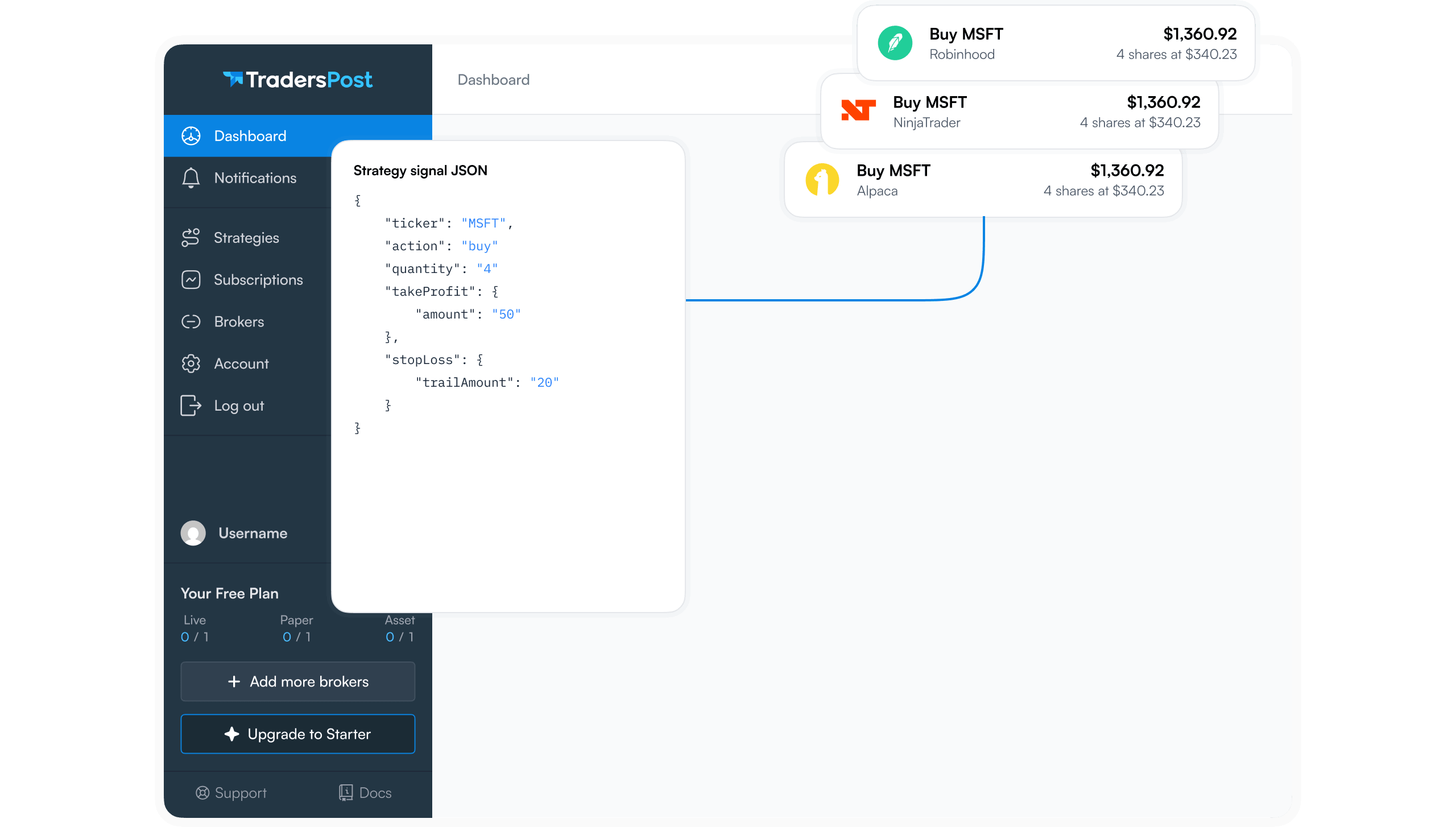
A webhook should transmit enough information for downstream contract-selection and sizing logic to act without ambiguity. Include the ticker, strategy identifier, intended direction, signal timestamp, underlying price, breakout level, relative volume, and any risk or position-sizing fields required by the execution layer.2
- ticker: NVDA
- strategy_id: ai_breakout_20d_v1
- direction: long_call
- signal_price: 142.35
- relative_volume: 1.82
- max_contract_cost: 450
Use unique strategy identifiers so 20-day breakouts, moving-average reclaims, and earnings-momentum systems can be evaluated separately. Implement frequency controls, such as one entry alert per ticker per strategy per trading day, to prevent duplicate orders from repeated intrabar updates or recurring bar-close signals. Test every alert path during market hours in paper trading, including rejected contracts, duplicate-signal handling, and broker order acknowledgments, before routing live capital.
Choose Expiration and Delta for Automated Calls
Set Dynamic Expiration-Selection Rules
Automated call-buying systems should select expirations through a defined days-to-expiration (DTE) window, not by manually choosing whichever contract appears attractive when a signal fires. Short-dated calls require less premium but carry faster theta decay and greater sensitivity to timing errors. Longer-dated calls cost more in absolute dollars, but provide more time for the underlying thesis to develop and generally retain value better if the anticipated move is delayed.
Match the DTE window to the strategy’s expected holding period. A practical framework is:
- 21 to 45 DTE for short-term swing breakouts, where the expected holding period is several sessions to roughly two weeks.
- 45 to 90 DTE for slower trend-following entries, where the system may hold through consolidations, pullbacks, and multi-week continuation moves.
The scanner should reject any contract expiring before the strategy’s maximum planned holding period, preferably with an additional time buffer. For example, a model designed to hold a breakout for up to 15 trading days should not buy a call with 14 calendar days remaining. The contract can lose substantial extrinsic value even if the stock remains above the original entry level.
Target a Delta Range Instead of a Fixed Strike
Delta is a more useful automation input than a fixed percentage out-of-the-money strike because it expresses approximate directional sensitivity. A 0.60 delta call should initially gain about $0.60 for every $1 increase in the underlying stock, before changes in implied volatility and gamma are considered. Lower-delta calls are cheaper but require a larger and faster move to overcome premium paid. Higher-delta calls behave more like stock, carry more intrinsic-value exposure, and require greater upfront capital.
For many directional swing systems, a 0.55 to 0.70 delta target range is a reasonable starting point. The correct range depends on the signal horizon, account risk limits, expected move, and tolerance for premium decay. Rather than instructing the system to always buy, for example, a 5% out-of-the-money call, rank eligible contracts by closeness to the target delta and select the nearest liquid contract.
For example, after an AI stock triggers a breakout signal, the automation can screen calls with 30 to 60 DTE, bid-ask spreads below a preset percentage of the midprice, and open interest above a minimum threshold. It can then select the contract nearest 0.60 delta. This adapts naturally when the stock price, volatility surface, and available strike spacing change.
Account for Implied Volatility Before Entry
Call buyers are exposed to stock direction, theta decay, and changes in implied volatility. A correct bullish signal can still produce a poor option return if implied volatility contracts after entry. This risk is especially relevant after a major AI-related headline, product announcement, or immediately before earnings, when option premiums may already embed unusually large expected moves.
Build an IV-aware filter into the execution logic. For example, when 30-day implied volatility or IV rank exceeds a strategy-defined threshold, the system can:
- Reduce position size.
- Select a higher-delta call with more intrinsic value.
- Wait for a pullback or volatility normalization.
- Skip the trade entirely.
A robust rule might prohibit new long calls when IV rank exceeds 80 unless the signal’s expected move exceeds the option-implied move by a defined margin. No expiration, delta, or IV filter eliminates volatility risk or guarantees profitability, but explicit contract-selection rules prevent the system from repeatedly paying inflated premiums for weak risk-adjusted exposure.
Size Automated Call Positions With Defined Risk
Use Premium-at-Risk Position Sizing
For a long call, the maximum loss is generally limited to the premium paid plus commissions, exchange fees, and any exercise-related costs. This assumes the option is closed or allowed to expire rather than exercised or assigned under unusual circumstances. An automated strategy should calculate position size from premium at risk, not from the underlying share price or the option delta alone.
Use the following sizing rule:
Maximum contracts = floor(Maximum risk per trade / Cost per contract)
Cost per contract equals the quoted premium multiplied by 100, plus estimated transaction costs. For example, if the strategy has a $500 maximum risk cap and selects a call quoted at $2.25, one contract costs $225 before fees. The system can buy two contracts for approximately $450 before fees. It should not buy three contracts, because $675 exceeds the risk budget.
Risk budgets should vary by setup quality and volatility. A highly volatile AI-linked name with elevated implied volatility, frequent 5% to 10% daily moves, or binary earnings exposure may warrant a smaller premium-at-risk allocation than a diversified index, broad software basket, or lower-volatility underlying. For example, an automation rule might cap speculative AI calls at 0.25% to 0.50% of account equity per trade, while allowing 0.50% to 1.00% for more diversified, liquid setups.
Set Portfolio-Level Exposure Limits
Individual trade risk limits do not prevent portfolio concentration. Calls on semiconductor designers, cloud providers, data-center operators, and AI infrastructure names can behave as one directional exposure when market sentiment shifts. An automated system should not treat five AI-related call positions as five independent trades.
- Cap total open premium at risk, such as 3% to 5% of account equity across all long calls.
- Set a maximum number of concurrent bullish call positions, such as three to five positions.
- Limit premium at risk in a single underlying and in a single theme, such as no more than 1% per ticker and 2% across AI infrastructure.
- Reject a new entry when the account already holds several bullish semiconductor, cloud, or AI infrastructure trades.
- Restrict concentration in contracts sharing the same expiration week and catalyst, especially earnings, CPI releases, Federal Reserve decisions, or major AI product announcements.
A practical rule is to block a new cloud-software call if the portfolio already contains bullish calls on two semiconductor names and one data-center infrastructure name expiring after the same earnings cycle. The new signal may be valid, but it adds correlated gap risk rather than meaningful diversification.
Plan for Gaps and Fast Losses
Stop-loss orders on option contracts are not guaranteed to fill at the intended price. During overnight gaps, wide bid-ask spreads, rapid implied-volatility changes, or a sharp decline in the underlying, an option stop can execute materially below its trigger. Position size must therefore be small enough that a near-total premium loss remains survivable under the overall trading plan.
- Price-based exit: Close when the option reaches a specified premium or when the underlying breaches a technical level.
- Percentage-of-premium stop: Exit after, for example, a 40% to 50% decline in option value.
- Time stop: Close if the expected move has not begun within a defined number of sessions or if remaining days to expiration fall below a threshold.
- Thesis-invalidation exit: Close when the catalyst, trend condition, relative-strength signal, or market regime that justified entry no longer exists.
Defined risk does not mean small risk. A long call has capped downside per contract, but purchasing too many contracts can still create an unacceptable portfolio loss.
Automate Entries and Exits With TradersPost
Connect TradingView or TrendSpider Alerts
A TradersPost workflow begins with a defined signal on TradingView or TrendSpider, such as an AI-related stock closing above a 20-day resistance level while volume exceeds its 30-day average. Build and test the indicator or strategy first, then create an alert that sends a webhook to TradersPost. TradersPost validates the incoming payload, applies the selected automation rules, maps the action to the connected brokerage account, and submits the configured options order.3
Use bar-close alerts when the strategy depends on a confirmed breakout. A stock that trades above resistance intrabar but closes back below it has not produced the same signal as a confirmed close above resistance. For example, a daily call-buying system may require NVDA to close above its prior 20-day high before opening a long call. Configure the alert to trigger only after the daily bar closes.
More active systems can use intrabar alerts, particularly on 5-minute or 15-minute charts, but they must address false breakouts and repeated signals during the same bar. Configure duplicate-entry rules and ensure the alert logic does not send a new entry every time price ticks above the trigger level.
- Name alerts with the ticker group, timeframe, direction, and strategy version, such as AI-Megacap_15m_LongCall_v3.2.
- Validate webhook payloads in a simulated or small-size environment before enabling live trading.
- Confirm that the payload identifies the intended underlying, action, and strategy routing logic.
- Monitor TradersPost execution records and brokerage fills, especially after changing alert code or option-selection rules.
Use Rule-Based Order and Duplicate-Entry Controls
An automated call-buying strategy must explicitly define what happens when a position already exists. Without this decision, a repeated breakout alert can unintentionally pyramid exposure into the same underlying. For many directional call systems, a one-trade-per-symbol rule is appropriate: if the account already holds an open long call position in AMD, ignore new AMD entry alerts until the existing trade is closed.
Add controls for a cooldown period after exit, a maximum number of entries per symbol per day, and reversal behavior. For example, after a stop-out in MSFT calls, prohibit another MSFT long-call entry for 60 minutes. If the strategy can reverse from bearish exposure into a bullish call position, define whether the existing position must be closed and confirmed before the new order is sent.
Choose order behavior based on liquidity and urgency. Market orders may be appropriate for highly liquid contracts when immediate exposure matters, while limit orders provide more control when bid-ask spreads are wider.4 Options spreads can widen sharply during breakouts, earnings-related volatility, and fast market declines. Test the automation under realistic bid-ask conditions, not only against theoretical mid-price fills.
Automate Exits Before Expiration Becomes a Problem
Long calls require explicit exit logic. Define one or more of the following: a profit target, a technical breakdown exit, a premium-loss threshold, a trailing exit, or a time-based exit.5 A practical ruleset could close a call when the underlying closes below its 10-day moving average, when the option premium declines 40% from entry, or when fewer than 10 days to expiration remain.
If the strategy is not specifically designed for near-expiration trading, close or roll long calls before the final days to expiration. Gamma can become highly sensitive to small moves in the underlying, while theta accelerates as expiration approaches. These effects can make a previously manageable position behave very differently from the original entry model.
A roll should not be an emotional response to an unrealized loss. Treat it as a new trade decision with separate rules: require a valid bullish signal, define the new expiration and strike-selection criteria, and confirm that remaining expected upside justifies the new premium paid.
Paper Test an AI Call-Buying System Before Going Live
Test the Complete Workflow, Not Just the Chart Signal
A profitable backtest on the underlying stock does not prove that an automated call-buying system can execute options trades correctly. The system must be tested from signal generation through entry, position management, and exit confirmation. A TradingView or model alert that correctly identifies an AI-related stock breakout can still fail if the webhook payload is malformed, the broker API cannot locate the intended contract, or the selected expiration has no usable liquidity.
Use paper trading to validate each operational component:6
- Alert formatting, including ticker normalization, strategy ID, side, quantity, and exit instructions.
- Webhook delivery timing and whether delayed or duplicated alerts create duplicate orders.
- Broker authentication, order acknowledgements, rejection handling, and position synchronization.
- Option-chain availability, including whether the requested strike and expiration exist at the time of entry.
- Contract-selection rules, such as buying the 0.60 delta call with 30 to 45 DTE rather than accidentally selecting a weekly 0.15 delta contract.
- Quantity calculations based on premium, account risk limits, and buying power.
- Market-session behavior, especially premarket signals, opening-auction spreads, halted stocks, and end-of-day exits.
Maintain a test-trade log for every automated paper order. Record the signal timestamp, underlying price, selected contract, delta, DTE, bid-ask spread, order type, requested limit price, simulated fill result, exit message, and final position status. For example, if a bullish NVDA signal arrives at 9:31 a.m. but the selected call has a $1.20 spread, the issue may be execution quality rather than signal quality. Paper testing should expose these failures before capital is at risk.
Measure Option-Specific Strategy Performance
Evaluate the option position, not only the underlying stock return. Track win rate, average premium gained or lost per contract, maximum drawdown, average holding period, and the percentage of positions still held during the final week before expiration. A system may correctly predict that an AI stock rises 3%, yet lose money if implied volatility contracts after earnings or theta decay offsets the directional move.
For each trade, record the underlying move alongside the option return. If the stock rises but calls repeatedly underperform, investigate entry implied volatility, delta selection, spread cost, and holding duration. Segment results by:
- Delta range, such as 0.40 to 0.55 versus 0.60 to 0.75.
- DTE range, such as 7 to 14, 21 to 45, and 60-plus days.
- Volatility environment, including elevated earnings IV versus normal IV.
- Setup type, such as breakout, pullback continuation, post-earnings momentum, or index-confirmed trend entry.
Test across bullish, bearish, range-bound, and high-volatility conditions. Results generated only during a strong AI-led bull run may reflect favorable market beta rather than a durable call-buying edge.
Move to Live Trading Gradually
After paper validation, begin with the smallest viable live quantity, typically one contract per signal. Deploy one symbol or one setup first, such as liquid 30 to 45 DTE calls on NVDA, rather than activating every AI-related ticker simultaneously. Compare live fills, slippage, spreads, and order latency against paper results.
Expand only after the live workflow behaves as designed. Continue monitoring automation after strategy edits, webhook changes, broker migrations, API updates, earnings events, and major market dislocations. Automated execution reduces manual effort, but it does not remove the need for active operational oversight.
Common Mistakes in Automated Call Buying
Buying Cheap Out-of-the-Money Calls Without a Move Forecast
A low premium does not make a call inexpensive in probabilistic terms. Far out-of-the-money (OTM) calls often have low delta, a low probability of expiring in the money, and substantial theta exposure. A $0.25 call may look safer than a $3.00 at-the-money contract because the maximum dollar loss is smaller, but it can still be a poor use of capital if the underlying would need an unrealistic move before expiration.
Automated entries should begin with a quantified move forecast. If a signal expects an AI-related stock trading at $180 to rise 4% over the next five trading days, a $210 call expiring that Friday is unlikely to match the thesis. The strike is too distant and the expiration provides too little time. A call with a delta target, such as 0.35 to 0.60, and a defined days-to-expiration (DTE) window, such as 14 to 45 DTE, is generally more aligned with a directional strategy than selecting the lowest-priced listed contract.
- Set a minimum delta, such as 0.30, unless the strategy explicitly trades convex lottery-style structures.
- Define DTE based on expected signal duration, not on the nearest available expiration.
- Reject contracts when the required move to reach the strike materially exceeds the system's modeled price target.
- Include bid-ask spread limits, because low-priced OTM calls can have spreads that consume a large percentage of premium.
Ignoring Implied Volatility and Earnings Risk
A correct bullish view can still produce a losing call trade when implied volatility falls. This is particularly relevant before earnings, product launches, regulatory decisions, or major AI announcements. A stock may rise after earnings, yet the call can lose value if the realized move is smaller than the move already implied by option prices and post-event implied volatility collapses.
Your system must identify its objective. A trend-following call strategy typically seeks sustained price appreciation and may avoid entering immediately before earnings. An earnings-volatility strategy is different: it must model expected move, event timing, implied volatility rank or percentile, and post-event volatility behavior. Do not apply trend-following entry rules to an earnings trade and assume that a bullish signal alone offsets volatility crush.
For example, if a stock implies a 10% earnings move and rises 4% the next morning, a near-term call purchased at elevated implied volatility may decline despite the favorable direction. Backtest or paper-test event-specific rules using historical option data where possible. Untested assumptions about post-earnings pricing are not a valid automation rule.
Automating Without Safeguards or Monitoring
Do not connect an untested webhook, alert script, or AI-generated signal directly to a live brokerage account with unrestricted order permissions. A malformed payload, repeated alert, stale option chain, or brokerage API retry can turn one intended order into multiple positions.
At minimum, the execution layer should enforce:
- Maximum contracts per order and a maximum premium allocation per trade.
- Maximum open positions by symbol, sector, and total account exposure.
- Duplicate-order controls using unique signal IDs, timestamps, and cooldown periods.
- Alert logs that record the signal, selected contract, order payload, broker response, and fill status.
- Paper testing across normal sessions, volatile sessions, and earnings periods before live deployment.
- Broker-order monitoring that detects rejected, partially filled, cancelled, or unexpectedly duplicated orders.
Automation is not a one-time deployment. Strategy code, alert platforms, brokerage integrations, option liquidity, and market regimes change. Review execution logs regularly, reconcile broker positions against internal records, and retest safeguards whenever the strategy logic, broker API, or order-routing process changes.
Frequently Asked Questions
Can you automate options call buying with TradingView alerts?
Yes. A TradingView strategy or indicator can generate webhook alerts when bullish entry conditions are met. TradersPost can receive supported webhook alerts and apply your configured automation rules to route eligible orders to a connected supported broker. Before using real capital, test alert payloads, contract-selection logic, order behavior, position sizing, and exit rules in paper trading. Confirm that alerts fire only when intended and that the automation handles duplicate or delayed signals appropriately.
What delta is best for buying calls on AI stocks?
There is no universal best delta for AI stock calls. The appropriate choice depends on your expected move size, planned holding period, premium budget, and risk tolerance. Many directional swing traders evaluate calls around 0.55 to 0.70 delta because they generally provide more stock-like exposure than far out-of-the-money contracts. Set a predefined delta range, then review results across different volatility environments instead of selecting strikes emotionally after a rally begins.
How far out should call options be when automating a rally strategy?
Choose an expiration that exceeds your strategy’s expected holding period and gives the trade thesis time to develop. A swing strategy might use a defined 21-to-45 DTE window for quicker moves or a 45-to-90 DTE window when the expected rally may take longer. Avoid allowing automated positions to drift into the final days before expiration without a plan, as theta decay and gamma risk can increase substantially near expiry.
What is the maximum loss when buying a call option?
For a standard long call, the maximum loss is generally the premium paid, plus commissions and fees. However, that loss can still be meaningful if the automated strategy uses oversized positions or opens several correlated AI and technology call positions at once. Set premium-at-risk limits for each trade and portfolio-level exposure caps before enabling automation. Your position-sizing rules should account for the possibility that multiple calls lose value simultaneously during a sector decline.
Should I automate AI stock calls before earnings?
Only if the strategy has been specifically tested for earnings-related implied-volatility and price-move behavior. Pre-earnings calls can be expensive because implied volatility is often elevated, and they may lose value after results even if the stock moves modestly higher. A conservative automated workflow can include an earnings filter that blocks new call entries within a defined number of days before scheduled results. If you trade earnings, use separate rules designed for that event risk.
Conclusion
Automated call buying can help traders participate in AI-driven rallies with greater consistency, faster alert-to-order execution, and clearer risk controls. The opportunity is not simply to buy calls whenever AI headlines move the market, but to define the technical triggers, option selection rules, position sizing, and exit criteria that fit your strategy. Because momentum can reverse quickly and implied volatility can make contracts expensive, disciplined automation matters as much as signal quality.
Ready to build and validate your process? Create a TradersPost account, connect alerts from TradingView or TrendSpider, and paper test your options workflow before committing capital to live execution. Use the results to refine entries, contract parameters, and risk limits, then move forward only when your system performs as intended. Start testing your AI call-buying strategy with confidence today.
References
1 TradersPost Docs, Position Sizing
2 TradersPost Docs, Webhooks
3 TradersPost Docs, TradingView Signal Source
4 TradersPost Docs, Order Behavior
5 TradersPost Docs, Options Trading
6 TradersPost Docs, Paper Trading