Geopolitical Risk for Retail Traders in 2026
Learn how retail traders can manage geopolitical risk in 2026 using position sizing, event rules, defensive rotations, and automated execution tools today.

Marketing

Bottom Line
- In Charles Schwab's Q2 2026 client sentiment release, 70% of respondents ranked geopolitical conflict among the top market drivers, while 53% cited oil prices.
- Geopolitical events can cause asset repricing during illiquid overnight sessions, leading to index-futures gaps, spikes in implied volatility, and sharp moves in crude oil or gold.
- A disruption to a major shipping route can immediately lift freight rates and energy prices, affecting airlines, transport companies, and consumer-discretionary shares.
- Retail traders should use automated alerts, conditional orders, and execution tools to respond to geopolitical risks with discipline.
- An automated risk-control rule could reduce broad equity exposure by 25% when the S&P 500 closes below a predefined support level, the VIX exceeds its 20-day moving average, and crude oil rises more than 3% over two sessions.
In 2026, a single tariff announcement, shipping disruption, election result, or escalation near a critical trade route can reprice stocks, currencies, commodities, and volatility before retail traders have time to read the headline. Geopolitical risk retail traders face is no longer a distant macro concern, it is a direct threat to stop levels, option premiums, margin requirements, and overnight positions. The challenge is not predicting every flashpoint. It is building a trading process that can absorb sudden uncertainty without forcing emotional decisions.
This guide explains how to identify the geopolitical events most likely to affect your holdings, adjust position size before known risk windows, and set practical rules for holding trades through weekend or overnight headlines. You will learn when defensive rotations into sectors, cash, bonds, gold, or volatility strategies may make sense, and when they may simply add noise. We will also cover automated alerts, conditional orders, and execution tools that help retail traders respond with discipline when markets move faster than discretion allows. The goal is straightforward: protect capital during geopolitical shocks while remaining positioned to capture opportunity when uncertainty creates mispricing.
Why Geopolitical Risk Matters to Retail Traders
Geopolitical Events Can Move Markets Before Headlines Are Clear
Geopolitical risk is a market-structure problem before it becomes a forecasting problem. Conflict escalation, sanctions, export controls, election results, shipping disruptions, and diplomatic negotiations can reprice assets during illiquid overnight sessions, often before the facts are fully verified. The initial reaction may include index-futures gaps, a spike in implied volatility, sharp moves in crude oil or gold, and rapid rotation into or out of affected sectors.
For example, a disruption to a major shipping route can lift freight rates and energy prices immediately, while pressuring airlines, transport companies, and consumer-discretionary shares. A new sanctions package may affect energy producers, industrial exporters, banks, or a specific currency. These first moves are often headline-driven and can reverse quickly. The more durable effect is different: a multi-week macro trend can alter inflation expectations, central-bank policy assumptions, bond yields, currency flows, and earnings estimates for energy, defense, industrial, and multinational companies.
Retail traders do not need to predict the political outcome. They need rules for the market reaction: whether to reduce gross exposure after an overnight gap, avoid opening new positions when volatility exceeds a threshold, or tighten risk limits when correlated positions are moving together.
What Retail Investors Identified as 2026 Market Risks
Geopolitical risk is not just an institutional macro concern. In Charles Schwab’s Q2 2026 client sentiment release, 70% of respondents ranked geopolitical conflict among the top drivers of markets, while 53% cited oil prices.1 Those responses matter because energy is frequently the most direct transmission channel from geopolitical developments to retail portfolios. Higher oil prices can affect inflation-sensitive assets, transportation and consumer sectors, bond yields, and broad equity-index volatility at the same time.
For an automated trader, this supports treating geopolitical and energy exposure as portfolio-level risk inputs. A strategy holding long technology equities, airline shares, and short energy ETFs may appear diversified by ticker count, but it can carry concentrated downside exposure during an oil-driven geopolitical shock. Position limits should account for correlated exposures, not only individual stop distances.
Source: Charles Schwab, Q2 2026 client sentiment release.
The Retail Trader’s Edge: Repeatable Execution, Not Prediction
The practical retail advantage is repeatable execution. Breaking news creates discretionary errors: chasing the first candle, widening a stop after entry, averaging into a losing position, or treating a temporary halt in liquidity as a signal. A rules-based process limits those failures.
- Use smaller position sizes when implied volatility, ATR, or overnight gap risk rises above predefined levels.
- Trade liquid instruments, such as major index ETFs, liquid sector ETFs, futures, or highly traded options, when event risk is elevated.
- Define exits before entry, including a hard stop, maximum portfolio loss, and a time-based exit for trades that fail to develop.
- Require objective entry criteria, such as a post-news breakout holding above VWAP, a volatility-adjusted trend signal, or confirmation after the opening range.
Automation can enforce these controls when emotions rise. A trading system can block new entries after a specified volatility spike, reduce order size after a portfolio drawdown, cancel unfilled orders before major scheduled events, and prevent exposure from exceeding a sector or currency-risk limit. The objective is not to trade every geopolitical headline. It is to keep exposure survivable when headlines change the market faster than discretionary judgment can respond.
The Four Macro Risks Retail Traders Should Track
Geopolitical Conflict and Supply-Chain Disruptions
Conflict risk reaches markets through identifiable channels: broad equity selling, energy supply concerns, disrupted shipping routes, higher freight costs, defense-sector relative strength, safe-haven demand for U.S. Treasuries or gold, and higher implied volatility. Retail traders should not trade every headline. Build rules around market-confirmed signals that show risk is being repriced.
For example, an automated risk-control rule could reduce broad equity exposure by 25% when all three conditions occur: the S&P 500 closes below a predefined support level, the VIX closes above its 20-day moving average by a specified threshold, and crude oil rises more than 3% over two sessions. This approach requires confirmation across equities, volatility, and energy rather than relying on news sentiment alone.
- Track major index support and resistance levels.
- Monitor oil, freight-sensitive stocks, defense ETFs, gold, and implied volatility.
- Use position-size reductions and tighter portfolio risk limits rather than impulsive directional trades.
Oil Prices and Energy-Market Shocks
An oil spike can lift producers and oilfield services companies while pressuring airlines, transportation, chemicals, and consumer discretionary shares. Higher fuel costs can also raise inflation expectations, increase Treasury yields, and cause markets to price fewer Federal Reserve rate cuts. The important distinction is whether the move is a one-day geopolitical reaction or a sustained trend with broader market consequences.
Automation can separate noise from persistence. A practical energy trend rule is: only consider long energy-sector exposure when front-month crude oil is above its 50-day moving average and an energy ETF, such as XLE, is outperforming the S&P 500 over the prior 20 trading days. Add an ATR-based filter, such as requiring crude oil's 14-day ATR percentage to remain below a defined maximum, to avoid entering after disorderly volatility has already expanded.
The Federal Reserve Path and Interest-Rate Repricing
Federal Reserve meetings, CPI and PCE releases, payrolls data, and changes in implied rate-cut probabilities can rapidly reprice Treasury yields, growth stocks, banks, the U.S. dollar, and index futures. A rate decision is not inherently bullish or bearish. Market direction depends on the difference between what was expected and what the statement, economic projections, and press conference communicate.
For automated strategies, define an event-risk protocol. If a system has not been tested through FOMC decisions or high-impact inflation releases, reduce new entries before the event and avoid increasing leverage. A simple rule is to block new positions from 60 minutes before a scheduled release until 15 to 30 minutes after, then permit trades only after spreads, volatility, and price signals normalize.
Inflation Persistence and Consumer Pressure
Sticky inflation can weigh on long-duration growth stocks, push bond yields higher, reduce real consumer purchasing power, and complicate the Fed's ability to ease policy. Traders should monitor CPI, PCE, wage growth, retail sales, and market-based or survey-based inflation expectations. No single release should be interpreted in isolation, particularly when revisions and category-level details contradict the headline number.
Use post-release confirmation instead of placing a large trade immediately before an inflation report. For example, after CPI, wait for a defined confirmation window and require both a Treasury yield move and an index-futures breakout or breakdown to persist before entering. A system might authorize a bearish growth-stock signal only if the 10-year yield remains above its pre-release high and Nasdaq futures remain below the first 15-minute post-release range.
Build an Event-Risk Plan Before the Market Moves
Create a Calendar of Known Market Catalysts
Before opening any swing trade, review the next one to two weeks of scheduled catalysts. A geopolitical-risk calendar should combine macroeconomic releases with policy and diplomatic events that can reprice currencies, commodities, rates, equity indices, and sector ETFs.
- Federal Reserve meetings, minutes, and major central-bank decisions
- US CPI, core CPI, PCE, core PCE, employment reports, jobless claims, and wage data
- OPEC and OPEC+ meetings, production-target announcements, and emergency energy-policy statements
- Major elections, coalition negotiations, referendums, and inauguration dates
- Tariff implementation deadlines, trade-negotiation dates, export-control decisions, and sanctions announcements
- Geopolitical summits, ceasefire deadlines, security meetings, and scheduled diplomatic talks
Planned events are easier to manage than surprise headlines because exposure can be reduced before the release. For example, a trader holding crude oil, energy equities, and CAD pairs ahead of an OPEC production decision may recognize that these positions share the same underlying energy-risk factor. The correct response may be to reduce aggregate exposure, not merely to evaluate each trade independently.
Classify Events by Expected Impact on Your Strategy
Use a simple three-tier classification within the trading plan:
- Low impact: Events unlikely to affect the instrument or holding period materially. New entries and normal position sizing remain permitted.
- High impact: Events likely to increase volatility or invalidate short-term technical levels. New entries may require smaller size, wider volatility-adjusted stops, or delayed execution until after the event.
- Account-level risk: Catalysts capable of producing large gaps, rapid implied-volatility expansion, thin liquidity, or correlated losses across multiple positions.
An account-level event could include an unexpected sanctions decision affecting energy supply, a major election result with uncertain fiscal implications, or an escalation deadline involving a strategically important shipping route. Document the required response for each tier: whether new entries are allowed, how existing positions are reduced, how stop placement changes, and the maximum total account exposure permitted. For automated systems, store the event tier as a tradable risk flag that can block entries or apply a position-size multiplier.
Use Prewritten If-Then Rules Instead of Last-Minute Decisions
Prewritten rules reduce discretionary errors when markets move quickly. Rules should be specific enough for manual execution or automation:
- If CPI is released tomorrow at 8:30 a.m. ET, then do not open new swing positions after 3:00 p.m. ET unless the position is explicitly designated as event exposure.
- If the VIX closes above a chosen threshold, or the instrument's 20-day realized volatility exceeds its six-month percentile threshold, then reduce new position size by 50%.
- If a position gaps beyond the strategy's maximum loss threshold, then exit at the first executable price rather than averaging down.
- If aggregate exposure to one geopolitical driver exceeds the account limit, then reject additional correlated entries.
Set thresholds using the strategy's time frame, account size, instrument liquidity, and tested historical behavior. A rule suitable for liquid S&P 500 futures may be unsafe for a thinly traded country ETF or an out-of-the-money option. Avoid rigid automation that ignores bid-ask spreads, halted markets, broker order restrictions, or the possibility that a stop order will execute far from its trigger during a gap.
Position Sizing and Exposure Rules for Volatile Markets
Reduce Size When Volatility Rises
A position that was appropriately sized in a quiet market can become materially oversized when geopolitical risk expands average true range (ATR), implied volatility, or daily trading ranges. The dollar amount invested is not the relevant risk measure. The relevant measure is the expected loss if the trade reaches its stop, including the possibility that an overnight headline produces a gap through that stop.
Use a fixed risk budget per trade, expressed as either a dollar amount or a percentage of account equity.2 Then calculate quantity from the distance between entry and stop:
- Position quantity = maximum trade risk ÷ stop distance per share
- For options, use the estimated loss at the invalidation level, not simply the premium paid, unless the option is intentionally structured as a defined-risk premium loss.
For example, if a normal setup risks $100 and requires a $2 stop, the maximum position is 50 shares. If a central-bank decision, sanctions announcement, or military escalation increases volatility and the technically valid stop must widen to $4, reduce the position to 25 shares. The trade still has room to function, but the planned loss remains near $100.
Automated systems should recalculate quantity from current ATR or stop distance before order submission. A simple rule is to reduce size when 14-day ATR as a percentage of price exceeds its trailing median, or when implied volatility rises above a defined percentile. Do not retain normal share quantities merely because the entry signal remains valid.
Set Portfolio-Level Exposure Limits
Individual stops do not control portfolio risk when several positions are driven by the same macro event. Different ticker symbols can represent the same underlying exposure: multiple semiconductor stocks, several oil-sensitive equities, defense contractors, emerging-market ETFs, or a cluster of high-duration growth stocks.
- Total open risk: Cap the combined loss at all active stops, for example 2% to 4% of account equity.
- Sector concentration: Limit risk allocated to one sector, theme, or country-sensitive group.
- Directional exposure: Measure net long and net short beta, rather than counting positions alone.
- Simultaneous positions: Set a maximum number of correlated trades that can be opened during scheduled event windows.
For example, avoid holding several long growth-stock positions plus a broad Nasdaq long position immediately before a Federal Reserve decision. Although the positions have different symbols, all may reprice lower if rates, policy guidance, or risk sentiment moves against long-duration equities. An automated portfolio layer should aggregate exposure by sector, factor, and index beta before permitting another entry.
Avoid Averaging Down During Headline-Driven Volatility
Adding to a losing position after a geopolitical headline can convert a controlled loss into a portfolio-level problem. Markets can gap on developments that occur outside regular trading hours, and a lower entry price does not make a thesis more valid. It only increases exposure if the original premise is failing.
A planned scale-in strategy is different from emotional averaging down. A valid scale-in plan defines entries, total maximum size, invalidation, and the conditions required for each add before the first order is placed. For example, a system may buy one-third of intended size at a support zone, add only after confirmation above a specified level, and exit all tranches if price closes below a predefined invalidation level.
Every trade should have a hard invalidation level and a maximum loss limit. Automation should block new add orders once the trade’s aggregate risk exceeds its budget, cancel pending scale-in orders after invalidation, and prevent discretionary overrides during major headline windows unless the strategy explicitly permits them.
Defensive Rotations Without Chasing Headlines
Understand Common Risk-Off Market Rotations
Geopolitical shocks do not produce one universal “safe” trade. Capital may move into cash, short-duration Treasury exposure, defensive equity sectors, gold-related instruments, energy, or defense-related themes, but the direction depends on the catalyst, inflation expectations, interest-rate expectations, and the shock’s expected economic impact.
- Cash and short-duration Treasuries: Instruments such as Treasury bill ETFs or short-duration Treasury ETFs may attract flows when traders prioritize capital preservation and want to reduce equity beta. They can still decline if yields rise sharply.
- Defensive sectors: Utilities, consumer staples, and health care may outperform a broad equity index during a growth scare, but they can lag badly when rising yields pressure equity valuations.
- Gold-related instruments: Gold ETFs, miners, and futures may respond to currency uncertainty, real-rate declines, or systemic risk. Gold miners add equity-market and operational risk, so they are not equivalent to bullion exposure.
- Energy and defense themes: Energy ETFs may strengthen when supply disruption is credible. Aerospace and defense ETFs may respond to increased procurement expectations. Both can reverse quickly if the news impact is already priced in.
For an automated watchlist, rank candidate instruments by relative strength versus a broad-market ETF, average daily dollar volume, bid-ask spread, trend quality, and rolling correlation to the portfolio. A sector appearing in a headline is not a valid entry signal. A liquid ETF holding above its 20-day moving average while the broad market weakens is more actionable than an illiquid thematic name that has already gapped 12%.
Trade Confirmation, Not the First Headline
Breaking-news gaps often create the worst execution conditions for retail traders: spreads widen, market orders fill poorly, implied volatility rises, and the initial move can reverse once official details emerge. Buying a large gap at the open frequently produces an unfavorable stop distance and poor reward-to-risk ratio.
Require objective confirmation before allowing an automated entry. For example:
- Wait for price to break a prior-day high or defined resistance level and hold above it for 15 to 30 minutes.
- Use a pullback entry after a breakout, with price respecting the breakout level and volume contracting on the retracement.
- Require current volume to exceed a specified fraction of 20-day average volume by a set time of day.
- Require the instrument’s relative-strength ratio versus SPY or another benchmark to make a new 10-day high.
Missing the first move is preferable to entering an untested, oversized position after volatility has expanded. Automation should reject entries when spreads exceed a preset percentage, when the opening gap exceeds a defined multiple of average true range, or when the required stop would exceed the strategy’s maximum risk budget.
Example Defensive Rotation Rule Set
A hypothetical daily rule framework could be: if a broad-market ETF closes below its 20-day moving average, a volatility measure such as VIX closes above 22, and an energy or defensive-sector ETF ranks in the top 20% of the watchlist on 20-day relative strength, reduce aggressive long exposure and allow only confirmed defensive setups.
A confirmation rule might require the selected ETF to close above its 10-day high on above-average volume, with a stop placed below the breakout level or a volatility-adjusted support level. Position size should be calculated from the stop distance and a fixed portfolio risk limit, not from conviction about the headline.
This is an educational example, not personalized investment advice or a guaranteed strategy. Backtest the rules across multiple geopolitical and macro regimes, paper trade the execution logic, and adapt thresholds, liquidity filters, and instrument selections to your own universe and risk constraints.
Automate Risk Rules With TradersPost
Turn TradingView Alerts Into Repeatable Trade Execution
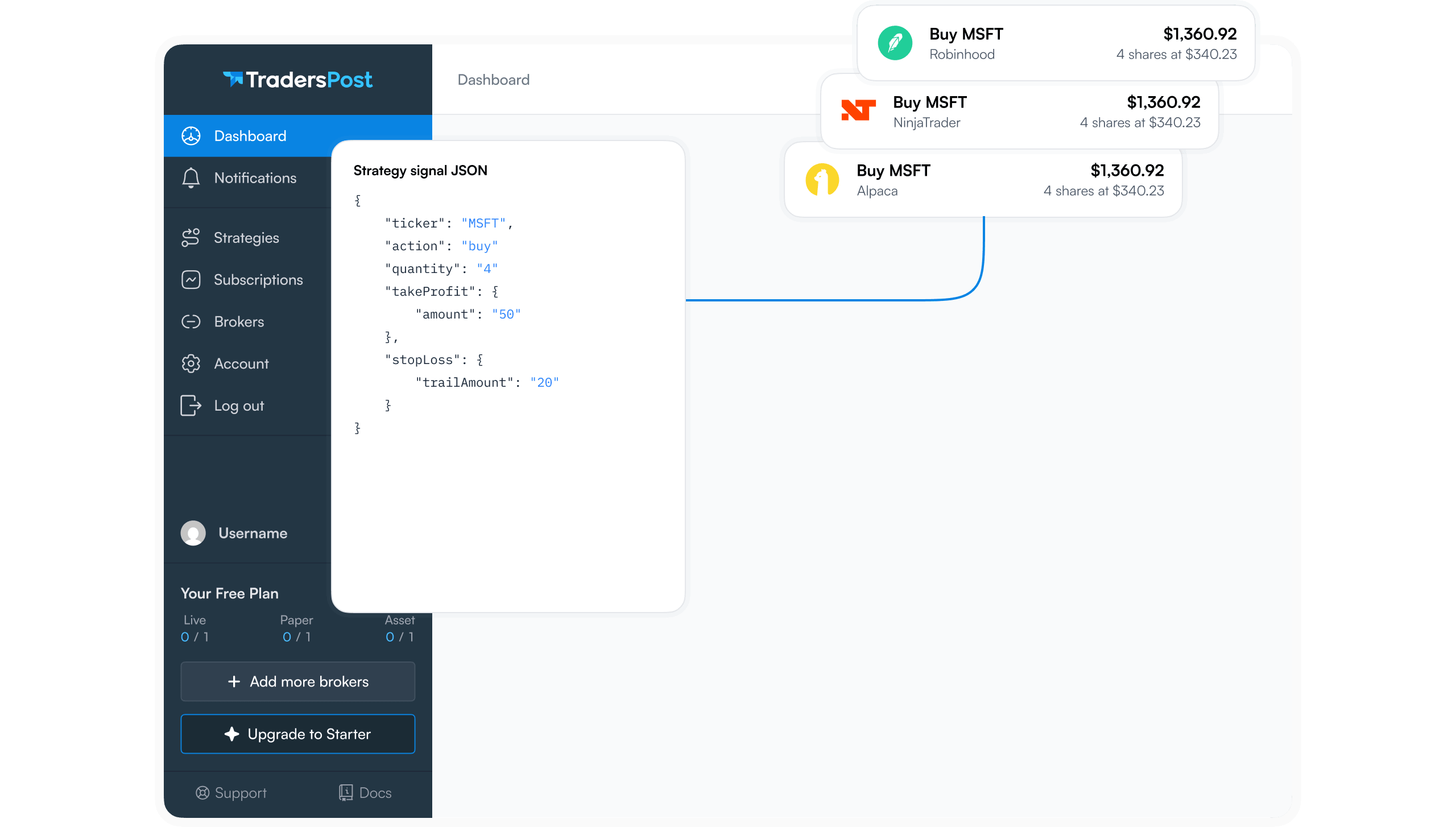
TradingView can define the technical conditions, while TradersPost can turn a qualifying alert into an order instruction for a connected broker. The workflow is straightforward: build a strategy or alert condition in TradingView, configure a webhook alert with the required symbol and action fields, send that alert to a TradersPost webhook endpoint, and let TradersPost interpret the signal and route the order according to the automation settings.3
For geopolitical-risk trading, the objective is not to automate a prediction about a military escalation, sanctions announcement, or emergency policy decision. The objective is to automate a pre-defined response once price and volatility confirm that the market is repricing risk.
- Technical-confirmation entry: Buy an energy ETF only after it closes above a defined breakout level and volume exceeds the strategy threshold.
- Stop-loss exit: Close a long position when price breaches the protective stop level after a headline-driven reversal.
- Profit-taking: Sell part of a position when it reaches a predetermined target, such as 2R or a prior resistance zone.
- Position reversal: Exit a long oil position and establish a short position only when the strategy's reversal condition is met.
- Reduced-size setup: Trade a smaller allocation when implied volatility, ATR, or gap risk exceeds the strategy's normal operating range.
Use alerts that state the intended action unambiguously. A signal should identify the ticker, side, quantity or sizing method, order type, and any relevant exit instructions. Avoid relying on discretionary interpretation after the alert fires, particularly when geopolitical headlines are moving futures and ETFs rapidly.
Use TrendSpider Webhooks for Systematic Macro Setups
Traders who create multi-condition alerts in TrendSpider can use a webhook-based workflow to send qualifying signals to TradersPost. This is useful when a geopolitical thesis requires confirmation across several markets rather than a single chart breakout.
For example, a TrendSpider alert could trigger only when WTI crude oil breaks above a defined resistance level, an energy-sector ETF demonstrates relative strength versus the S&P 500, and volatility remains below the strategy's maximum permitted threshold. That structure prevents an oil breakout from automatically becoming a trade when volatility is so elevated that spreads, gaps, and stop execution are outside the system's assumptions.
Before deploying, standardize the alert payload and test it in a controlled environment. Confirm ticker mapping between TrendSpider, TradersPost, and the broker, especially for ETFs, futures-related products, leveraged funds, and symbols with exchange-specific formatting. The payload should clearly specify the order instruction, including buy, sell, close, or reverse.4 Test both successful alerts and failure cases, such as an invalid symbol, an alert received outside the trading session, or a signal arriving while a position is already open.
Build Safeguards Into the Automation
Geopolitical events create conditions in which a valid signal can still produce an unacceptable trade if risk controls are absent. Configure safeguards before connecting a live broker account:
- Maximum position size: Cap dollar exposure, share quantity, or contracts per symbol.
- Maximum daily loss: Stop new entries after the account or strategy reaches its daily loss limit.
- Duplicate-alert prevention: Prevent repeated webhooks from stacking unintended entries.
- Trading-session restrictions: Limit execution to approved regular or extended-hours windows.
- Exit-first logic: During high-risk periods, require the system to close an existing position before opening the opposite side.
Know exactly how the connected broker handles market, limit, stop, stop-limit, and extended-hours orders. Market orders can fill far from the alert price during a headline shock. Stop orders may trigger in thin liquidity, while limit orders may not fill at all.5 Extended-hours availability and order rules also vary by broker and instrument.
Automation reduces execution delay and inconsistency, not oversight requirements. Monitor incoming alerts, broker acknowledgments, fills, connectivity, rejected orders, and open-position status. A trader should be able to quickly disable an automation when market structure changes beyond the strategy's tested conditions.
Paper Test Your Macro Risk Strategy Before Going Live
Test Across Different Market Regimes
Paper testing should cover more than the latest conflict headline or a short period of unusual volatility. A geopolitical-risk strategy that performs well during one overnight escalation may fail when markets are calm, when inflation data changes rate expectations, or when risk assets rally despite deteriorating headlines. Test the same entry, exit, sizing, and risk rules across multiple regimes:
- Calm, low-volatility equity and FX markets, where false breakout signals are common.
- Inflation surprises and central-bank repricing, particularly rate-sensitive selloffs in technology equities, long-duration bonds, and growth currencies.
- High-volatility periods marked by elevated VIX, broad index gaps, and rapidly widening bid-ask spreads.
- Oil shocks, such as abrupt moves in Brent or WTI following supply-disruption reports, sanctions, or shipping-route threats.
- Risk-on rallies, where defensive positions may decay or trend signals may reverse sharply.
Segment results by market conditions. Compare performance during overnight gaps, wide intraday ranges, regular-session moves, and elevated implied volatility. For example, an automated long-oil breakout system may show attractive backtested returns during headline-driven gaps, but paper results may reveal that its stop orders are consistently filled far below the modeled exit price. Do not approve a strategy because it captured three recent moves in crude oil, gold, or defense-sector ETFs.
Measure More Than Win Rate
Win rate is not a sufficient approval metric for an automated macro strategy. A system can win 35% of trades and still be viable if its losses are predefined, its winners are materially larger than its average loss, and it avoids catastrophic gap exposure. Track the following statistics separately for each instrument and regime:
- Maximum drawdown: peak-to-trough equity decline, including open-position losses where possible.
- Average loss and largest gap loss: distinguish ordinary stopped trades from losses caused by price discontinuities.
- Profit factor and expectancy: gross profits divided by gross losses, and average expected profit or loss per trade.
- Time in trade: identify whether positions are exposed through illiquid overnight or weekend periods.
- Slippage sensitivity: rerun results with worse fills, especially for stop-market orders and thinly traded contracts.
- Correlation of simultaneous positions: long gold, long oil, short equities, and long volatility may appear diversified but can become one concentrated geopolitical-risk trade.
Set a maximum acceptable drawdown before committing capital. If a 12% drawdown would cause you to override the system or disable it at the worst moment, the strategy should be sized so its expected adverse period remains below that threshold.
Move From Paper Trading to Live Trading Gradually
Passing paper tests is an operational milestone, not proof that a strategy is ready for full allocation. Begin live trading at reduced size, such as one-quarter or less of the intended risk budget. Verify that real fills, spread costs, slippage, alert timestamps, broker order handling, and stop behavior match the paper-trading assumptions.6
For automated execution, log the signal time, order-submission time, acknowledgment time, fill price, and exit reason for every trade. Pay particular attention to major macro events, including emergency sanctions announcements, central-bank decisions, energy-supply disruptions, and weekend geopolitical developments. After each event, conduct a structured review: identify whether the strategy followed its rules, whether execution differed from expectation, and whether any change is justified across a broad sample. Do not rewrite parameters to fit one headline outcome. Improve durable controls, such as position caps, stale-data checks, volatility filters, and kill-switch conditions.
Frequently Asked Questions
How should retail traders manage geopolitical risk?
Retail traders should use predefined event-risk rules, smaller position sizes, clear stop-loss or trade invalidation levels, and portfolio exposure limits. Focus on market-confirmed price action instead of trying to predict every geopolitical headline. Avoid carrying oversized or highly correlated positions through known high-impact events, since sudden news can create gaps, spreads, and volatility that exceed normal expectations. A written plan helps keep decisions consistent when headlines move quickly.
What assets tend to react to geopolitical conflict?
Market reactions depend on the specific event, but energy markets, defense-related stocks, gold-related instruments, major stock indexes, bonds, currencies, and volatility products can all respond. However, no asset is automatically defensive or guaranteed to move in one direction. Traders should evaluate the current trend, liquidity, correlations, and event-specific risks before entering a position. Strong risk controls matter more than assumptions about how an asset “should” behave.
Should I trade during Fed meetings or inflation reports?
Only trade Fed meetings or inflation reports if your strategy has been specifically tested under comparable volatility, spread, and gap conditions. Many retail traders may prefer to reduce position size, avoid opening new trades, or wait for post-event price confirmation. Your written trading plan should define how open positions are handled before, during, and after the release. If the event creates conditions outside your tested rules, staying out is a valid decision.
Can TradersPost automate risk management rules?
TradersPost can automate rule-based order execution from TradingView or TrendSpider webhook alerts when configured with supported broker connections. Traders can use alerts for entries, exits, position adjustments, and strategy-specific sizing logic. However, automation requires careful configuration, testing, understanding of broker order behavior, and ongoing monitoring. Before using real capital, confirm that alerts, order types, position sizing, and risk limits behave as intended in realistic market conditions.
Why should I paper trade a macro strategy first?
Paper trading helps validate a macro strategy’s rules, alert timing, order workflow, and expected behavior during volatile conditions. It can uncover problems with position sizing, duplicate alerts, slippage assumptions, execution timing, and correlated portfolio exposure before real money is at risk. Paper results do not guarantee live performance, especially during fast markets. After testing, consider beginning live deployment with reduced size while continuing to monitor execution and risk.
Conclusion
Geopolitical risk in 2026 is less about predicting headlines and more about preparing for how markets may react when uncertainty rises. Retail traders should watch for volatility regime changes, widening spreads, overnight gaps, sector rotation, and correlations that can shift quickly during global events. A disciplined plan with predefined entries, exits, position limits, and circuit breakers can help turn an emotional news cycle into a manageable trading process.
Create a TradersPost account and paper test a TradingView or TrendSpider alert workflow before trading live. Automating risk rules can help ensure that protective decisions are executed consistently when market conditions become fast and stressful.
When you are ready to move from simulation to live trading, start with reduced size and validated risk rules. Build confidence through evidence, refine your process, and trade geopolitical uncertainty with greater discipline and control.
References
1 Charles Schwab, Q2 2026 Retail Client Sentiment Report
2 TradersPost Docs, Position Sizing
3 TradersPost Docs, TradingView Signal Source
4 TradersPost Docs, Webhooks
5 TradersPost Docs, Order Behavior
6 TradersPost Docs, Paper Trading