Meme Stock Automation Alerts for Breakouts
Build meme stock automation alerts for volume breakouts and squeeze setups, with automated stops, profit targets, and paper-tested execution rules today.

Marketing

Bottom Line
- Meme stock automation alerts focus on identifying breakout conditions through measurable factors like relative-volume surges and resistance breaks.
- The June 2026 Wendy's rally highlights the need for a framework to measure participation and avoid relying solely on social-media attention.
- Automation requires a breakout close above defined resistance, with relative volume above 2.5, to confirm sustained buying interest.
- Tradeability filters should include average daily dollar volume above $10 million and a bid-ask spread no wider than 0.5% of the midpoint.
- Automation workflows can calculate share size from a fixed dollar risk and place stops below defined invalidation levels to manage risk effectively.
Meme stock automation alerts can turn a chaotic stream of social buzz, unusual volume, and fast-moving price action into a disciplined trading process. The goal is not to chase every ticker trending online. It is to identify measurable breakout conditions, confirm momentum with liquidity and volume data, and act only when predefined rules align.
This guide shows you how to build alerts for key meme-stock setups, including relative-volume surges, resistance breaks, short-interest-driven squeeze conditions, and volatility expansion. You will learn how to define triggers that reduce noise, route qualifying signals into a watchlist or paper-trading workflow, and avoid treating a single headline or viral post as a trade thesis.
More importantly, the framework connects entries to risk controls. We will cover automated stop levels, profit targets, position-sizing limits, and time-based exits so each alert comes with a complete execution plan. By paper testing the rules before committing capital, you can evaluate whether a breakout strategy has a real edge rather than relying on adrenaline, social momentum, or hindsight.
Why Meme Stock Automation Alerts Matter in Fast Markets
The Problem With Trading Reflexive Meme-Stock Moves Manually
Meme-stock breakouts can move from a watchlist candidate to an unmanageably volatile trade in minutes. The most aggressive moves usually occur when several measurable forces converge: accelerating social-media attention, volume far above the stock’s normal intraday baseline, elevated call-option activity, a heavily shorted float, and a break through a widely watched technical level. Once those conditions align, price can gap through levels that a manual trader expected to use for entry or risk control.
Manual execution commonly fails at the points where discipline matters most:
- Late entries: The trader sees the alert, checks multiple charts, reads headlines, and enters after the initial breakout has already expanded several percent.
- Chasing extended candles: A five-minute candle closes well above VWAP or a prior resistance level, but the entry occurs near the candle high rather than on a defined pullback or continuation trigger.
- Missed exits: Rapid upside reversals can erase open gains before a discretionary trader recognizes that volume, breadth, or price structure has deteriorated.
- Emotional stop management: A predefined stop is widened after entry because the trader labels normal volatility as “noise,” converting a controlled loss into outsized exposure.
- Alert paralysis: The breakout notification arrives, but no action follows because the trader has not defined the exact conditions required to trade it.
Automation does not predict a meme-stock rally. It converts a tested decision process into consistent execution. For example, an alert can require price to reclaim VWAP, break the opening-range high, trade at least 300% of its average five-minute volume, and maintain a minimum relative-volume threshold before submitting an order. The same workflow can calculate share size from a fixed dollar risk, place a hard stop below a defined invalidation level, and reduce exposure when price reaches a predetermined target or loses VWAP.
What the June 2026 Wendy’s Rally Can Teach Traders
The June 2026 Wendy’s rally illustrates how quickly meme-stock attention can translate into high-volume price expansion, followed by sharp reversals once early momentum participants begin taking profits.1 The lesson is not that a similar rally should be expected in every consumer-facing stock with social-media attention. It is that traders need a framework for measuring participation before committing capital.
Use the event as an educational template. First, define the setup: identify the catalyst, the key premarket or prior-day resistance level, the stock’s average intraday volume, and the location of VWAP. Second, confirm participation: require expanding volume, sustained trade above the breakout level, broadening options activity where relevant, and a spread narrow enough for the intended stop distance.
Third, automate only when the filters pass. A practical rule set might enter only after a five-minute close above resistance, relative volume above 4.0, and no more than a specified percentage of extension from VWAP. Finally, use preplanned exits: a hard stop below the breakout level, a partial profit target at a defined multiple of initial risk, and a time-based or VWAP-failure exit if momentum stalls. This structure turns a highly reflexive event into a bounded, rules-driven trade decision.
Break Down the Wendy's Meme-Stock Setup
Identify the Catalysts Behind a Potential Meme-Stock Breakout
A Wendy's (WEN) meme-stock setup typically begins with attention, but attention alone does not create a tradable breakout. Monitor a defined group of catalysts: accelerating viral discussion across major retail-trader communities, company-specific news, unusual retail participation, reported short interest, elevated call-option volume, and price action approaching a widely recognized resistance level.
For automation, treat these inputs as watchlist qualifiers rather than entry commands. A surge in WEN mentions or unusually active near-term calls can explain why the ticker deserves monitoring, but neither condition confirms that buyers can absorb overhead supply. A catalyst becomes actionable only when price and volume validate it.
- Social and retail attention: Alert when mention volume or engagement rises materially above its recent baseline, rather than reacting to a single viral post.
- Short-interest context: High short interest can increase squeeze potential, but it does not guarantee forced covering or sustained upside.
- Options activity: Track call volume, open interest concentrations, and unusually short-dated activity, particularly near round-number strikes.
- Price confirmation: Require a breakout through a predefined level with relative volume above the stock's normal intraday pace.
Maintain a focused watchlist of liquid, highly discussed names with identifiable catalysts and clean technical structure. Scanning every ticker with social-media activity produces excessive alerts and makes it difficult to distinguish a genuine momentum expansion from routine speculative noise.
Map the Price Levels That Matter Before the Market Opens
Before the opening bell, map the prior-day high, premarket high, opening-range high, daily resistance, volume-weighted average price (VWAP), and major gap levels. For WEN, these levels convert a narrative-driven trade into a rule-based alert framework. They also provide clear invalidation points when momentum fails.
For example, if WEN closed at $8.10, traded to $8.42 in premarket, and has visible daily-chart resistance near $8.50, an automation workflow can separate observation from execution:
- Send an early alert when price approaches the $8.42 premarket high on expanding volume.
- Trigger a breakout candidate alert only after a completed intraday bar closes above $8.42.
- Validate the signal only if price remains above VWAP and relative volume is above the configured threshold.
- Escalate the alert if price clears $8.50, where daily resistance may trigger additional momentum participation.
A practical rule is: only consider a long breakout if price closes above the premarket high and remains above VWAP. This prevents an alert system from treating a brief wick above resistance as a confirmed move. The opening-range high can serve as a second confirmation level, while the prior-day high and gap boundaries help define upside targets and failure zones.
Review the Wendy's Event Timeline and Market Context
For the underlying event sequence, catalyst interpretation, and broader trading environment, read the June 2026 Wendy's meme-stock rally analysis. Use that case study to understand why attention developed, then apply the level-based and volume-confirmed alert rules above rather than automating entries from headlines or social activity alone.
Build High-Volume Breakout Alerts
Use Relative Volume to Separate Real Participation From Noise
Relative volume (RVOL) measures current traded volume against typical volume, either for the same time of day or against a historical average. For automated breakout alerts, time-of-day RVOL is generally more useful. A stock trading 800,000 shares by 10:00 a.m. may look active in isolation, but that figure is unremarkable if it normally trades 1 million shares by that time.
A practical starting rule is to require RVOL above 2.0 to 3.0. For example, an alert might require that cumulative volume at 10:15 a.m. exceeds 2.5 times the symbol's average cumulative volume at 10:15 a.m. over the prior 20 trading sessions. Adjust this threshold by liquidity and test results. Highly liquid meme names may need RVOL above 3.0 to avoid frequent alerts, while thinner but still tradable names may warrant a lower threshold if other filters are strict.
Raw share volume can be misleading, particularly in low-float stocks. A 2 million-share print can represent genuine demand in one ticker and routine churn, promotional activity, or a brief liquidity event in another. RVOL normalizes activity against the symbol's own behavior, making it more effective for identifying abnormal participation.
Require a Breakout Close, Not Just an Intrabar Spike
Automation should generally trigger from a bar close above defined resistance, rather than from a momentary trade above that level. Meme stocks frequently print wick-throughs caused by thin order books, aggressive market orders, and short-lived liquidity gaps. An intrabar high above resistance does not establish that buyers can hold the level.
A concrete 5-minute confirmation rule could be:
- Trigger only when a 5-minute candle closes above the premarket high.
- Require time-of-day RVOL above 2.5.
- Require the closing price to remain above session VWAP.
- Reject the signal if the candle closes less than 0.15% above resistance, unless the strategy specifically tests minimal-breakout entries.
For example, if a stock's premarket high is $8.40, an eligible signal requires a completed 5-minute candle closing above $8.40, elevated RVOL, and price above VWAP. Traders seeking earlier entries can test intrabar triggers as a separate strategy, but should expect more false signals, higher slippage, and tighter invalidation rules.
Add Liquidity and Spread Filters Before Automation
A technically valid breakout can still be unsuitable for automated execution. Apply tradeability filters before an order is sent. A reasonable baseline is average daily dollar volume above $10 million, a share price above $1.00, and a bid-ask spread no wider than 0.5% of the midpoint at the time of the alert. More conservative systems may require $25 million in average daily dollar volume and a spread below 0.25%.
- Exclude symbols currently halted or pending a volatility pause.
- Reject symbols with fragmented quotes, stale bids, or rapidly widening spreads.
- Block automated execution where the broker has opening-only, closing-only, or other trading restrictions.
- Use limit orders with a maximum permitted slippage threshold, rather than unrestricted market orders.
These filters ensure the alert identifies not only a breakout pattern, but a setup that can be executed with controlled fill quality.
Add Unusual-Volume and Short-Squeeze Filters
Create an Unusual-Volume Alert Stack
Unusual volume is most useful when it confirms a price event, not when it appears in isolation. Meme stocks can print elevated volume during failed squeezes, news-driven churn, or liquidity spikes that never develop into a tradable breakout. Build alerts that require several conditions to align before notifying the strategy or permitting an order.
An illustrative 5-minute breakout rule set could require all of the following:
- Relative volume: session RVOL greater than 3.0 versus the stock's average volume for the same time of day over the prior 20 sessions.
- Bar-level expansion: current 5-minute volume is at least 150% of the preceding 5-minute bar.
- VWAP confirmation: the 5-minute close is above session VWAP.
- Breakout condition: the close exceeds a defined resistance level, such as the premarket high, opening-range high, or a prior intraday pivot.
- Extension control: price is no more than 5% above VWAP when the signal triggers.
For example, if a stock breaks a $12.40 premarket high on 4.2 RVOL, prints 900,000 shares versus 500,000 in the prior bar, and closes at $12.55 with VWAP at $12.10, the setup qualifies. If it closes at $13.05, more than 5% above VWAP, the automation should flag it as extended rather than chase it. Stacked conditions reduce alert frequency, but they filter out low-quality volume spikes and concentrate attention on names showing both participation and price acceptance.
Use Short Interest as Context, Not a Standalone Buy Signal
Short interest can identify names vulnerable to forced covering, but it does not predict a squeeze. High short interest may persist because the market is pricing dilution risk, weak fundamentals, debt stress, or a declining business. An automated system should treat short data as a ranking input rather than an entry trigger.
- Short interest percentage: indicates the portion of float sold short.
- Days to cover: estimates how many average-volume trading days would be required for shorts to cover.
- Borrow availability and borrow fee: indicate whether shorting is becoming constrained or expensive.
- Float size: helps assess whether new demand can move the stock materially.
A squeeze-prone candidate typically needs a catalyst, strong volume, price acceptance above resistance, and sustained buying after the initial breakout. High short interest without these price and volume conditions is not confirmation.
Watch for Squeeze Confirmation Through Price Behavior
After an alert triggers, price behavior should determine whether the strategy enters, scales, or rejects the setup. Favor a sequence of higher highs and higher lows, repeated VWAP reclaims after shallow pullbacks, closes near the upper portion of each 5-minute range, and breakout retests that hold above the former resistance level.
Define invalidation before sending an order. For a breakout entry above $12.40, the invalidation might be a 5-minute close below $12.40, a loss of VWAP with expanding sell volume, or a break below the most recent higher low. Warning conditions should suppress new entries: failed breakouts, heavy upper wicks, increasing-volume VWAP failures, volatility halts, and rapid reversal after parabolic extension. Automation should respond to these events mechanically, including canceling unfilled orders, blocking adds, and reducing exposure when the original breakout thesis fails.
Filter False Meme-Stock Breakout Signals
Avoid Chasing Extended Moves Away From VWAP
Many meme-stock breakout failures begin when an alert triggers after the most favorable entry has already passed. A stock that has moved sharply above its intraday VWAP or its original breakout level may still print higher highs, but the risk-to-reward profile often deteriorates quickly. Late entries are vulnerable to VWAP mean reversion, profit-taking from earlier buyers, and liquidity withdrawals near parabolic highs.
Build a measurable extension filter into the automation. For example, reject a new long entry when the trigger price is more than 3% above intraday VWAP or more than 1.25 times the 5-minute ATR above VWAP. A $10 stock with a VWAP of $9.70 would fail a 3% extension rule if the alert fires above $9.99. An ATR-based rule adapts better to changing volatility, particularly for lower-float names that can trade in wide intraday ranges.
- Calculate VWAP and ATR from the same bar interval used for the breakout signal.
- Record the VWAP distance at every alert, including rejected alerts, for later analysis.
- Test separate limits for 1-minute, 5-minute, and 15-minute strategies rather than applying one threshold to every ticker.
- Consider a pullback-and-hold condition: permit entry only if price retests near the breakout level or VWAP and then reclaims a short-term high on volume.
Require Market and Sector Context
A meme-stock breakout does not occur in isolation. Before allowing a long alert to route an order, assess whether the broad market is supportive, whether the relevant sector or thematic basket is participating, and whether the ticker has a verified company-specific catalyst. A strong move in one ticker while comparable names are weak may be valid, but it should be treated differently from a broad momentum move supported by sector participation.
Market-wide risk-off conditions increase the probability that upside breakouts will fail. A practical automation rule is to pause new long entries when the benchmark index, such as SPY or QQQ, is below intraday VWAP and making lower intraday lows. Validate the rule with historical and simulated data. Measure breakout follow-through, stop-out rate, and maximum adverse excursion with the filter enabled and disabled.
- Use a sector ETF or peer basket where available, such as XBI for biotech-related momentum or a custom basket for retail and social-media-driven names.
- Require a minimum relative-volume threshold and confirm that the catalyst source is timestamped and verified.
- Flag moves driven solely by unconfirmed social posts, stale headlines, or abnormal options activity without supporting cash-equity volume.
Protect Against Poor-Quality Alerts and Duplicate Entries
Alert quality controls are as important as signal logic. Every webhook or API alert should contain a unique alert identifier, ticker symbol, strategy name, timestamp, intended order direction, quantity logic, and broker-account destination.2 Store the identifier before submitting an order, then reject retransmitted alerts with the same ID. This prevents duplicate orders caused by platform retries, network latency, or multiple chart conditions firing simultaneously.
Enforce a one-position-per-symbol limit and track both open positions and pending orders. If the system already owns shares or has an unfilled buy order, subsequent long alerts for that symbol should be ignored unless the strategy explicitly supports scaling.
- After a stop-out, block re-entry for 15 to 30 minutes.
- Override the cooldown only when a new high-volume consolidation forms and price breaks a newly defined resistance level.
- Validate ticker formatting, including share-class symbols and exchange suffixes, before routing orders.
- Confirm that long and short directions map correctly to the broker API and that alerts cannot route to the wrong account.
- Run malformed payload, duplicate-ID, stale-timestamp, and wrong-symbol tests in paper trading before enabling live automation.
Automate Position Sizing, Stops, and Profit Targets
Size Positions From a Fixed Dollar-Risk Amount
Automate position size from the amount you are willing to lose if the stop is reached, not from a fixed share count.3 The core calculation is:
Shares = maximum dollar risk ÷ (entry price - stop price)
For example, assume a $200 maximum loss, a planned entry at $20.00, and a stop at $19.20. The risk per share is $0.80, so the position size is:
$200 ÷ ($20.00 - $19.20) = 250 shares
Before submitting the order, reduce the size or widen the risk estimate to account for expected slippage, commissions, and the possibility that a stop order fills below its trigger price. If the strategy assumes an additional $0.08 per share of execution risk, use $0.88 rather than $0.80 as the effective risk per share.
Using the same number of shares on every meme-stock breakout creates inconsistent account risk. A 500-share position with a $0.20 stop risks $100 before slippage, while the same 500 shares with a $2.00 stop risks $1,000. Fixed-risk sizing keeps the loss budget consistent even when volatility, share price, and stop distance change.
Use Hard Stops That Account for Volatility
Your automation should calculate the stop before entering and transmit it as a hard exit instruction where supported.4 Valid stop references include:
- Below the breakout level: useful when a reclaimed resistance level should become support.
- Below VWAP: appropriate for intraday momentum trades that depend on sustained institutional-style demand.
- Below the most recent higher low: suitable when the trade thesis is based on a developing intraday uptrend.
- ATR-based: use a multiple of average true range to adapt stop distance to current volatility.
A stop that is too tight will be repeatedly triggered by normal meme-stock noise. A stop that is too wide can make a single failed breakout exceed the account-level risk limit. The alert workflow should reject trades when the required stop distance produces a position size below the strategy minimum or when expected slippage makes the total risk unacceptable.
Include a slippage buffer in every calculation. Fast moves, trading halts, gaps, thin order books, and imperfect fills mean a stop price is not a guaranteed exit price. Alerts should distinguish between the stop trigger, the estimated worst-case fill, and the maximum permitted dollar loss.
Lock Gains With a Profit-Taking Ladder
Define R as the initial risk per share: entry price minus stop price. If entry is $20.00 and the stop is $19.20, then 1R equals $0.80 per share. A systematic profit-taking ladder can then adapt across different price levels and volatility regimes:
- Sell one-third at 1R, or $20.80 in this example.
- Sell another one-third at 2R, or $21.60.
- Trail the final one-third using a prior-bar low, VWAP, or volatility-based stop.
Automate alerts for each target, partial-fill confirmation, and trailing-stop updates. Partial profit-taking reduces the temptation to make discretionary decisions after a rapid spike while retaining a defined portion of the position for a genuine squeeze. The remaining shares participate in extended upside, but the trade has already realized gains and reduced exposure.
Connect TradingView or TrendSpider Alerts to TradersPost
Choose the Alert Platform for Your Workflow
Choose the platform that matches how you define a meme-stock breakout, not the platform with the most indicators. TradingView is well suited to traders using custom Pine Script conditions, discretionary chart levels, or strategy-generated signals. For example, a Pine Script alert can require price to break the premarket high, relative volume to exceed a threshold, and the candle to close above VWAP before issuing a long instruction.5
TrendSpider is a stronger fit when the workflow depends on multiple technical factors, automated trendline analysis, and scanner-driven idea generation. A scanner can identify symbols with expanding volume, a break above an automated resistance line, and bullish moving-average alignment, then trigger an alert only when the full rule set is satisfied.
Before creating any alert, write the trading logic in plain language. Define the entry trigger, session filter, invalidation condition, sizing rule, and exit process. For example: “Buy only when a stock breaks its premarket high on at least three times average five-minute volume, only between 9:35 and 11:00 a.m. ET, with risk capped at 0.5% of account equity.” This written specification prevents a chart alert from becoming an ambiguous trade instruction.
Build a Webhook Alert With a Clear Trade Instruction
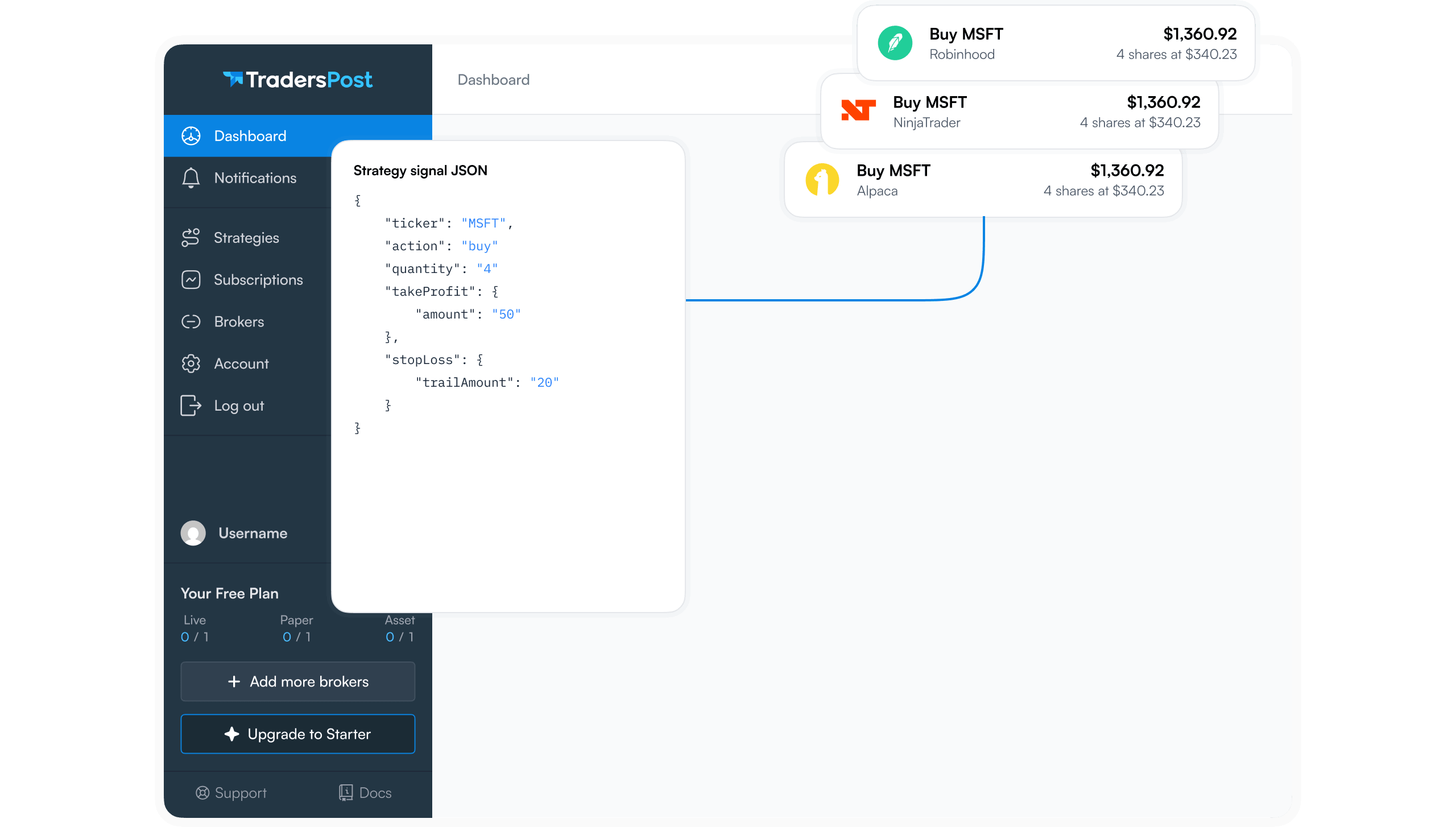
An alert sent to TradersPost should communicate enough information to identify and route the trade correctly. At minimum, include:
- Symbol: the tradeable ticker, such as GME or AMC.
- Action: buy, sell, short, or cover, consistent with the broker connection and strategy permissions.
- Strategy name: a stable identifier such as meme_premarket_breakout_v1.
- Quantity or sizing instruction: a fixed share amount, dollar allocation, or other supported sizing method.
- Optional tracking metadata: alert ID, chart timeframe, setup type, signal price, stop reference, or scanner name.
Do not assume that a message which looks correct on a chart will produce the intended order. First send alerts through a non-live workflow and verify that the receiving system recognizes the correct symbol, action, strategy, and quantity. Check the current TradersPost webhook documentation before implementing payload fields, authentication settings, and order instructions, since supported formats and capabilities can change.
Paper Test Before Going Live
Meme-stock alerts must be tested in conditions that expose execution risk, not only in clean historical breakouts. Paper test high-volume breakouts, failed breakouts, trend days, low-liquidity choppy sessions, and post-halt volatility. A signal that performs well in a gradual breakout may fail badly when a halted stock reopens 15% above the alert price.
Track each alert and resulting simulated trade: alert frequency, assumed fill price, slippage versus signal price, maximum adverse excursion, maximum favorable excursion, win rate, average R multiple, and the percentage of trades affected by delayed or missed fills. Separate results by setup type and time of day.
Validate the rules over a meaningful sample of trades across different market regimes before deploying capital. Once the process is stable, begin live trading with reduced position size, then compare live fills and slippage against the paper-test assumptions before increasing exposure.
A Practical Meme-Stock Automation Checklist
Pre-market checklist
Run the automation checklist before the opening auction, not after the symbol begins moving. First, confirm the catalyst from a primary source: an SEC filing, company press release, earnings release, merger announcement, FDA decision, or a reputable wire report. Social-media mentions alone are not a sufficient catalyst for enabling automated breakout entries.
- Watchlist status: Confirm the symbol is explicitly enabled for the session. Use an allowlist rather than permitting the strategy to scan and trade any high-volume ticker.
- Key levels: Record premarket high, premarket low, prior-day high and low, prior close, and major daily-chart resistance. Define these levels before regular-hours volatility changes the structure.
- Relative volume baseline: Compare premarket volume and opening volume against the symbol’s typical volume for the same time of day. A 2.5 RVOL reading is more meaningful when calculated against a consistent intraday baseline.
- Short-interest context: Review reported short interest, days to cover, borrow availability, and borrow fee where available. High short interest can amplify upside moves, but it also increases the probability of abrupt liquidity failures and reversals.
- Liquidity: Set minimum average daily volume, minimum current volume, maximum bid-ask spread, and minimum displayed depth requirements. A breakout alert is not actionable if fills are likely to occur far from the expected entry price.
- Broker eligibility: Verify the symbol is tradable through the intended account, including restrictions related to margin, hard-to-borrow status, fractional-share rules, corporate actions, and broker-specific risk controls.
Set a maximum daily loss, a maximum number of automated entries, and a fixed list of symbols permitted for trading. For example, disable new entries after a $500 realized-plus-unrealized daily loss, three completed trades, or one failed breakout in the same symbol. Review scheduled events such as earnings calls, investor presentations, halts, compliance notices, secondary offerings, lockup expirations, and anticipated regulatory decisions. Configure the system to disable entries, reduce size, or require manual approval around these events.
Example automated breakout playbook
The following is a starting framework for a long breakout alert and order workflow. Trigger an entry only when all conditions are true:
- A 5-minute candle closes above the premarket high, rather than merely trading through it intrabar.
- Relative volume exceeds 2.5 versus the defined time-of-day baseline.
- Last price is above session VWAP.
- The bid-ask spread is below a predefined threshold, such as $0.05 or 0.30% of price, depending on the symbol.
- Price is not excessively extended from VWAP. For example, block entries when price is more than 3% above VWAP or more than 1.5 ATR from the 5-minute VWAP reference.
Calculate position size from a fixed dollar-risk limit. If the account permits $200 of risk and the entry is $10.20 with a hard stop at $9.90, risk per share is $0.30 and maximum size is 666 shares, rounded down for buying-power and liquidity constraints. Place the hard stop below the breakout level or the most recent valid 5-minute swing low. Prohibit more than one open position in the same symbol.
At 1R, sell a defined partial position, such as 33%. At 2R, sell another 33%, then trail the remainder using a 5-minute swing low or a VWAP-based exit rule. Exit the full position if price loses VWAP on expanding sell volume or if the hard stop triggers. These thresholds are starting examples, not financial advice, and must be tested against the trader’s market, broker execution behavior, and risk tolerance.
Frequently Asked Questions
Can I automate meme-stock breakout trades with TradingView alerts?
Yes. TradingView alerts can be configured around objective conditions such as a candle close above resistance, relative-volume thresholds, and confirmation that price is above VWAP. When those conditions are met, a webhook can send the approved signal to TradersPost, which can route rule-based orders to a connected broker. Before risking live capital, test the complete alert, webhook, order-routing, and execution workflow in paper trading.
What is the best alert for a meme-stock breakout?
There is no single best alert for every meme stock, but a strong starting framework combines a confirmed break above resistance, elevated relative volume, price above VWAP, and liquidity filters. Avoid treating social-media mentions, short interest, or one sharp price spike as standalone entry signals. Backtest and paper test different thresholds to find settings that fit the tickers, session times, and timeframes you trade.
How do I avoid false meme-stock breakout alerts?
Require candle-close confirmation instead of reacting to every intrabar wick above resistance. Add filters for relative volume, bid-ask spread, distance from VWAP, overall market conditions, and duplicate-entry prevention. You can also limit signals to stocks meeting minimum liquidity requirements. Even with strong filters, meme stocks can reverse quickly, so every automated strategy should include a defined hard stop and a maximum loss limit.
Can automated trading protect me from meme-stock volatility?
Automation can enforce predefined position sizes, stop-losses, profit-taking rules, daily trade limits, and maximum-loss controls. However, it cannot eliminate market risk. Fast price moves, trading halts, overnight gaps, liquidity changes, and slippage may cause fills that differ from expected prices. Use conservative position sizing, account for potential execution delays, and paper test the strategy during volatile market conditions before deploying it with live funds.
Should I use short interest as an automated buy signal?
No. High short interest can provide context for possible squeeze dynamics, but it does not prove that a stock will move higher. Use short-interest information alongside price acceptance above resistance, unusual volume, VWAP confirmation, and a clearly defined risk plan. Short-interest data may also be delayed, making it unsuitable as a real-time trigger on its own. Treat it as supporting context rather than an automated buy signal.
Conclusion
Meme-stock breakouts can move quickly, but automation is most useful when it enforces disciplined execution rather than amplifying impulse. Define objective breakout, volume, liquidity, and risk parameters, then use alerts to trigger a repeatable workflow instead of chasing social-media momentum. Position sizing, stop rules, and trading-hour filters matter as much as the entry signal when volatility expands.
Before committing capital, create a TradersPost paper trading workflow, connect your TradingView or TrendSpider alert, and validate how your rules perform across different market conditions.6 Review fills, false breakouts, and risk exposure, then refine the system before placing live meme-stock trades.
Ready to build a more consistent process? Start paper testing your automated breakout playbook with TradersPost today, then move live only when the data supports your rules. Trade systematically and stay prepared.
References
1 Seeking Alpha, Wendy's meme stock rally (June 2026)
2 TradersPost Docs, Webhooks
3 TradersPost Docs, Position Sizing
4 TradersPost Docs, Order Classes
5 TradersPost Docs, TradingView Signal Source
6 TradersPost Docs, Paper Trading