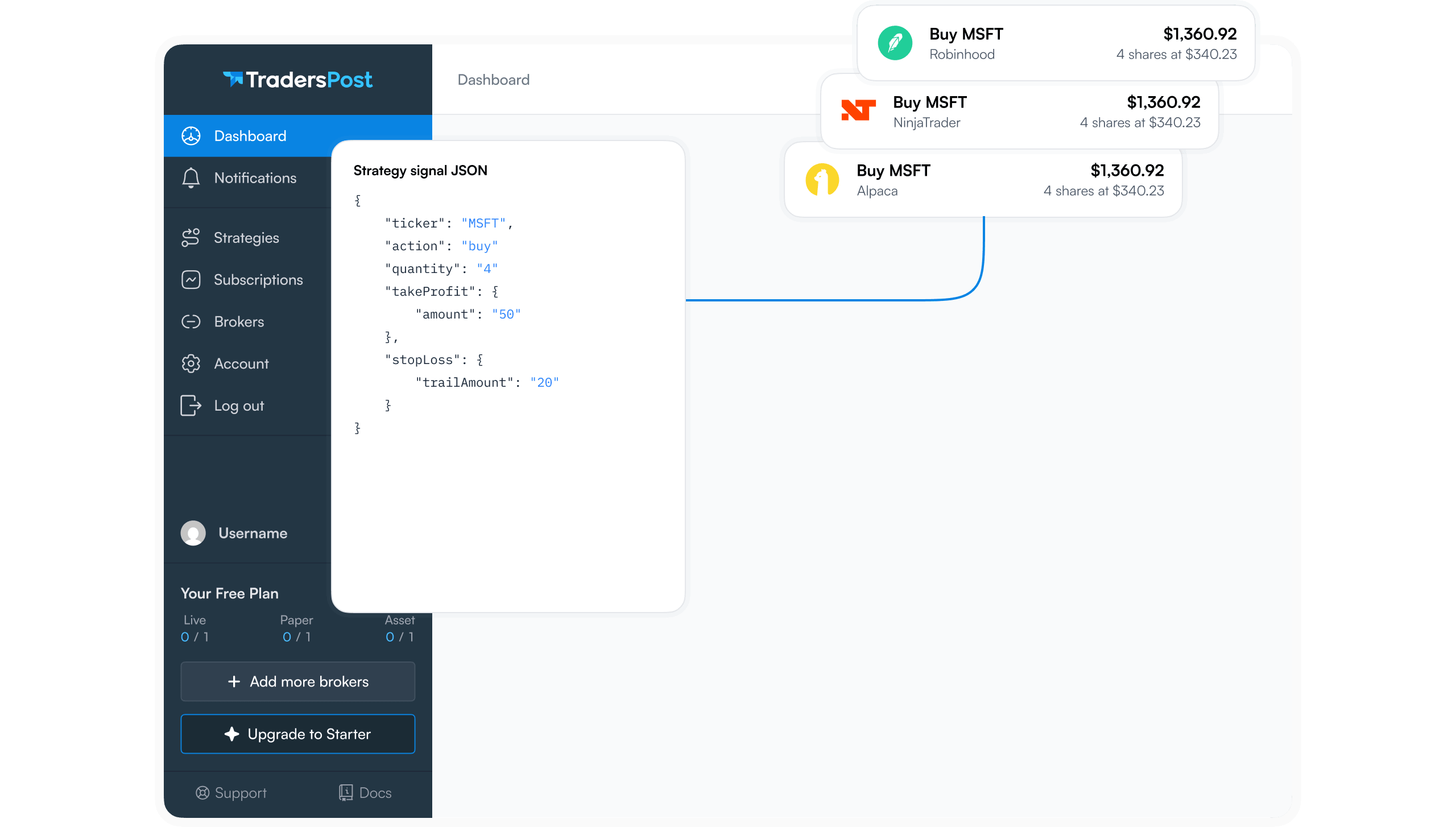
Multi-Broker Automation Scaling: Best Practices
Learn multi-broker automation scaling best practices for webhook routing, allocation rules, monitoring, and failure recovery with TradersPost at scale.

Marketing

Bottom Line
- Multi-broker automation scaling requires converting a single strategy intent into broker-specific orders, considering each account's capital, positions, and order types.
- A $5,000 SPY call debit spread signal may be allocated differently across accounts, such as one spread for a $25,000 account and four for a $100,000 account.
- Scaling across brokers introduces challenges like separate authentication methods, rate limits, and different contract identifiers.
- Operational risks increase with each account, including potential for duplicate alerts, inconsistent sizing, and symbol mismatches.
- Allocation models should be defined before going live, with options like equal dollar, equal risk, fixed quantity, percentage of equity, and account-priority allocation.
Scaling automated trading across multiple brokerage accounts introduces a different class of risk: a valid signal can still produce the wrong allocation, route to an unavailable account, duplicate an order, or leave positions out of sync after a webhook failure. Effective multi broker automation scaling requires more than connecting additional accounts. It requires deliberate routing logic, account-specific sizing controls, position awareness, and clear safeguards for every order lifecycle event.
This guide explains how to build a scalable multi-broker workflow with TradersPost without sacrificing execution discipline. You will learn how to structure webhook payloads for reliable routing, apply allocation rules across accounts and strategies, separate broker-specific constraints, monitor orders and fills in real time, and design recovery procedures for rejected, delayed, or partially executed trades. Whether you are distributing signals across personal accounts, managing distinct strategy allocations, or expanding an options workflow across brokers, these practices help reduce operational errors while keeping automation controllable, auditable, and ready to scale.
What Multi-Broker Automation Scaling Actually Requires
Move Beyond Simple Trade Copying
Multi-broker automation scaling means operating one strategy decision engine across multiple brokerage accounts while controlling how each signal is routed, sized, executed, monitored, and recovered. Trade copying is only the distribution layer. A robust system must convert a single normalized strategy intent, such as “buy 10 delta calls with 30 DTE risk capped at 1% of equity,” into broker-specific orders that account for each account’s capital, existing positions, option permissions, buying power, and supported order types.
For example, a signal to open a $5,000 SPY call debit spread cannot be sent identically to every account. A $25,000 account may be allocated one spread, a $100,000 account may receive four, and a paper account may receive a simulated order for validation only. If one broker requires option symbols in OCC format while another accepts a platform-specific contract identifier, the routing layer must translate the instrument correctly before submission.
Reliable scale also requires controls beyond order transmission:
- Alert consistency: Every downstream account must receive the same unique strategy signal, with an idempotency key to prevent duplicate execution after retries or webhook redelivery.
- Allocation rules: Define whether sizing is fixed, equity-weighted, risk-weighted, or limited by available buying power.
- Execution monitoring: Track submitted, accepted, rejected, partially filled, filled, canceled, and expired orders at the account level.
- Recovery procedures: Specify how the system responds when an order fails, an API is unavailable, or an account is disconnected.
Scaling across multiple accounts at one broker is generally simpler because order APIs, symbol conventions, and account rules are more consistent. Scaling across brokers introduces separate authentication methods, rate limits, contract identifiers, order capabilities, and fill-reporting formats. Scaling across account types adds another layer: live accounts require capital and risk controls, while paper accounts are useful for integration testing but may not reproduce live fills, liquidity constraints, or rejection behavior.
Identify the Operational Risks That Grow With Every Account
Each additional account increases the number of possible execution states. A single strategy alert can produce a fill in one account, a partial fill in another, and a rejection in a third. The difference may result from available buying power, unsettled funds, existing position limits, margin treatment, short-option approval, fractional-share support, or broker-specific restrictions on complex option orders.
Common failures include duplicate alerts that open the same position twice, inconsistent sizing caused by stale account equity, symbol mismatches between broker APIs, rejected orders, partial fills that create unintended directional exposure, and API outages that leave one account unexecuted. An account can also fall out of sync when a trader manually closes a position, when an order is canceled externally, or when a broker adjustment changes option contracts after a corporate action.
Before adding accounts, document an operating model that defines:
- the source of truth for strategy positions and account positions;
- the allocation formula and maximum risk per account;
- broker-specific symbol mapping and supported order types;
- retry limits, idempotency controls, and escalation rules for rejected orders;
- how partial fills are handled, including whether remaining legs or quantities are canceled, replaced, or hedged;
- daily reconciliation procedures comparing internal records with broker-reported positions, cash, and open orders.
A scalable automation stack treats every account as an independently verified execution endpoint, not as a passive copy of a master account.
Build a Webhook Architecture That Scales Cleanly
Use One Source of Truth for Every Strategy Signal
Generate entries, exits, and reversals from one authoritative TradingView strategy or TrendSpider alert configuration per strategy-market-timeframe combination. For example, an opening-range breakout system for E-mini S&P 500 futures should have one defined signal source rather than separate copies running on multiple charts, browser sessions, or workspaces.
Manually recreating logic across alert copies introduces configuration drift. One copy may use regular trading hours while another includes overnight data; one may calculate on bar close while another evaluates intrabar; one may retain an older stop or reversal rule. These differences can produce conflicting broker instructions even when the strategy appears to have the same name.
- Use a consistent alert name: ORB_ES_5M_LIVE_V3.
- Include strategy name, market, timeframe, environment, and version in every identifier.
- Maintain a simple alert registry recording the active alert ID, chart or workspace location, activation date, and retirement date.
- Promote changes through explicit versions, such as V3 to V4, rather than modifying an active production alert without documentation.
Separate Strategy Logic From Account-Routing Logic
The strategy alert should state what occurred, not who should trade it. Its webhook payload should contain the action and sufficient context for the automation layer to interpret it: buy, sell, exit, or reverse, plus ticker, contract or symbol, timeframe, strategy name, version, timestamp, and signal ID.1
Account selection, broker mapping, position sizing, and account-specific risk limits belong in the routing configuration. A single ORB_ES_5M_LIVE_V3 buy signal might route one MES contract to a small futures account, two MES contracts to a larger account, and no order to an account currently paused for evaluation or drawdown control.
This design prevents account administration from contaminating the underlying signal logic. To add a new broker account, pause an underperforming allocation, change one account from MES to ES, or retire a funded account, update the routing rule only. The TradingView or TrendSpider strategy remains unchanged, preserving signal continuity and reducing the risk that an account-management change alters trade generation.
Prevent Duplicate and Stale Webhook Executions
Duplicate webhooks are a material operational risk. They can result from chart reloads, edited or recreated alerts, multiple alerts attached to the same condition, overlapping strategy versions, or a user mistakenly enabling both paper and live copies. Without idempotency controls, one valid signal can become multiple broker orders.
Include a unique signal_id and strategy_version in the payload whenever the platform supports it. A practical identifier might combine strategy, symbol, timeframe, action, bar time, and version: ORB_ES_5M_LIVE_V3_BUY_20260710T143500Z. Your webhook receiver should record processed IDs and reject repeats within a defined retention window.
- Never run overlapping alerts for the same strategy condition unless duplication is intentional and documented.
- Document which alert version is active before enabling it.
- Disable retired alerts immediately, do not merely rename them.
- Log every received webhook, routing decision, broker submission, and broker response.
Stale signals require an explicit policy. For time-sensitive intraday systems, reject alerts older than a defined threshold, such as 30 or 60 seconds, and require manual review. For slower swing strategies, a longer validity window may be appropriate. The key is to define whether delayed signals are executable before production deployment, not after a late order reaches several broker accounts.
Design Allocation Rules for Different Brokers and Accounts
Choose an Allocation Model Before Going Live
Define the allocation logic at the strategy-to-account level before enabling live routing. A multi-broker automation should calculate each account’s intended order independently, rather than copying the same share quantity to every destination.
- Equal dollar allocation: Send the same notional value to each account, such as $5,000 per account. This is appropriate when accounts have similar equity, buying power, and risk limits.
- Equal risk allocation: Size each account so its maximum loss at the stop level is equal. If a trade has a $2 stop distance and each account is assigned $500 of risk, each account receives 250 shares, subject to buying-power constraints.
- Fixed quantity: Send a predetermined number of shares or contracts, such as 100 shares or 2 futures contracts. Use this only where account balances, margin treatment, and instrument eligibility are sufficiently comparable.
- Percentage of equity: Allocate a defined percentage of current net liquidation value, such as 10% of equity per signal. This is generally better for accounts with materially different balances because exposure scales as equity changes.
- Account-priority allocation: Fill a primary account first, then distribute remaining exposure across secondary accounts. This is useful when one account has superior margin, lower commissions, tax preferences, or a larger capital mandate.
Identical share quantities do not create identical risk. A 500-share position may represent 5% of one account’s equity and 25% of another’s. Risk also differs when accounts use different leverage, stop-loss settings, or options and futures equivalents.
Account for Buying Power, Margin, and Instrument Constraints
A $10,000 cash account, a margin-enabled equity account, and a futures-enabled account cannot necessarily execute the same signal. A cash account may be limited by settled funds and cannot short stock. A margin account may support short selling but have broker-specific maintenance requirements. A futures account uses contract margin, not stock-style notional buying power, and may require a micro contract instead of a standard contract to meet risk limits.
Build an account capability matrix and make it a required input to the routing engine:
- Broker and account type: Cash, margin, IRA, portfolio margin, futures, or options approval level.
- Supported assets: Equities, ETFs, fractional shares, listed options, futures, crypto, and shortable symbols.
- Position-sizing method: Dollar, percentage of equity, shares, contracts, or risk-at-stop.
- Available buying power: Include a configurable reserve rather than sizing to the displayed maximum.
- Known restrictions: Minimum order sizes, fractional-share availability, extended-hours support, options contract limits, futures session rules, and short-sale locate requirements.
Validate capabilities before order creation. If one broker does not support fractional shares, round down to whole shares. If an account cannot trade premarket, queue the signal for the regular session or exclude that account from the route.
Example: Scale One Breakout Strategy Across Three Accounts
Assume a TradingView breakout alert calls for $30,000 of total intended long exposure in XYZ. The routing policy assigns Account A 50%, Account B 30%, and Account C 20%. The initial targets are therefore $15,000, $9,000, and $6,000.
- Account A: $100,000 margin account, capped at $15,000 per position. It receives the full $15,000 target.
- Account B: $40,000 account using 20% of equity per trade, capped at $8,000. Although its allocation target is $9,000, the router submits only $8,000.
- Account C: $12,000 cash account using a fixed $2,000 allocation because its settled-cash and concentration limits are restrictive. It receives $2,000 rather than the nominal $6,000 target.
The breakout thesis remains identical across all three accounts: enter on the same confirmed signal and exit on the same invalidation or profit rule. Only execution changes, including notional exposure, quantity rounding, maximum position limits, and account eligibility. This separation prevents a valid strategy signal from becoming an unsuitable order in a smaller or more constrained account.
Standardize Execution Rules Across Brokers Without Forcing Uniformity
Define the Non-Negotiable Execution Rules
Start with a baseline execution policy that applies to every automated account, regardless of broker, asset class, or account size. These rules protect strategy integrity by ensuring that scaling capital does not alter the underlying decision process.
- Entry order policy: Define whether the strategy enters with market, limit, stop, or stop-limit orders, and specify the conditions under which an order may be repriced or cancelled.
- Exit behavior: Specify protective stop placement, profit-taking logic, time-based exits, and whether exits may use marketable limits instead of market orders.
- Reversal handling: State whether an opposing signal closes the current position only, reverses immediately, or requires a flat-state confirmation before a new entry.
- Position and activity limits: Set maximum contracts, shares, notional exposure, open orders, and trades per day at both the account and strategy level.
- Trading-hour restrictions: Define allowed entry windows and a hard cutoff for new positions. For example, an intraday futures strategy may allow entries from 09:35 to 15:30 ET but require all positions flat by 15:55 ET.
Rules such as maximum exposure, daily trade limits, reversal logic, and “no new entries after cutoff” should be identical across accounts. A broker-specific configuration should not quietly permit additional trades, overnight holds, or wider risk because that turns one strategy into several untracked variants. Document every exception in a controlled configuration record, including the reason, approving party, effective date, and expiry or review date.
Handle Broker-Specific Order Behavior
Order instructions have common names but not always identical execution behavior. A market order prioritizes execution certainty but may incur substantial slippage. A limit order controls price but can miss a fill. A stop order becomes a market order when triggered, while a stop-limit order becomes a limit order and can remain unfilled in a fast move.2
A strategy may therefore require different order choices by venue. For example, a highly liquid equity ETF may tolerate a marketable limit for entry, while a thin futures contract may require a limit order with a defined cancel-and-replace interval. Crypto venues may treat stop orders as exchange-native, broker-simulated, or unavailable during certain maintenance conditions. Options orders require additional controls for bid-ask width, legging risk, and complex-order routing.
Do not assume brokers report statuses identically. One API may report an order as accepted before routing, another may use working, and a third may expose partial fills with delayed cumulative quantities. Cancel-replace workflows also differ: some brokers preserve order linkage, while others require explicit cancellation confirmation before a replacement is safe.
- Test submissions, modifications, cancellations, rejects, partial fills, and duplicate-event handling for every broker-account combination.
- Simulate disconnects during open orders and verify reconciliation after API recovery.
- Validate that the automation never submits a replacement order before confirming the remaining quantity of the original order.
Use Symbol and Session Mapping Carefully
Symbol normalization is a production control, not an administrative detail. The same instrument can have different symbols, expiration formats, multiplier conventions, or exchange suffixes across brokers. Futures may use continuous symbols for charting but contract-specific symbols for execution. Options require correct underlying, expiration, strike, put/call, and deliverable mapping. Crypto symbols may differ between spot and perpetual products, such as BTC/USD versus BTC-PERP.
Session definitions must also be mapped explicitly. A strategy designed for regular trading hours cannot assume that a broker’s default session excludes premarket, after-hours, overnight futures, or weekend crypto trading. For example, an equities strategy with a 09:30 to 16:00 ET session must enforce regular-hours-only eligibility rather than relying on a broker order flag whose behavior varies by venue.
Maintain a broker-specific symbol and session reference sheet containing executable symbols, exchanges, contract multipliers, tick sizes, trading calendars, allowed sessions, and order restrictions. Review and version this reference whenever a strategy changes, a contract rolls, or a broker connection is added or modified.
Monitor Every Automation Like a Production System
Track the Full Signal-to-Fill Chain
Monitor each automation as a sequence of independently verifiable events, not as a single broker-side outcome. The required chain is: strategy signal generated, webhook sent, automation processed, order submitted, broker accepted or rejected, order filled or canceled, and position reconciled. Each event should carry a unique signal or order correlation ID so that a trader can trace one strategy decision across the charting platform, webhook provider, automation layer, and broker.
A broker position alone is insufficient evidence that an automation is healthy. A flat position may mean the strategy correctly exited, but it may also mean the chart alert never fired, the webhook failed delivery, the automation rule rejected malformed payload data, or the broker rejected an order for insufficient buying power. Similarly, a correct position may conceal a late fill, duplicate order, or manually corrected trade that should be investigated.
- Record the strategy name and version, alert ID, account, symbol, intended action, quantity, timestamp, broker order ID, execution status, and reconciliation result.
- Maintain a daily audit log listing active strategies, enabled alerts, connected accounts, scheduled sessions, manual interventions, rejected orders, and unresolved exceptions.
- Reconcile expected versus actual positions after entries, exits, roll events, and at the end of each trading session.
Create an Account-Level Monitoring Dashboard
Use a single dashboard that presents operational state by account, not just aggregate portfolio performance. At minimum, track account name, broker, strategy version, expected position, actual position, daily P&L, buying power, rejected orders, and last successful signal timestamp. For options strategies, also include the active contract symbols, expiration, strike, position quantity, and whether the position is intended to be open, closing, or rolled.
A small operation can maintain this in a spreadsheet populated from broker exports and automation logs. Once accounts, brokers, or strategies increase, move to a database-backed dashboard with broker API polling, webhook event ingestion, and exception reporting. The objective is not visual sophistication. It is rapid identification of an account that diverges from its expected state.
Assign ownership. For example, require an opening review before the first active session, an intraday review after major signal windows, and a closing reconciliation after the final expected exit. If the system is unattended, define a named escalation owner for each broker and strategy group.
Set Alert Thresholds for Intervention
Alerts should be tied to explicit operational conditions and documented responses. Trigger an intervention alert for any rejected order, a missed exit, a position mismatch, a webhook processing error, or no signal activity during an expected active session. For example, if a strategy normally emits an entry or status heartbeat between 9:35 and 10:00 a.m., no event by 10:05 a.m. should create an investigation ticket.
- Informational: successful entry, expected fill, routine cancellation, or buying power below a preferred buffer.
- Warning: delayed webhook, partial fill beyond a defined time limit, stale signal timestamp, or a noncritical expected-versus-actual position difference.
- Stop-trading incident: rejected exit order, duplicate order submission, unauthorized position, broker connectivity failure, or an unreconciled mismatch in a live account.
Every notification must lead to a defined action: acknowledge, investigate, retry, manually flatten, disable the strategy, or escalate to broker support. Alerts without ownership, severity, and resolution status become noise and will eventually be ignored.
Plan for Failures, Position Mismatches, and Broker Outages
Write a Failure-Handling Playbook Before It Is Needed
Every multi-broker deployment should have a written incident playbook that operators can follow without improvising under market pressure. The playbook should begin by identifying the affected strategy, signal timestamp, instrument, order group, and every linked broker account. It should then define a controlled sequence:
- Freeze new entries for the affected strategy or accounts when execution state is uncertain.
- Verify actual broker positions, including quantity, average price, option contract identifiers, and realized orders.
- Determine whether protective exits remain active, distinguishing broker-hosted stop or limit orders from exits that depend on the automation process remaining online.
- Reconcile expected versus actual state, including open positions, working orders, canceled orders, and strategy-side position records.
- Document the incident, including timestamps, API responses, manual actions, final reconciliation results, and the root cause if known.
Pause only the affected account when the problem is isolated, such as a single broker API rejection while all other accounts have confirmed positions and working exits. Pause the entire strategy fleet when the strategy engine cannot reliably determine whether entries or exits were transmitted, when a shared signal may be duplicated, or when market data and order-state integrity are compromised across accounts.
Manual intervention should be deliberate, limited, and recorded immediately. A manual closing order entered at one broker without updating the automation state can cause the system to submit another exit, reverse the position, or incorrectly calculate aggregate exposure.
Handle Partial Execution Without Creating New Risk
A common failure sequence occurs when a strategy sends an entry to three accounts: two accounts fill, while the third is rejected for insufficient buying power, invalid contract status, or a transient broker error. Another variation is that the third order remains working while the first two accounts fill immediately.
Do not automatically retry the rejected or unfilled order. Retry only when the original entry conditions remain valid, the strategy has not invalidated the signal, and the current market price remains within the strategy's permitted entry range. If a credit spread was intended to fill for a $1.20 credit and the available credit has declined to $0.85, retrying simply to equalize allocation may introduce materially worse risk-adjusted execution.
Define a maximum tolerated allocation variance before deployment. For example, if the intended aggregate exposure is 100 contracts across five accounts, permit a 10% deviation before intervention is required. A 90-contract aggregate position may remain acceptable, while a 60-contract position requires an explicit decision: reduce filled accounts, resize remaining orders, or accept the smaller aggregate trade. The policy should account for risk, not merely contract count, especially where account-specific margin rules or option multipliers differ.
Reconcile Positions After an Interruption
Broker outages, connectivity loss, API timeouts, rejected exits, and manual orders can leave each account in a different state. One account may be flat, another may hold a partial spread, and a third may have a working exit that the automation platform does not recognize.
Before re-enabling automation, compare the expected strategy position with the actual position at every broker account. Reconciliation should include:
- Open quantity and contract legs, including expiration, strike, and call or put designation.
- Average entry price and realized fills.
- All pending entry, exit, stop, and limit orders.
- Strategy state, including whether it believes the position is open, closed, partially filled, or pending.
Use a strict restart rule: do not turn automation back on until open positions, pending orders, and strategy state are understood and explicitly reconciled. If certainty cannot be established, keep new entries disabled and manage the residual exposure through a documented manual process.
Paper Test the Entire Multi-Broker Workflow Before Scaling Live
Test Workflows, Not Just Strategy Performance
A profitable backtest validates the strategy's historical decision logic. It does not validate the production workflow that translates an alert into synchronized orders across multiple broker accounts.3 Before adding live capital, paper test the complete chain: signal generation, webhook delivery, payload parsing, account routing, position sizing, order creation, broker acknowledgement, fill reconciliation, and exception handling.
Build a test matrix that covers normal and abnormal conditions. For example, submit a standard entry, partial exit, full exit, and reversal through the exact alert format and automation service used in production. Confirm that each target account receives the intended symbol, side, quantity, order type, time-in-force instruction, and account-specific sizing adjustment.
- Send a duplicate webhook and verify that idempotency controls prevent an unintended second entry.
- Simulate a rejected order caused by insufficient buying power, an invalid contract, a restricted symbol, or an order outside broker trading hours.
- Test a broker API timeout or connection loss while an alert is being processed, then confirm whether the system retries, marks the order as unknown, or requires manual review.
- Test a reversal when one account is flat, another is long, and a third has a partial fill.
- Compare the automation platform's internal position record with each broker's actual paper-account position after every test.
Paper trading will not reproduce every fill-quality issue, but it should prove that the workflow handles known operational failure modes without creating uncontrolled exposure.
Use a Phased Rollout Plan
Scale account coverage in controlled stages rather than connecting every broker simultaneously. Define promotion criteria before moving to the next phase.
- Phase 1: Run all alerts through paper accounts. Validate alert timestamps, routing rules, quantities, order acknowledgements, and post-trade position reconciliation.
- Phase 2: Deploy to one live account at reduced size, such as 10% to 25% of the intended allocation. Monitor accepted orders, fills, slippage, and any differences between expected and actual positions.
- Phase 3: Add one broker or account at a time. Keep existing allocations unchanged while evaluating the new connection's symbol mapping, margin treatment, execution timing, and error responses.
- Phase 4: Increase allocations only after a predefined number of successful sessions, such as 20 trading sessions with no unresolved position mismatches, duplicate orders, or unreviewed broker rejects.
Maintain an execution log by broker. A workflow that performs correctly at one broker may fail at another because of different contract naming, fractional-share support, order-type rules, or session restrictions.
Create a Change-Management Checklist
Treat every production change as a new deployment. Re-test the full workflow after any modification to strategy code, alert payloads, symbols, broker connections, position-sizing rules, trading hours, or order types. A minor payload edit, such as changing qty from a fixed integer to a percentage-based value, can materially alter order behavior across accounts.
- Assign a version identifier to each strategy, webhook schema, and routing configuration.
- Record the date, reason for the change, affected accounts, expected behavior, paper-test result, and approving operator.
- Verify broker-specific symbol and order mappings before enabling a changed configuration live.
- Do not make discretionary live changes during active market conditions unless the change is required for incident response.
If an incident requires an immediate change, document the temporary action, stabilize positions first, and perform a full paper re-test before treating the revised configuration as the new production baseline.
A Repeatable Operating Checklist for Multi-Broker Scale
A multi-broker deployment should operate from a documented daily control process, not from ad hoc monitoring. The checklist below is designed to catch synchronization, capital, and execution problems before they become portfolio-level errors. Apply it account by account, while retaining a consolidated view of aggregate exposure.
Pre-market checklist
- Confirm the production strategy version: Verify the deployed strategy ID, configuration hash, symbol universe, sizing model, and risk limits match the approved release. Do not rely on a dashboard label alone if code or configuration can be updated independently.
- Validate alert and automation status: Confirm that the signal source is live, webhook or API authentication is valid, alert queues are empty, and each broker connector reports a healthy session. A signal generator showing “active” does not confirm that downstream order routing is available.
- Review connected accounts and buying power: Check each account’s cash, margin buying power, day-trading limits, options approval level, and concentration restrictions. If a strategy requires $25,000 of intraday buying power per account, exclude an account reporting $18,000 rather than allowing partial, inconsistent allocations.
- Confirm market-session controls: Verify regular-hours versus extended-hours settings, exchange calendars, early closes, option expiration handling, and broker-specific order cutoff times. Review scheduled events relevant to the strategy, such as CPI, FOMC decisions, earnings, index rebalances, trading halts, or exchange holidays.
- Clear prior-session exceptions: Reconcile all manual positions, open orders, conditional orders, and broker-held stop orders. A manually opened 200-share position in one account can cause the automation to calculate an incorrect net position or send an unintended exit order.
- Exclude impaired accounts: Temporarily disable accounts with maintenance windows, stale balances, low buying power, unresolved rejects, or a recent execution discrepancy. Record the exclusion reason and expected reactivation condition.
During-market checklist
- Inspect the first live signal: Treat the first signal as an end-to-end production test. Confirm signal receipt, order creation, broker acknowledgment, fill status, and position update for every included account. Compare timestamps to identify connector latency or queueing.
- Monitor execution exceptions: Review rejected orders, partial fills, duplicate submissions, allocation deviations, fills outside expected price or slippage limits, and position mismatches. For example, if four accounts should receive 10 contracts each but one receives 6 due to a buying-power rejection, flag the aggregate position as incomplete immediately.
- Preserve configuration discipline: Do not alter sizing, routing, account weights, or symbol mappings mid-session unless a predefined risk procedure requires it. Emergency changes should be logged with the operator, timestamp, reason, affected accounts, and rollback plan.
Post-market checklist
- Reconcile positions and trades: Compare the automation ledger with each broker’s final positions, executions, commissions, fees, realized P&L, and open orders. Resolve differences before the next session, particularly for options assignments, corporate actions, or late trade corrections.
- Document exceptions and remediation: Log each incident with its root cause, account impact, corrective action, and verification result. Update the operating playbook when a failure mode is new or when an existing control did not detect it early enough.
- Measure against tolerances: Review allocation accuracy, broker rejection rates, fill latency, slippage, and execution quality against predefined thresholds. If Broker B repeatedly exceeds a 20-basis-point slippage tolerance or has materially higher reject rates, reduce its allocation or suspend it pending investigation.
Frequently Asked Questions
Can one TradingView or TrendSpider strategy trade across multiple brokers?
Yes. One TradingView or TrendSpider strategy can serve as the alert source for multiple account-specific automations when routing and execution rules are configured correctly.4 Each broker account can use different position sizes, symbols, order types, session rules, and risk limits while following the same underlying signal. Before enabling live trading, paper test every broker-account workflow to confirm alerts route correctly and each account behaves as intended.
What is the best position-sizing method for multi-broker automation?
The best sizing method depends on each account’s equity, buying power, instrument type, and risk tolerance. Percentage-of-equity or risk-based sizing is usually more scalable than sending the same fixed share quantity to every broker.5 For example, each account can risk a defined percentage of capital per trade rather than buying identical quantities. Set maximum exposure limits per account to prevent one automation from creating unintended aggregate risk.
How do I prevent duplicate trades from webhook alerts?
Use one authoritative alert for each strategy condition and maintain clear alert names, versions, and routing rules. When you update a strategy, disable or remove legacy alerts so older webhook configurations cannot overlap with the new one. Avoid creating multiple alerts that trigger on the same event unless that behavior is intentional. Test duplicate-alert, retry, and alert-edit scenarios in paper trading before connecting multiple live accounts.
What should I do if one broker rejects a trade while other accounts fill?
First, determine whether the rejected order leaves your overall exposure outside the allocation tolerance you defined. Then verify the reason for the rejection, such as insufficient buying power, market-session restrictions, unsupported symbols, invalid order settings, or a broker-side issue. Follow a documented recovery plan instead of automatically chasing the missed entry or making unplanned manual adjustments. Consistent recovery rules help protect risk controls during uneven fills.
Should I use paper trading before adding another broker account?
Yes. Paper trading helps validate the complete workflow before more capital is exposed, including strategy alerts, webhook routing, account-specific sizing, supported symbols, and order behavior.6 Test both normal trade conditions and failure scenarios, such as rejected orders, delayed alerts, and unavailable buying power. After paper testing, use a reduced-size live rollout before scaling. Re-test whenever strategy logic, broker connections, or execution rules change meaningfully.
Conclusion
Scaling automation across multiple brokers is less about adding accounts quickly and more about building a controlled operating framework. Standardize symbol mapping, sizing logic, risk limits, alert formats, and broker-specific exception handling before expanding strategy coverage. Paper testing is the essential checkpoint: it reveals differences in fills, order acceptance, buying power calculations, and position reporting that can materially affect live results.
Ready to validate your workflow? Connect a paper account to TradersPost, send TradingView or TrendSpider alerts through your automation, and confirm account-specific sizing and execution rules before scaling live. Once those controls are proven, use a final operating checklist to monitor allocations, reconcile positions, review failed orders, and maintain consistent risk oversight across every broker. Thoughtful automation can scale efficiently, with confidence and discipline.
References
1 TradersPost Docs, Webhooks
2 TradersPost Docs, Order Behavior
3 TradingView, Pine Script Repainting & Backtesting Limits
4 TradersPost Docs, Subscriptions
5 TradersPost Docs, Position Sizing
6 TradersPost Docs, Paper Trading