Automated Crypto Trading Volatility: 24/7 Rules
Learn automated crypto trading volatility rules for 24/7 spot markets, including stops, limit orders, and bid-ask spread filters with TradersPost today.

Marketing

Bottom Line
- In early June 2026, Bitcoin's price dropped from approximately $67,000 to $59,100, resulting in over $3 billion in leveraged positions being liquidated within 48 hours.
- TradersPost supports spot crypto trading, emphasizing the importance of managing spot entries and exits during volatile conditions that can widen price ranges and increase execution unpredictability.
- For automated trading, it is crucial to confirm that the broker supports the specific spot crypto symbol intended for trading and that the account has the necessary permissions.
- Alert-driven automation can help apply trading rules consistently by sending alerts only when predefined conditions, such as a breakout above a consolidation range, occur.
- Automated entry rules should be based on explicit chart conditions, such as a completed 15-minute candle closing above a defined range high, to ensure consistent and objective decision-making.
Crypto markets do not close, and neither should your risk controls. A sharp overnight move, a thin weekend order book, or a widening bid-ask spread can turn an unattended strategy into an expensive lesson. Managing automated crypto trading volatility requires more than choosing a signal, it requires rules that define exactly when your bot can enter, exit, pause, and avoid unfavorable market conditions.
This guide explains how to build practical 24/7 spot-market safeguards around automated trading. You will learn how stop-loss and take-profit rules can cap downside and lock in gains, how limit orders can improve execution versus market orders, and why bid-ask spread filters matter when liquidity deteriorates. We will also cover volatility-aware position sizing, trading-session considerations, and conditions that can help prevent a strategy from chasing sudden price spikes.
With TradersPost, you can translate these rules into a more disciplined automation framework, helping your strategy respond consistently when crypto prices move fastest, not just when you are available to watch them.
Why Automated Crypto Trading Volatility Requires Different Rules
Crypto volatility does not pause when markets get fast
Crypto trades continuously, including overnight, through weekends, and during periods when liquidity can be materially thinner than during major market hours. A move that begins with a modest decline can accelerate quickly when resting bids are limited, large orders reach the market, or traders exit correlated positions at the same time. For a spot trader, the practical issue is not simply identifying volatility, it is maintaining consistent order decisions while price, spreads, and available liquidity are changing.
Manual monitoring creates obvious gaps. A trader may be away from the screen when an entry signal occurs, may delay an exit while reassessing the move, or may submit an order after the price has already moved through the intended level. Automation does not eliminate market risk or guarantee a profitable outcome. Its value is consistent execution of rules defined before the market becomes difficult to assess in real time.
For example, an automated spot strategy can specify that a BTC position is entered only after a defined signal, uses a predetermined quantity, includes a protective exit level, and expires an unfilled entry order after a set period. Those decisions are made in advance rather than improvised during a sudden overnight decline.
A recent reminder of how quickly crypto conditions can change
Early June 2026 provided a clear illustration of the speed of crypto repricing. Bitcoin fell from approximately $67,000 to approximately $59,100. Reported figures indicated that more than $3 billion in leveraged positions were liquidated over 48 hours.1 The reported backdrop included a hawkish Federal Reserve, U.S.-Iran tension, selling by a large holder, and record ETF outflows. CoinDesk reported on the persistent bearish derivatives signal after this period of stress.
Those liquidation figures relate to leveraged derivatives activity, not spot trading results. TradersPost supports spot crypto trading, not crypto futures.2 The relevant automation question for TradersPost users is therefore how to manage spot entries and exits when volatility widens price ranges, increases the chance of rapid reversals, and makes order execution less predictable.
The goal: disciplined execution, not predicting every move
A volatile-market strategy should explicitly define four elements:
- Entry conditions: Identify the exact signal required before buying, rather than entering because price is falling or rising quickly.
- Position quantity: Use a smaller, predetermined quantity when testing a strategy in unusually fast conditions. A Percent of equity allocation can help keep sizing consistent across account values.3
- Exit protection: Define the intended loss limit and profit-taking logic before entry. A Stop Market order or Trailing Stop can provide structured exit instructions, but neither guarantees the expected execution price.4
- Order expiration: Set an expiration for an entry order so an unfilled signal does not remain active after the original market setup has changed.
Fast markets require realistic assumptions. A stop can trigger and fill at a meaningfully different price than its trigger level. A limit order can remain unfilled if price moves through the level without sufficient available liquidity. Start with smaller quantities, use Paper trading to evaluate rule behavior, and treat execution outcomes during sharp moves as part of strategy testing rather than as exceptions to ignore.
Choose the Right Spot Crypto Automation Setup
Confirm Broker and Asset Support Before Building Alerts
Start with the execution venue, not the indicator. For spot crypto automation, the relevant broker options are Coinbase, Kraken, Binance, Bybit, and Alpaca. This workflow is designed for spot crypto, not crypto futures. A spot strategy buys or sells the underlying asset, such as BTC or ETH, rather than opening a leveraged futures contract.
Before creating chart alerts, verify that your selected broker supports the specific spot crypto symbol you intend to trade and that your account has the required trading permissions. Broker listings can differ by jurisdiction, account type, and available quote currency. For example, a strategy designed around a BTC/USD pair should not be assumed to work if the broker offers the asset only through a different tradable pair. Confirm the exact spot market, available balances, and account access before connecting live automation.
Match the Chart Symbol to the Broker-Tradable Ticker
A charting-platform symbol is not automatically the same as the ticker accepted by the broker. TradingView and TrendSpider may display an exchange-prefixed market label, a composite price feed, or a symbol format that differs from the ticker used for execution. Automation should be configured around the exact broker-tradable ticker, not a generic chart label.
For a Bitcoin strategy, first identify the specific ticker supported by the selected broker, then ensure the alert uses that intended ticker. A chart labeled broadly as Bitcoin or BTC may be useful for analysis, but it is not sufficient confirmation that the broker can execute the corresponding spot order. Test the symbol mapping in a Paper trading workflow before committing live funds. This can reveal problems such as an unsupported pair, an incorrect quote currency, or a symbol formatting mismatch while the consequence is still limited to simulated execution.
- Confirm the spot pair listed at the broker.
- Use that exact intended ticker in the alert configuration.
- Validate the full alert-to-order workflow with Paper trading.
Use Alert-Driven Automation for Repeatable Conditions
Alert-driven automation separates market analysis from execution. A strategy in TradingView or TrendSpider can monitor defined conditions continuously, then send a webhook alert only when those conditions occur. This is particularly useful in crypto markets, where volatility can emerge outside normal market hours and a rule must be applied consistently at any time of day.
Examples of objective alert conditions include:
- A breakout above a defined consolidation range, such as a close above the highest price of the prior 20 bars.
- A moving-average trend confirmation, such as a faster average crossing above a slower average while price remains above both.
- A breakdown below a defined support level that triggers a spot exit or reduces exposure.
No single indicator is universally profitable. A breakout rule can fail during false moves, and a moving-average signal can lag during abrupt reversals. Define the condition precisely, test it across different volatility regimes, and use alerts only when the strategy’s entry and exit logic is clear enough to execute without discretionary interpretation.
Build 24/7 Entry Rules for Fast Crypto Markets
Define an Entry Condition That Can Be Evaluated Objectively
An automated entry rule should produce the same decision every time the same market data is presented. Avoid discretionary instructions such as “buy when momentum looks strong” or “enter when the trend appears bullish.” Those phrases require interpretation, which creates inconsistent alerts and makes meaningful testing difficult.
Use explicit chart conditions with defined timeframes and thresholds. For example, a long entry rule on a 15-minute BTC/USD chart could be:
- Range: Calculate the highest high of the prior 20 completed 15-minute candles.
- Breakout: Enter long only when a completed 15-minute candle closes above that range high.
- Confirmation: Require the closing price to also be above a 50-period moving average, or require volume to exceed the 20-bar average volume.
The important detail is the completed candle. A live candle may trade above a breakout level several times before closing back inside the range. If alerts evaluate intrabar, a choppy market can create repeated apparent breakouts that disappear before the bar closes. Waiting for the 15-minute close reduces these transient alerts and gives the automation a stable, verifiable trigger.
Set Quantity Before Volatility Increases
Determine trade quantity before an alert is sent, rather than increasing or reducing size after a large price move. A fixed, preplanned quantity is easier to test because each trade follows the same sizing rule. It also makes it easier to separate strategy performance from the effect of emotional sizing changes.
During initial testing, use conservative quantities. Crypto markets trade continuously, and sharp reversals, thin liquidity periods, and price gaps can cause live fills and realized outcomes to differ from backtest assumptions. A strategy that appears manageable at a small quantity may have unacceptable drawdowns when scaled too quickly.
Quantity should be based on the trader’s own account value, risk tolerance, available buying power, and applicable broker minimums. There is no universally appropriate position size. Before enabling automation, define the exact quantity or sizing method that will be used for every qualifying alert, then evaluate results over a meaningful sample of trades.
Avoid Duplicate Entries From Repeated Signals
Fast crypto charts can produce multiple same-direction signals during one sustained move. If a strategy sends a new long alert on every bar that remains above a breakout level, an automated system may repeatedly add exposure even though the original breakout occurred only once.
Define the intended trade frequency in the source strategy or alert condition before automation is enabled. If the intent is one entry per breakout, require a new breakout condition, not merely continued trading above the breakout level.
For example, if the range high is $65,000, send a long entry alert only when the prior completed 15-minute candle closed at or below $65,000 and the current completed candle closes above $65,000. Do not send another entry alert simply because the next candles close at $65,100, $65,300, and $65,500. A new alert should require price to reset below the level and subsequently close above it again, or another explicitly defined setup.
Use Stop Loss Rules to Define Downside Before Entry
Place Stops at a Level That Invalidates the Trade Idea
A stop loss should represent the point at which the original trade thesis is no longer valid, not an arbitrary percentage chosen after entry. For a breakout strategy, that invalidation point may be below the breakout range. For a support-based long entry, it may be below the most recent support level that justified the trade.
Define this level before the entry alert is allowed to execute. Doing so turns risk control into a rule rather than a discretionary decision made while the market is moving. A stop below a structural level gives the strategy a measurable premise: if price returns through that level, the anticipated breakout or support hold did not occur as expected.
- For a range breakout, test whether the stop belongs below the range low, below the breakout candle low, or below another clearly defined structure point.
- For trend-following entries, test whether a prior swing low or a moving support level better represents invalidation.
- Do not assume that a fixed 1%, 3%, or 5% stop is appropriate across crypto assets or volatility regimes without testing it.
A stop loss defines the intended exit rule and the maximum planned loss under normal execution conditions. It does not guarantee that an exit will occur at the exact displayed stop price.
Account for Slippage and Gaps During Rapid Moves
Crypto markets trade continuously, but continuous trading does not eliminate execution risk. During a sharp decline, price can move through a stop level before an order is filled. The resulting fill may be materially worse than the stop trigger, particularly in thin liquidity, sudden liquidation events, or periods of unusually wide spreads.5
Automated traders should distinguish between having a protective stop rule and assuming that the stop will always produce an exit at the trigger price. A Stop Market instruction is intended to prioritize exiting once triggered, but the eventual fill can vary as market conditions change. This is especially important when position size is large relative to available liquidity.
Evaluate stop behavior in Paper trading first, then use small-scale live testing to observe actual fills, slippage, and position-sizing effects. Review the difference between the planned stop level and the realized exit price across normal and volatile conditions before increasing exposure.
Example: A Breakout Trade With a Defined Stop
Consider an illustrative breakout setup, not a recommendation. A trader identifies a consolidation range and enters only after a confirmed move above the range high. The trade idea is that former resistance should hold as support. If price falls back below the range low, the breakout thesis is invalidated, so the trader defines a stop below that level.
The exact entry, stop, and quantity must come from the trader's tested rules. There is no universal stop percentage that fits every coin, timeframe, or breakout pattern. A strategy should test whether its stop placement provides enough room for normal volatility while still exiting when the setup fails.
When the breakout condition occurs, an alert can carry the essential instructions:
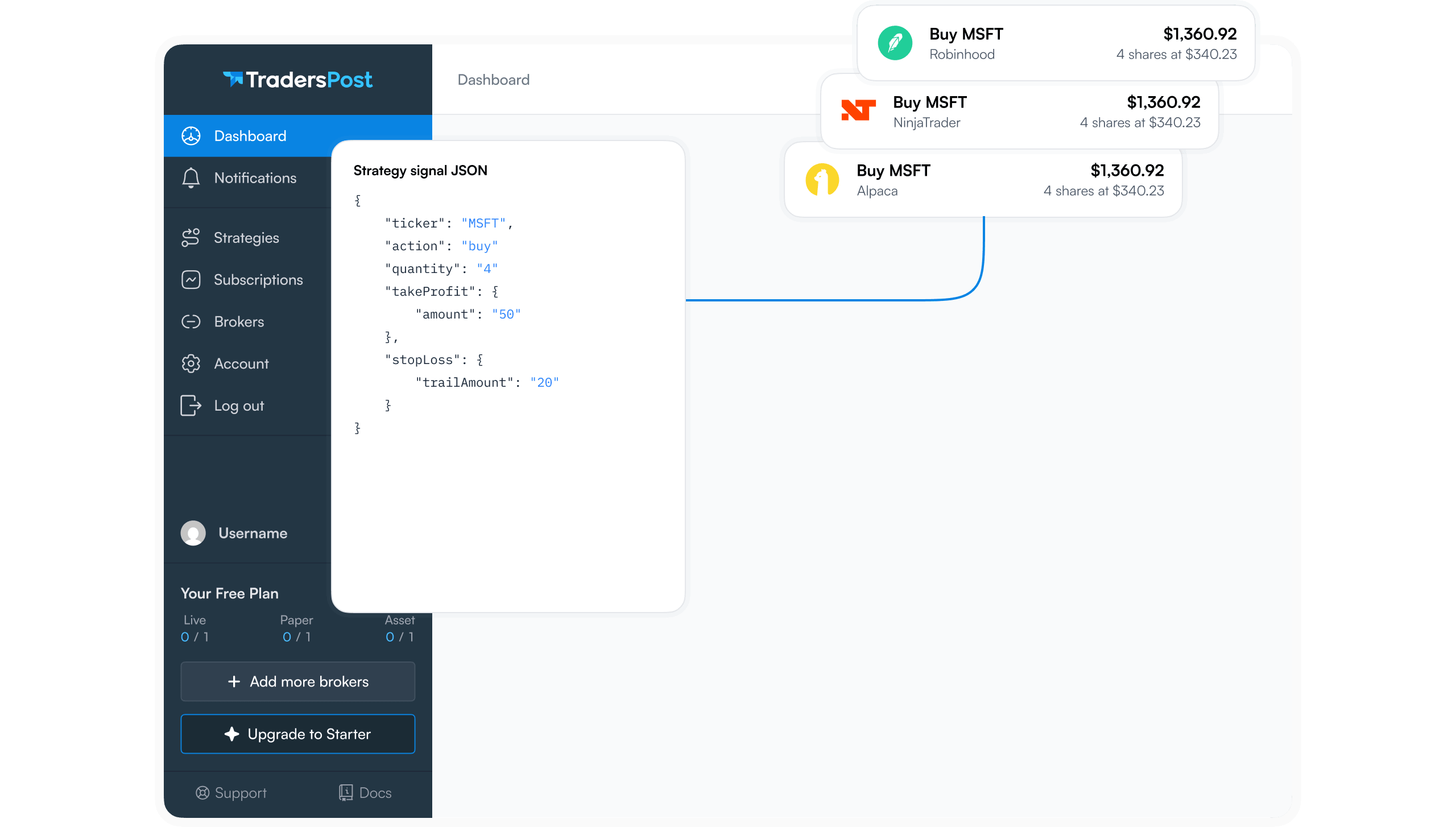
- ticker: the crypto symbol to trade
- action: the intended entry action
- quantity: the tested position size
- stopLoss: the pre-defined invalidation level below the range
This structure ensures that the protective exit is specified at entry rather than added later under pressure.
Use Limit Orders and Expiration to Control Entry Quality
When a Limit Order May Be Preferable in a Fast Tape
During a volatility spike, a market order prioritizes execution, not entry quality. A limit order lets the automation define the maximum price it will pay to buy or the minimum price it will accept to sell. That control can be valuable when spreads widen, candles expand rapidly, and the price shown at alert time may be materially different by the time an order reaches the exchange.
The trade-off is straightforward: price control can reduce execution certainty. A buy limit below the current market may never fill if price continues higher. Likewise, a sell limit above the current market may remain unfilled if the market reverses before reaching that level. The correct choice depends on whether the strategy requires immediate exposure or requires a specific risk-adjusted entry price.
For example, assume BTC breaks above a defined resistance level with a large five-minute candle. Rather than automatically buying near the candle high, a trader might configure the alert to submit a buy limit at the prior breakout level or at a predefined pullback price. If price retests that area, the order can enter at a level consistent with the plan. If BTC continues without a retest, the system misses the trade, but it avoids converting a planned pullback entry into a late breakout chase.
- Use a buy limit when the strategy has a defined maximum acceptable entry price.
- Use a sell limit when exiting or initiating a short requires a minimum acceptable price.
- Do not assume a limit order will fill simply because the alert triggered.
Prevent Stale Orders With Expiration
An order should remain active only while the market condition that justified it remains valid. In crypto markets, an entry setup can expire quickly. A breakout alert intended to capture continuation during the next hour may no longer be relevant after a sharp reversal, a failed retest, or a broad market move that changes the structure.
Use the expiration field to constrain the life of a pending order to the time horizon of the underlying alert strategy. For a short-term breakout setup, an expiration aligned with the next hour prevents an unfilled buy limit from remaining available long after the breakout thesis has failed. Without an appropriate expiration, a later price decline could fill the old order under conditions that the strategy never intended to trade.
Match expiration to the signal cadence and holding logic. A five-minute or fifteen-minute momentum signal generally warrants a shorter expiration than a four-hour support entry. Review whether the order would still be valid if it filled near the end of its allowed life. If the answer is no, shorten the expiration.
Balance Fill Probability Against Price Discipline
Limit-price selection is a measurable strategy decision. An aggressive buy limit placed close to the current ask is more likely to fill, but provides less protection from paying into a spike. A more conservative buy limit at a deeper pullback level may produce better average entry prices, but will miss more trades when momentum persists.
Evaluate this trade-off in Paper trading before applying it to live automation. Compare:
- How often each limit-price rule receives a fill.
- How many alerts become missed entries because price never retraces.
- The average entry price relative to the alert price and subsequent price action.
- Whether filled trades produce better results after accounting for missed high-performing moves.
A disciplined limit rule is not automatically superior because it obtains a lower price, and an aggressive rule is not automatically superior because it captures more signals. The useful setting is the one whose fill rate and entry quality match the strategy’s tested expectancy.
Apply the Bid-Ask Spread Filter During Volatile Conditions
Why the bid-ask spread matters when crypto moves quickly
The bid-ask spread is the difference between the current bid price, the highest price a buyer is offering, and the current ask price, the lowest price a seller is willing to accept. A market buy typically executes near the ask, while a market sell typically executes near the bid. That difference is an immediate execution cost.
During a rapid crypto move, spreads can widen sharply. This is common during lower-liquidity hours, abrupt liquidation events, exchange-specific disruptions, and news-driven repricing. A token that normally shows a $0.05 spread may briefly show a $0.40 or $1.00 spread as liquidity providers adjust quotes or pull orders.
A wider spread creates trading friction before commissions, exchange fees, slippage, funding costs, or other broker costs are considered. For example, if an automated strategy buys at $100.30 while the current bid is $99.90, the position begins with a $0.40 per-unit disadvantage. If the strategy's expected profit target is only $0.60, spread alone consumes two-thirds of the planned move.
Set a spread threshold that fits the strategy
Define a maximum acceptable spread as part of the entry plan. Express it in dollars, ticks, or as a percentage of price, but evaluate it relative to the strategy's expected holding period and profit objective. A short-term breakout or mean-reversion strategy can be highly sensitive to a small change in spread. A longer-term trend strategy targeting a multi-percent move may tolerate a wider spread, provided the threshold remains consistent with tested results.
- Measure normal conditions: Record typical spreads for each traded symbol during the strategy's intended trading hours.
- Measure stressed conditions: Review spreads during major price expansions, overnight periods, weekend trading, and scheduled news events relevant to crypto markets.
- Test the threshold: Compare results with and without the filter across both normal and high-volatility samples.
- Include missed trades: A spread filter may improve average execution while reducing the number of entries.
Do not select a threshold from one favorable session. A limit that appears conservative in calm conditions may block nearly every entry during a volatility event. Conversely, a threshold based only on extreme conditions may permit poor fills during ordinary trading. A strict filter can reject low-quality entries, but it can also cause a valid signal to remain untraded. That trade-off should be intentional and tested.
Example: skipping a breakout when the spread widens
Assume a strategy trades a crypto breakout only when the spread is no more than 0.15% of the current price. A breakout alert occurs at a reference price of $200. Under normal conditions, the bid is $199.90 and the ask is $200.10, a 0.10% spread that meets the rule.
During a sudden volatility surge, the same alert occurs while the bid is $199.40 and the ask is $200.60. The $1.20 spread equals 0.60% of price, substantially above the tested threshold. Entering with a market buy near $200.60 would require a much larger favorable move before the trade can overcome the initial execution disadvantage.
In that situation, the spread filter rejects the entry because execution quality is outside the strategy's plan. The breakout may continue higher after the skipped signal, but that does not make the skipped trade a failure. Rule-based automation is designed to decline trades when pre-defined conditions are not met, including conditions that protect against abnormal transaction costs.
Add Take-Profit Rules Without Ignoring Volatility Risk
Define One Realistic Profit Objective for the Setup
A take-profit level should come from the strategy’s tested market structure, not from an arbitrary percentage selected after entry. For a breakout strategy, the objective might be the next prior resistance area visible on the same chart timeframe. For a mean-reversion strategy, it may be a return to a moving average, range midpoint, or other level used consistently in testing. A trend-following system may instead define its objective as a fixed reward multiple relative to the initial stop-loss.
For example, if a BTCUSD breakout setup enters above a four-hour consolidation at $62,000 and prior resistance sits near $64,500, that resistance zone can be a candidate take-profit area. It is not a prediction that Bitcoin will reach $64,500. In volatile conditions, price can reverse sharply before the target is touched. It can also move through the target rapidly during a liquidity surge, making the realized exit materially different from the chart level used in planning.
Use one clearly defined objective per setup type, then test it consistently. Avoid changing the target after every trade based on recent price action or the size of an unrealized gain.
Pair Take-Profit Planning With Downside Planning
Set the take-profit level and stop-loss level before the trade is eligible to enter. These exits define the trade’s expected structure: where the setup is invalidated, where the strategy intends to realize gains, and how much adverse movement the strategy is designed to tolerate.
A practical review is to compare the distance from entry to the stop-loss with the distance from entry to the take-profit. If an entry at $62,000 uses a stop-loss at $61,400, the defined downside is $600 per unit. A take-profit at $62,300 offers only $300 of planned upside before execution costs and slippage. That may be unsuitable for a strategy that historically requires larger reward objectives to offset losing trades. Conversely, a $63,200 target offers a larger planned reward, but it may be less likely to be reached within the setup’s intended holding period.
- Define invalidation first: Place the stop-loss where the tested setup no longer supports the original trade thesis.
- Set the objective second: Use a resistance area, support area, range boundary, or tested reward objective.
- Evaluate the pair: Confirm that the potential reward reasonably compensates for the defined downside in your own backtesting, Paper trading, and live results.
This is planning, not a guarantee. Volatility, spread changes, and rapid market movement can affect actual fills.
Review Whether Targets Are Reachable in the Strategy Timeframe
A target must fit both the chart structure and the intended holding period. A 6% target may be reasonable for a multi-day four-hour trend strategy, but unrealistic for a five-minute intraday system designed to hold positions for 20 minutes. The same target can be valid in one strategy and structurally inconsistent in another.
Review historical chart behavior for the specific instrument and timeframe. Measure how far price typically travels after valid entries, how often it reaches the proposed objective before reversing, and how long those moves usually take. Then compare those observations with Paper trading outcomes and live-market execution. Paper trading can help evaluate rule logic, while live trading may reveal differences caused by changing liquidity and rapid price movement.
Crypto volatility can produce rapid gains followed by equally rapid reversals. Pre-defined take-profit and stop-loss rules help prevent an automated strategy from turning a planned exit into an improvised decision while markets are moving quickly.
Paper Trade and Deploy Your Volatility Rules Carefully
Test the Complete Alert-to-Broker Workflow First
Paper trade every automated crypto volatility strategy before committing capital. A volatility rule can be logically sound on a chart yet fail operationally if the alert payload, order instructions, or broker handling differs from your expectation. Treat the complete sequence as the system under test:
- The chart condition produces the intended long, short, exit, or reversal signal.
- Your TradingView or TrendSpider alert fires once, at the expected time and price context.
- The webhook sends the correct instructions to TradersPost.
- TradersPost processes the alert and submits the intended broker-side order.
- The broker accepts, fills, cancels, or expires the order according to the specified instructions.
Verify each alert field before relying on it during a rapid move. Confirm the ticker matches the tradable crypto instrument at your broker, the action is correct, and the quantity reflects the position size you intend. Review protective instructions closely: a stopLoss should be positioned correctly for the trade direction, a takeProfit should match the planned exit level, and an expiration should not leave an outdated order active after the signal is no longer valid.
For example, paper trade a BTC strategy that enters only after a 5-minute range breakout. Confirm that the breakout alert does not repeatedly send entries while the condition remains true, and confirm that the stop-loss and profit-target instructions are attached or submitted as expected.
Track Execution Quality, Not Just Strategy Signals
A profitable backtest or clean chart signal does not establish executable performance. Record what happened after each paper or live alert: whether the entry filled, whether a limit order was missed, how far the market moved before the fill, and how bid-ask spreads behaved when the signal occurred.
- Compare the strategy's expected entry price with the actual fill price.
- Note whether a limit entry was skipped because price moved through the level too quickly.
- Record the spread at signal time, especially during abrupt breakouts and liquidations.
- Compare expected stop-loss and take-profit levels with actual exits.
- Separate results by market condition, such as orderly trends, high-range breakouts, and thin overnight trading.
Use a meaningful sample of trades to refine thresholds. If a breakout rule frequently triggers when spreads widen and limit entries do not fill, the solution may be a revised entry condition, a different order approach, or a volatility filter. Do not rewrite a system because of one unusually large candle or a single poor execution.
Move to Live Trading Gradually
After Paper trading confirms that alerts, webhook instructions, and broker-side behavior match the plan, begin live trading with a small quantity. The objective is to validate real execution under controlled exposure, not to immediately scale a newly automated rule.
Monitor the strategy across different liquidity conditions. Crypto trades continuously, but execution quality can change materially during weekends, lower-volume hours, major economic releases, exchange disruptions, and sharp market-wide moves. Review whether the same rules behave consistently when spreads are wider or price gaps through intended levels.
Increase size only after the workflow and execution record remain acceptable across those conditions. Automation enforces defined rules and reduces manual delay, but it does not remove market risk, liquidity risk, or execution risk.
Frequently Asked Questions
Can TradersPost automate crypto futures trading?
No. TradersPost supports automated spot crypto trading, not crypto futures trading. Traders can connect supported spot crypto broker options, including Coinbase, Kraken, Binance, Bybit, and Alpaca, then use automation to send trade instructions based on their strategy alerts. Before connecting any account, confirm that the symbols, account type, and trading permissions match the spot market strategy you intend to automate.
Can I automate crypto trades from TradingView or TrendSpider?
Yes. TradingView and TrendSpider can generate webhook alerts when your pre-defined strategy conditions are met. TradersPost can receive those alerts and use them to automate trade instructions with a connected supported spot crypto broker. For more reliable automation, make sure your alert conditions, ticker symbols, position-sizing logic, and exit rules match the strategy you tested before enabling live orders.
What webhook details should a crypto trading alert include?
A crypto trading webhook should include the documented fields needed for your strategy, such as ticker, action, quantity, takeProfit, stopLoss, and expiration when applicable. Keep every alert instruction aligned with the exact rules you validated in paper trading. Clear, consistent webhook details can help reduce errors caused by symbol mismatches, incorrect order sizes, or unintended exit settings during volatile market conditions.
How does the Bid-Ask Spread Filter help with automated crypto trading volatility?
The Bid-Ask Spread Filter can help avoid submitting orders when the difference between the bid and ask price is wider than your selected threshold. This may help reduce entries or exits during poor execution conditions, which can become more common during sharp crypto price moves. However, a tighter spread threshold can also cause more trades to be skipped, so choose a setting that fits your strategy and test it first.
Should I paper trade an automated crypto strategy before using real money?
Yes. Paper trading is recommended before using real money with an automated crypto strategy.6 Test alert timing, symbol mapping, order quantity, stop-loss rules, take-profit rules, expiration settings, and Bid-Ask Spread Filter behavior. Paper trading helps identify whether webhook alerts and broker instructions work as expected without risking capital. After successful testing, consider moving to live trading gradually, starting with a small quantity while monitoring performance.
Conclusion
Automated crypto volatility trading is less about predicting every price swing and more about building rules that can respond consistently when markets move quickly, overnight, and across changing liquidity conditions. Clear entry criteria, position sizing, stop logic, alert reliability, and exchange-aware execution all matter because crypto’s 24/7 structure leaves little room for delayed decisions or emotional intervention.
Before committing capital, validate how your strategy behaves across sharp breakouts, failed moves, weekend liquidity gaps, and periods of elevated volatility. Create a TradersPost paper trading workflow, connect your TradingView or TrendSpider alerts, and test your spot crypto volatility rules under realistic market conditions before going live. The goal is not perfect automation, but a repeatable process you understand and can refine with confidence. Start testing today and build a stronger foundation for disciplined crypto trading.
References
1 CoinDesk, Crypto bearish derivatives signal (June 2026)
2 TradersPost Docs, Crypto Spot Trading
3 TradersPost Docs, Position Sizing
4 TradersPost Docs, Order Classes
5 TradersPost Docs, Order Behavior
6 TradersPost Docs, Paper Trading