Crypto Retail Investors 2026 Correction: Resilience
Crypto retail investors faced a sharp June 2026 correction. See dip-buying data, allocation risks, and rules-based re-entry plans for disciplined trading.

Marketing

Bottom Line
- In the Strategy& Crypto Survey conducted in March and April 2026, 56% of retail investors reported using volatility to buy the dip, and over 80% planned to increase their digital-asset allocation over the next 12 months.
- Bitcoin's early-June 2026 sell-off highlighted the need for retail investors to follow predefined exposure, liquidity, and invalidation rules rather than reacting impulsively to market declines.
- Investors are advised to cap crypto exposure at a maximum of 10% of investable assets, with purchases made in 1% portfolio tranches to maintain discipline during market fluctuations.
- Repeated dip buying can lead to unintended concentration risk, as seen in a scenario where additional purchases increased crypto holdings to 13.2% of a portfolio, exceeding the original 10% cap.
- Setting a maximum allocation before volatility strikes is crucial, with a suggested framework including a target allocation of 8%, a maximum of 10%, and a rebalance threshold at 9.5%.
June’s selloff tested a familiar retail instinct: buy the dip before the market decides whether it is actually a dip. The crypto retail investors 2026 correction exposed both sides of that impulse, with traders stepping back into battered tokens while concentrated allocations, leveraged positions, and thin liquidity turned volatility into outsized portfolio damage. Resilience was not simply a matter of holding through red candles. It depended on position sizing, cash reserves, and knowing when a rebound thesis had failed.
This post breaks down what retail buying behavior during the correction reveals about conviction, risk appetite, and the difference between disciplined accumulation and emotional averaging down. You will see the allocation risks that can magnify a routine drawdown, the signals worth watching before re-entering, and a rules-based framework for rebuilding exposure without chasing the first green move.
For investors navigating the next leg of volatility, the goal is not to predict the exact bottom. It is to create a repeatable plan that protects capital, defines invalidation levels, and leaves room to participate when market conditions genuinely improve.
What the Early-June 2026 Crypto Correction Revealed
Bitcoin’s sharp early-June sell-off and the retail response
Bitcoin’s sharp sell-off in early June 2026 created a real-time test of retail investor conviction. Rapid declines tend to expose the difference between a defined trading process and reactive decision-making: some investors freeze, some sell into acceleration, and others add exposure without considering whether their portfolio risk has already expanded.
The correction should not be treated as proof of a new bear market or as an automatic buying opportunity. Sharp drawdowns occur in bull trends, range-bound markets, deleveraging events, and broader risk-off regimes. A 10% to 20% decline can represent a temporary liquidation-driven move, but it can also be the first stage of a deeper repricing. The relevant question for a retail trader is not whether a bottom has formed, but whether any new position fits predefined exposure, liquidity, and invalidation rules.
For automated traders, the useful response is to convert “buy the dip” from a sentiment statement into an executable rule set. For example:
- Allocate a fixed maximum percentage of capital to crypto, rather than increasing position size solely because price has fallen.
- Use staged entries, such as three equal orders triggered at predefined percentage declines or volatility thresholds, instead of deploying the full allocation on the first red candle.
- Require a market-condition filter, such as spot volume stabilization, a reduction in realized volatility, or a recovery above a defined moving average, before activating later tranches.
- Set a portfolio-level stop condition, such as pausing all new entries if total crypto drawdown exceeds a specified risk budget.
This analysis evaluates behavior, position sizing, and repeatable re-entry rules, not a directional Bitcoin price forecast. The objective is to ensure that a correction does not force an investor to improvise under pressure.
The survey signal: retail investors remained willing to buy
Retail appetite for digital assets remained notable despite volatility. In the Strategy& Crypto Survey, conducted among 2,500 investors in March and April 2026, 56% of retail investors said they used volatility to buy the dip.1 The same survey found that more than 80% planned to increase their digital-asset allocation over the following 12 months.
Those figures indicate resilient sentiment and a willingness to treat volatility as an entry mechanism. They do not establish that dip-buying will be profitable, that investors will execute their plans during a sustained decline, or that retail participants will time entries successfully. Survey responses describe stated intentions, not realized returns.
For systematic traders, the practical implication is to separate conviction from execution. A trader who intends to raise allocation should specify the maximum allocation, the assets eligible for purchase, order spacing, and the conditions under which the strategy stops adding risk. For instance, an automated plan might purchase Bitcoin only in 2% portfolio tranches, cap total exposure at 15%, and suspend new orders when 30-day realized volatility exceeds a preset threshold. That structure preserves the ability to participate in a recovery while limiting the common error of averaging down without a defined risk ceiling.
Conviction or Recency Bias? How to Tell the Difference
What Long-Term Conviction Looks Like in Practice
Long-term conviction is not a willingness to buy every red candle. It is adherence to a written thesis, predetermined allocation limits, and a repeatable execution plan during both rallies and drawdowns. The thesis should identify why the asset belongs in the portfolio, the expected holding period, the risks accepted, and the conditions under which that view is no longer valid.
For example, an investor may cap crypto exposure at 10% of investable assets and add exposure only in scheduled 1% portfolio tranches. If the portfolio is worth $100,000, the maximum crypto allocation is $10,000, and each planned purchase is $1,000. The investor does not double the next order because Bitcoin, Ether, or an altcoin declined sharply in one session. A bot or conditional-order workflow can enforce this discipline by rejecting new buy orders once the 10% allocation cap is reached.
Conviction also requires an invalidation rule. For a token-specific position, invalidation might include a material protocol exploit, a sustained loss of liquidity, a governance change that undermines tokenholder economics, or failure of a stated adoption metric. For a broader crypto allocation, invalidation may be portfolio-based, such as a maximum drawdown or correlation threshold that makes the position inconsistent with the investor’s risk mandate.
How Recency Bias Can Turn a Correction Into Overconfidence
Recency bias is the assumption that the latest market pattern will continue. During a 2026 correction, it can appear as the belief that every decline will produce the same rapid rebound seen after prior dips. That belief can convert a manageable allocation into excessive exposure precisely when volatility and liquidation risk are increasing.
- Increasing order size after a loss to recover losses quickly.
- Buying because social feeds claim that “the bottom is in.”
- Removing stop-loss or invalidation rules after price moves against the position.
- Shifting capital from diversified holdings into the most volatile token because it fell the most.
- Overriding automated allocation limits after a large intraday decline.
The distinction is operational. A rules-based decision is: “Buy $500 when condition X occurs, provided crypto exposure remains below 10% and the thesis is intact.” An impulse decision is: “Buy more because price fell 12% today.” The first can be coded, logged, tested, and reviewed. The second depends on emotion and a prediction that the most recent rebound pattern will repeat.
A Quick Pre-Trade Conviction Checklist
Before adding crypto exposure, document these four answers in a trading plan or order-ticket template:
- What is my maximum crypto allocation? Define the portfolio percentage and enforce it across spot, derivatives, and token-specific positions.
- What is my entry trigger? Use a measurable condition, such as a scheduled tranche date, price level, volatility threshold, or on-chain and liquidity criterion.
- What invalidates the trade? Specify the market, protocol, liquidity, or portfolio condition that requires reducing or closing exposure.
- What is my exit or rebalance rule? Define profit-taking, periodic rebalancing, drawdown controls, and how allocation returns to target weight.
A checklist cannot eliminate crypto market risk, gap risk, or execution risk. It can, however, reduce inconsistent decision-making by making each additional purchase accountable to the same rules that governed the original position.
Why Buying the Dip Can Create Allocation Risk
The Hidden Concentration Problem After Multiple Dip Buys
Repeated dip purchases can increase crypto exposure faster than an investor expects because the purchase decision is often framed in dollar terms rather than portfolio-weight terms. The risk is amplified when crypto falls sharply while stocks, cash, bonds, or other holdings decline less sharply. Each additional buy increases both the absolute crypto position and the portfolio’s dependence on a continued recovery.
Consider a $100,000 portfolio with a 10% crypto cap. It begins with $10,000 in crypto and $90,000 in other assets. If crypto falls 30%, the crypto position is worth $7,000. If the rest of the portfolio falls only 5%, those holdings are worth $85,500. The portfolio is now worth $92,500, with crypto representing about 7.6%.
Three additional $2,000 dip buys raise crypto holdings to $13,000. Assuming the purchases are funded with new cash, total portfolio value becomes $98,500 and crypto now represents roughly 13.2% of the portfolio, well above the original 10% cap. If the buys are funded by selling other holdings, the concentration becomes higher still.
Adding new capital to a long-term portfolio is not the same as averaging down on a short-term trade. Long-term accumulation should follow a planned allocation policy and funding schedule. A short-term trade requires a predefined invalidation level, position-size limit, and exit logic. Automated systems should calculate post-trade portfolio weight before submitting each order, not merely confirm that the next purchase amount is affordable.
Set a Maximum Allocation Before the Next Volatile Day
Set the allocation ceiling before volatility creates urgency. The appropriate limit depends on risk tolerance, liquidity needs, investment horizon, employment stability, debt obligations, and the possibility that crypto prices decline materially from current levels. A survey showing resilient retail sentiment may describe market behavior, but it does not justify exceeding a personal risk limit.
An illustrative framework could use three controls:
- Target allocation: 8% of investable assets, the desired long-term crypto weight.
- Maximum allocation: 10%, the hard ceiling above which no additional crypto buys are permitted.
- Rebalance threshold: 9.5%, the level that triggers a review, paused DCA orders, or partial rebalancing back toward target.
For automation, use portfolio-level rules rather than asset-only triggers. A bot can permit scheduled purchases only when projected crypto exposure after the order remains below the maximum allocation. It can also pause new entries when volatility rises or when available cash falls below a defined reserve.
Separate Investing Capital From Active Trading Capital
Long-term digital-asset accumulation and active trading should operate under separate capital pools and separate rules. Mixing them creates a common failure mode: a swing trade that breaches its stop is retained indefinitely and relabeled as an “investment.” That decision removes the original trade thesis, risk limit, and time horizon after the loss has already occurred.
For example, a long-term DCA account might buy a fixed dollar amount of BTC or ETH every two weeks, subject to the portfolio allocation ceiling. A separate swing-trading account might risk only 0.5% of total portfolio equity per trade, use a hard stop, and exit when a defined signal fails, such as a close below a support level or a moving-average trend filter.
Automation should enforce account-level separation: DCA orders should not be used to rescue trading losses, and trading bots should not access long-term holdings as margin or collateral.
Build a Rules-Based Re-Entry Plan After a Crypto Correction
Choose an Entry Model Before Price Becomes Emotional
A correction is the wrong time to improvise. Define the entry logic, order sizes, and maximum portfolio exposure before placing a buy order. Three non-predictive models are useful because they do not require calling the exact bottom.
- Time-based dollar-cost averaging: Buy a fixed dollar amount on a fixed schedule, such as $250 every Monday or $1,000 on the first business day of each month, regardless of short-term price movement. This model is straightforward to automate with recurring purchases, but it can continue buying during a prolonged downtrend unless paired with an allocation cap.
- Price-level tranches: Divide the intended allocation into smaller orders placed at predefined levels. For example, rather than committing $3,000 at one price, place three $1,000 limit orders at levels justified by prior support, volatility bands, or a percentage decline from a reference price. The key is that the levels are defined in advance, not moved lower each time the market falls.
- Trend-confirmation entries: Wait for a measurable condition before buying. Examples include daily price reclaiming and holding above a 50-day moving average, a breakout above a defined range high on above-average volume, or a momentum indicator turning positive after consolidation. These entries may occur above the low, but they reduce exposure to an unresolved downtrend.
For automated execution, encode each condition explicitly: asset, order size, schedule or trigger price, confirmation timeframe, and a rule preventing duplicate orders from firing during the same signal window.
Example: A Three-Tranche Post-Correction Plan
This is an educational example, not a recommendation. Assume an investor has a planned $3,000 crypto addition and a 15% maximum crypto allocation across the portfolio. They divide the planned addition into three $1,000 tranches:
- Tranche one: Purchase $1,000 on a scheduled date, such as the first Monday after the plan is approved.
- Tranche two: Purchase $1,000 only if the selected asset either reaches a predefined price level or closes above its 50-day moving average for two consecutive daily closes.
- Tranche three: Purchase $1,000 only if the first two tranches have executed and total crypto exposure remains below the 15% portfolio cap.
This structure avoids the risk of deploying the entire amount at one potentially poor entry, while also preventing unlimited averaging down. If conditions never occur, unspent capital remains in cash or its designated reserve. Dollar amounts, instruments, technical conditions, and allocation limits should be adjusted to the investor’s objectives, liquidity needs, tax position, and loss tolerance.
Write Exit, Stop, and Rebalance Rules Too
A re-entry plan is incomplete without rules for what happens after entry. For a trade-oriented position, define an invalidation level: the price or market condition showing that the original setup is no longer valid. A stop-loss should reflect acceptable dollar loss and strategy logic, such as a break below a documented support level or volatility-adjusted threshold, not an arbitrary round number.
- Downside rule: Exit if the daily close breaks the invalidation level, or if loss on the position reaches the pre-set risk budget.
- Profit-taking rule: Sell a specified portion at predefined targets, such as 25% at a prior resistance level and another 25% after a multiple of initial risk.
- Time exit: Close or reduce a trade if the expected confirmation does not occur within a fixed number of days or weeks.
- Rebalance rule: Trim holdings when crypto exceeds the portfolio’s maximum allocation, even if prices are rising.
Automation should include alerts, order-state checks, and position-size validation so that stops, profit targets, and rebalancing rules operate as one coherent system.
Automate Crypto Re-Entry Signals With TradersPost
Create Objective Alerts in TradingView or TrendSpider
Automation should begin with a precisely defined market signal, not with a broker order. For traders assessing re-entry opportunities after a 2026 crypto correction, the first task is to translate a discretionary idea, such as “buy when Bitcoin regains momentum,” into conditions that can be tested, alerted, and repeated.
TradingView alerts or TrendSpider strategies can generate the event that TradersPost receives and converts into an order workflow.2 Useful re-entry alert concepts include:
- Trend recovery: BTC/USD closes above its 50-day moving average after trading below it for a defined number of sessions.
- Momentum confirmation: Bitcoin’s 14-period RSI crosses back above 40 or 50, rather than buying solely because RSI was previously oversold.
- Planned DCA level: BTC reaches a predetermined support zone, such as a 10% decline from a recent swing high or a specified dollar price.
- Breakout confirmation: A TrendSpider strategy identifies a close above a resistance trendline with volume above its 20-period average.
The alert should specify the symbol, timeframe, trigger condition, and intended action. For example: “Buy BTC when the four-hour candle closes above the 200-period EMA and RSI(14) is above 50.” Indicators help define rules consistently. They do not guarantee that a reversal will hold, that support will remain valid, or that a breakout will avoid failure.
Define Order Size and Guardrails in Advance
Before connecting an alert to TradersPost, define how much capital each signal may deploy. A re-entry plan can use a fixed dollar amount, such as $500 per BTC purchase, a fixed quantity, such as 0.005 BTC, or a percentage of available capital, such as 5% of buying power.3 Percentage-based sizing can adapt as account equity changes, while fixed-dollar sizing can make staged DCA plans easier to audit.
Set guardrails at the strategy level rather than relying on intervention after alerts begin firing:
- Maximum of one or two new entries per symbol per day.
- Maximum aggregate position size, such as 20% of account equity allocated to BTC.
- A cooldown period, such as 12 or 24 hours after an entry, before another buy alert can place an order.
- A defined action when the maximum position is reached, such as ignoring additional buy signals.
These controls matter during correction rebounds, when price can move sharply around moving averages and generate multiple technical triggers within hours. Without entry limits and cooldowns, several overlapping alerts can unintentionally convert a measured re-entry plan into an oversized position.
Use Automation to Reduce Execution Friction, Not to Remove Judgment
TradersPost can reduce execution friction by routing valid alert-driven orders without waiting for manual confirmation. This can limit delayed entries, forgotten exits, and emotional overrides when a pre-approved signal occurs. It does not eliminate the need for monitoring or strategy review.
Review order logs, alert delivery, brokerage connectivity, fill quality, liquidity, spreads, slippage, and platform-specific order behavior. A signal generated on a chart may not fill at the displayed price, particularly during rapid crypto moves or thin liquidity periods.4 Confirm that the connected broker supports the intended asset, order type, and trading hours.
Risk disclosure: Crypto assets are volatile, and automated strategies can lose money. Test rules with paper trading or limited size, review performance across different market conditions, and retain the ability to pause automation when market structure or platform conditions change.
Paper Test a Crypto Strategy Before Going Live
Why Historical Results Are Only a Starting Point
A backtest shows how a strategy would have behaved under a defined set of historical assumptions. It does not prove that the same logic will survive the next crypto correction. Automated strategies are especially vulnerable to hidden optimism in indicator settings, execution assumptions, and market selection.
Test whether the rules work across materially different conditions: sustained BTC-led trends, low-volatility range-bound periods, altcoin rotations, liquidation cascades, and rapid correction sessions where spreads widen and order books thin out. A breakout system that performs well during a multi-week rally may repeatedly enter false breakouts when BTC trades in a narrow range. A mean-reversion system may look attractive until a sharp selloff turns a sequence of small losses into a large unhedged drawdown.
Review more than total return. Focus on:
- Maximum drawdown: Assess whether the historical peak-to-trough loss is financially and psychologically tolerable.
- Losing streaks: Determine the longest sequence of losses and whether your allocation can withstand it without rule changes.
- Trade frequency: Confirm that expected signal volume is practical after exchange fees, funding, and slippage.
- Risk-adjusted behavior: Compare returns relative to volatility and drawdown, rather than selecting the configuration with the highest raw profit.
- Fill sensitivity: Re-run results with less favorable spread and slippage assumptions, particularly for lower-liquidity altcoin pairs.
Do not optimize indicator lengths, stop distances, or profit targets until they perfectly fit one historical period. A strategy that only works with an RSI length of 13, a 1.7% stop, and a 2.4% target may be fitted to noise rather than a durable market behavior.5
Run a Paper-Trading Checklist
Paper trading should validate the entire automation chain, not just the strategy logic.6 Run the strategy through the same alert, webhook, exchange, and position-management path intended for live use.
- Verify that alerts fire at the intended time, including whether they trigger intrabar or only after candle close.
- Inspect webhook payloads for correct action, symbol, side, quantity, order type, and reduce-only instructions where applicable.
- Confirm symbol mapping, such as ensuring a BTCUSDT perpetual alert does not route to BTC spot or an incorrect exchange contract.
- Test entry orders, stop-loss orders, take-profit orders, partial exits, and emergency close instructions.
- Validate quantity calculations against account equity, contract size, leverage settings, and maximum allocation limits.
- Test duplicate-alert handling so a delayed webhook or chart recalculation cannot open the same position twice.
Record every paper trade in a log: signal timestamp, expected entry, simulated fill, exit reason, expected position size, actual position size, fees, and any execution exception. For example, if a strategy expects to buy ETH at $3,000 but the simulated order routinely fills 0.35% higher during volatility, incorporate that difference into the risk model.
Test for several weeks or, preferably, across a meaningful sample of signals. A system producing two signals is not validated. A system producing 30 to 50 fully logged signals across different market conditions provides a more useful operational sample.
Move to Live Trading Gradually
After paper testing, deploy a small allocation rather than immediately using the maximum planned size. The initial live phase is an execution audit. Even a sound paper workflow can differ from live trading because of queue position, spread changes, exchange latency, rejected orders, funding charges, and partial fills.
Review the first live trades against the paper log. Check alert delivery time, fill quality, realized slippage, order rejection rates, stop execution, and compliance with portfolio allocation limits. If a strategy is designed to risk 0.5% of equity per trade, verify that actual exposure remains near that threshold after leverage and contract rounding.
Change rules deliberately and document every revision. Do not widen a stop, raise leverage, or disable a filter after a single losing trade. Define the reason for each change, the expected effect, the date implemented, and the evidence supporting it. This preserves a clear distinction between systematic improvement and emotional intervention during a 2026-style crypto correction.
A Disciplined Retail Playbook for the Next Crypto Drawdown
Before Volatility: Define Limits and Alerts
Preparation should occur when prices are stable and decision-making is not being influenced by a sharp candle or social-media momentum. Start by setting a maximum crypto allocation as a percentage of total investable assets, then divide that allocation between long-term holdings and active trading capital. For example, an investor with a 15% crypto ceiling might reserve 10% for strategic holdings and limit trading inventory to 5%.
- Define an entry model: Specify whether purchases occur at fixed price levels, after a volatility threshold, on a moving-average confirmation, or through a time-based dollar-cost-averaging schedule.
- Document invalidation: For each trade, state the condition that makes the thesis wrong. This may be a weekly close below support, a deterioration in liquidity, or a portfolio-level drawdown limit.
- Set exit and rebalance rules: Define profit-taking levels, stop conditions, and the maximum number of averaging tranches before the first order is placed.
- Configure alerts in advance: Use exchange, charting, or API-based alerts for price levels, funding rates, liquidation events, volatility bands, and portfolio exposure thresholds.
For an automated strategy, alerts should trigger a review or a pre-defined workflow, not an uncontrolled market order. A 12% one-day decline, for example, might trigger a bot to pause new entries until the trader confirms that spread, slippage, and liquidity conditions remain acceptable. No rule set can identify the precise market bottom. The objective is to make risk bounded and execution repeatable when the bottom is unknowable.
During Volatility: Follow the Plan and Avoid Oversizing
Before placing an order, or allowing an automated order to execute, verify that the planned condition actually occurred. A price touching a support zone is not necessarily equivalent to a confirmed close above it. A funding-rate alert is not automatically a buy signal if spot liquidity is thin or the broader risk thesis has changed.
Review total exposure before every additional tranche. Include spot holdings, perpetual futures notional, options delta, collateral posted on lending platforms, and correlated crypto positions. A trader who owns BTC, ETH, a BTC-miner equity proxy, and long-call options may have substantially more directional exposure than a spot-only dashboard suggests.
- Cap each averaging tranche, such as 25% of the intended position rather than deploying the full allocation on the first decline.
- Use maximum position-notional and maximum portfolio-delta checks in automated execution logic.
- Pause or reduce order size when spreads widen beyond a pre-set threshold.
- Do not increase size solely because prices are falling quickly, funding has turned negative, or other investors appear confident.
Speed is not evidence. A rapid decline can create opportunity, but it can also indicate changing market structure, forced deleveraging, or impaired liquidity. Position size should be determined by the pre-defined risk budget, not by the emotional intensity of the move.
After Volatility: Review Results and Rebalance
Evaluate the process before evaluating the profit and loss. A profitable first purchase can still represent poor execution if it exceeded allocation limits, ignored invalidation criteria, or bypassed the strategy’s entry filter. Conversely, a controlled loss may validate that risk limits worked as designed.
Review execution logs, alert timestamps, slippage, fill quality, tranche sizing, and any manual overrides to automated rules. Then reassess allocation. A rebound may push crypto above its stated portfolio range, while a continued decline may reduce exposure below the desired strategic weight. Rebalance deliberately rather than allowing a temporary price move to redefine the portfolio.
The central takeaway is simple: retail resilience is strongest when optimism is paired with sizing discipline, tested rules, and repeatable execution.
Frequently Asked Questions
Did retail investors buy the crypto dip during the 2026 correction?
Yes, according to the Strategy& Crypto Survey of 2,500 investors conducted in March and April 2026, 56% of retail investors said they used volatility to buy the dip. This reflects reported investor behavior, not proof that dip buying is suitable or profitable for every investor. Market declines can continue longer than expected, so purchases should fit a defined risk plan. Source: Strategy& Crypto Survey.
How much crypto should a retail investor allocate after a correction?
There is no universal crypto allocation percentage. An appropriate amount depends on your risk tolerance, investment time horizon, financial obligations, liquidity needs, and ability to withstand further losses. Consider setting a target allocation, a maximum allocation, and a rebalancing rule before adding exposure. These guardrails can prevent repeated dip purchases from creating an unintended concentration. A recent price decline alone is not a reason to increase your crypto allocation.
What is a rules-based crypto re-entry strategy?
A rules-based crypto re-entry strategy defines entry conditions, position size, maximum exposure, and exit or rebalance rules before placing a trade. For example, an investor may use scheduled dollar-cost averaging, predetermined price-level tranches, or entries triggered by trend confirmation. The goal is not to predict the exact market bottom. Instead, a structured plan can make execution more consistent, reduce emotional decision-making, and keep risk limits clear during volatile conditions.
Can TradersPost automate crypto trading signals?
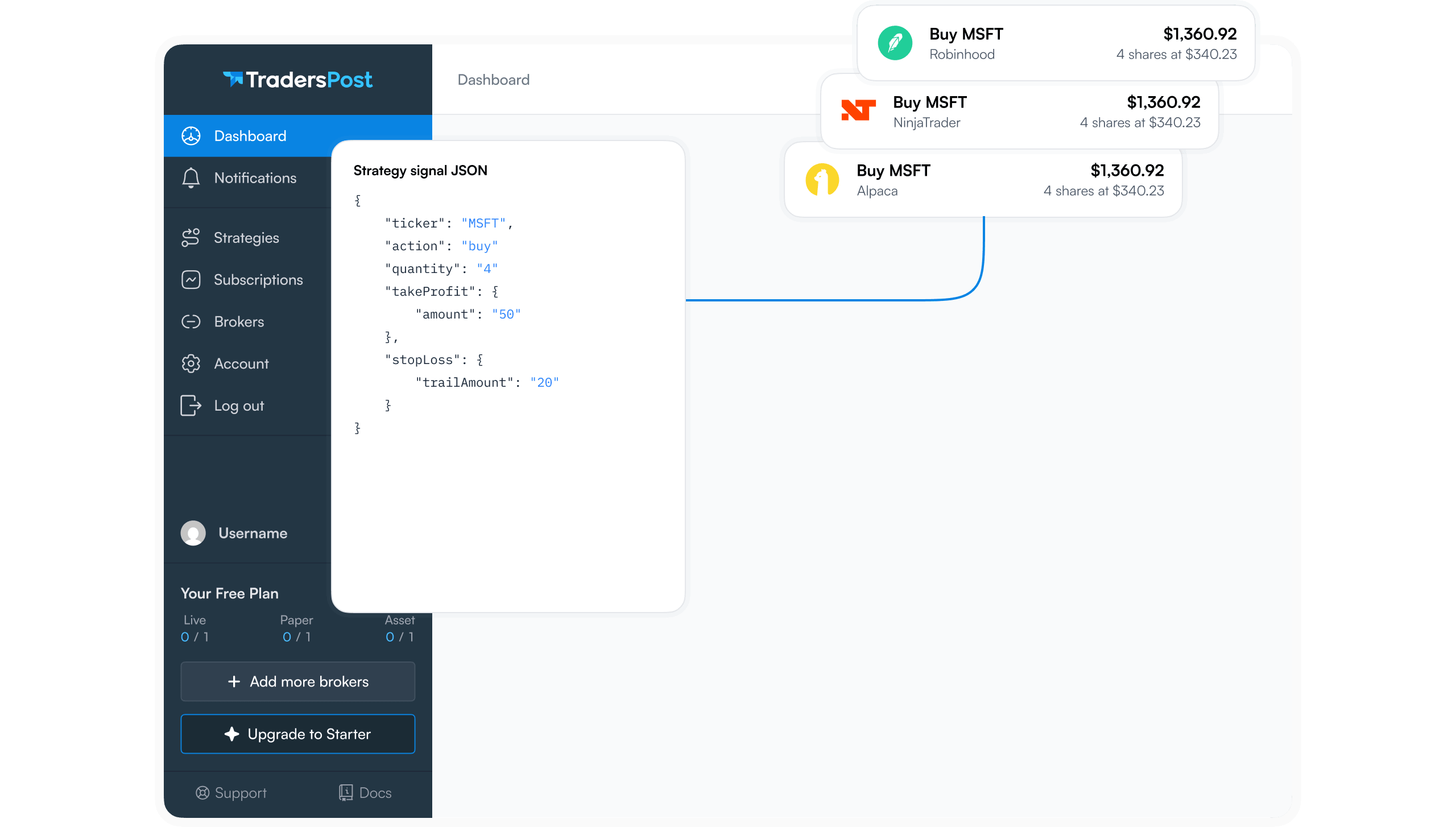
TradersPost can receive webhook alerts from TradingView or TrendSpider and use them to automate rule-based order execution through supported connected brokers. Before using live capital, investors should define and test their own signals, position sizing, exposure limits, and risk rules. Paper testing can help validate alert delivery, order instructions, symbol formatting, and end-to-end strategy behavior. Automation executes your rules; it does not determine whether the underlying strategy is sound.
Why should I paper test a crypto trading strategy first?
Paper testing helps uncover operational issues before real money is at risk, including problems with alerts, webhooks, symbols, quantities, exits, and duplicate signals. It also allows traders to observe how a strategy behaves in current market conditions without assuming backtest results will repeat. After paper testing, moving gradually to small live position sizes can help reduce operational and behavioral risk while confirming that the complete trading workflow performs as intended.
Conclusion
The 2026 correction is testing retail investors, but resilience comes from process, not prediction. Investors who protect capital, avoid emotional averaging down, and wait for confirmed trend improvement will be better positioned when conditions stabilize. Automation can reinforce that discipline by turning predefined risk limits and position-sizing rules into repeatable actions. As you build those rules, consider creating a TradersPost account to connect TradingView or TrendSpider webhook alerts and automate alert-driven sizing with greater consistency.
After completing your Disciplined Retail Playbook, take the next step: create a TradersPost account, paper test your crypto re-entry strategy, and validate its signals before committing live capital. A measured, tested approach can turn a difficult correction into a stronger foundation for the next opportunity.
References
1 Strategy& (PwC), Crypto Survey 2026
2 TradersPost Docs, Webhooks
3 TradersPost Docs, Position Sizing
4 TradersPost Docs, Order Behavior
5 TradingView, Strategy Properties (backtesting)
6 TradersPost Docs, Paper Trading